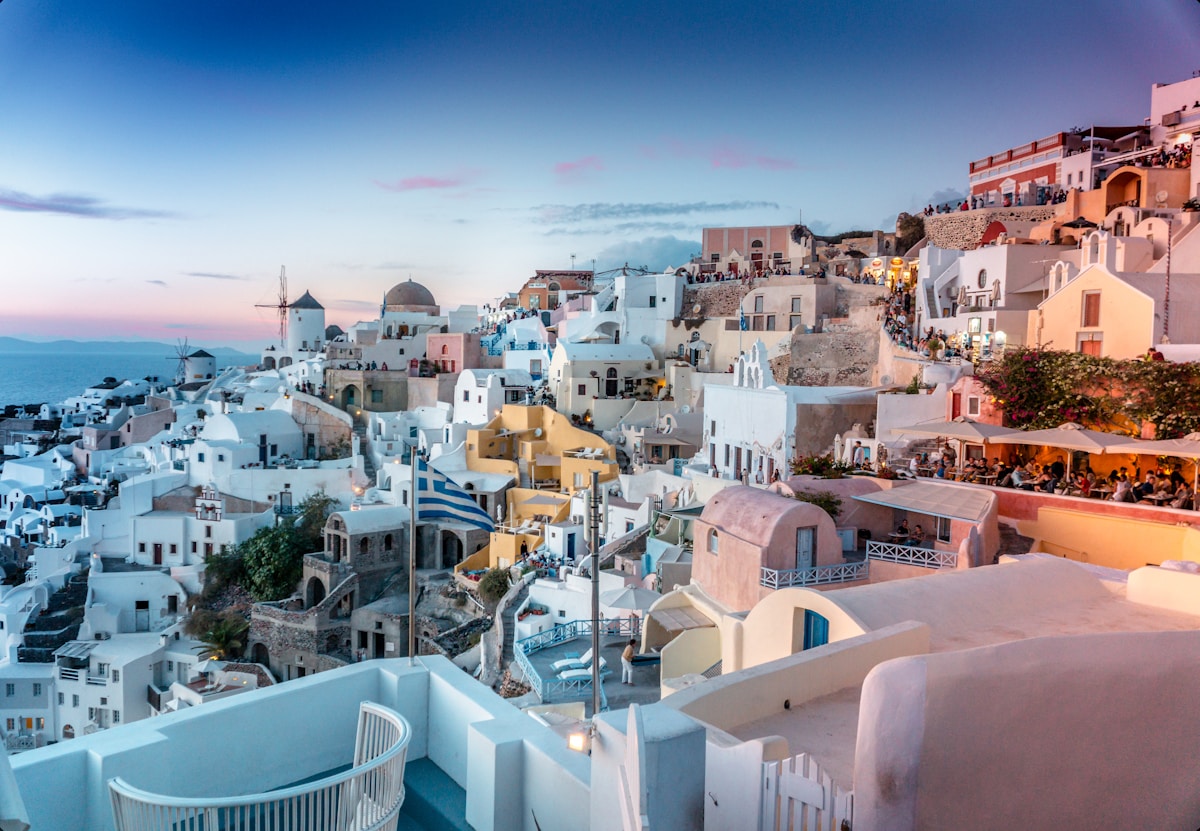
Greece and Italy are the two anchors of European classical civilisation, and both rank consistently among Europe’s most-visited countries. They share Mediterranean sunshine, ancient ruins, extraordinary food, and a coastline that draws travellers from around the world. What they deliver is quite different.
Quick Verdict
| Category | Greece | Italy |
|---|---|---|
| Ancient history | ★★★★★ | ★★★★★ |
| Food | ★★★★ | ★★★★★ |
| Art and museums | ★★★★ | ★★★★★ |
| Beach quality | ★★★★★ | ★★★★ |
| Budget value | ★★★★ | ★★★ |
| Island options | ★★★★★ | ★★★ |
| City culture | ★★★★ | ★★★★★ |
Choose Greece for island beaches, a simpler and more relaxed pace, better value, and an ancient history less trampled by mass tourism. Choose Italy for world-class art cities, greater culinary variety, more diverse landscapes, and an incomparable cultural density.
Ancient History
Both countries contain some of humanity’s most significant ancient sites. The Acropolis in Athens, Delphi, and Olympia in Greece stand alongside Rome’s Forum, Pompeii, and Sicily’s Valley of the Temples in Italy. Knossos on Crete adds Bronze Age Minoan civilisation that predates classical Greece by more than a millennium.
Italy has the additional weight of the Roman Empire at its core - not just ruins, but a living city (Rome) built on top of 2,000 years of continuous history. The Colosseum (entry approximately €18 as of 2026, pre-booking strongly recommended to avoid long queues), the Pantheon (€5), and the Roman Forum are within walking distance of each other. Pompeii and Herculaneum, preserved by the eruption of Vesuvius in 79 AD, are among the world’s most visited and affecting ancient sites - a half-day from Naples. Sicily’s Valley of the Temples at Agrigento contains some of the best-preserved Doric temples outside Greece itself. For sheer density of world-class monuments within a single city, Rome has no rival.
Greece’s sites tend to have more space and less congestion. The Acropolis Museum (entry approximately €20 as of 2026) pairs well with a 2-hour site visit. Delphi, Epidaurus, and Olympia can all be visited without significant queuing, even in summer - a welcome contrast to Rome’s main draws. Many Greek sites offer free or reduced entry on the first Sunday of each month outside peak season. The Palace of Knossos on Crete (entry approximately €15) benefits enormously from a guided tour rather than independent exploration; the Evans reconstruction is controversial but the context is genuinely helpful.
Verdict: Italy for art history and Roman heritage density; Greece for more breathing room and atmosphere at ancient sites.
Food
Greece
Greek food is grounded in the Mediterranean diet: olive oil, legumes, fresh vegetables, fish, and lamb. The greatness is in the ingredients. A fresh fish caught that morning, grilled simply, drizzled with olive oil, and served with horta (wild greens) and bread in a harbour taverna - few meals in Europe match that experience. Mezedes (small shared plates) are a social institution: grilled octopus, taramosalata, saganaki (fried cheese), fava with capers, courgette balls, stuffed vine leaves. Eating in Greece is communal, slow, and built for the table rather than the plate.
Cheese is serious: feta (PDO-protected, made from sheep’s milk in specific regions), graviera from Crete (hard, nutty, aged), kefalograviera from Epirus, and myzithra (fresh and dry variants). Cretan olive oil wins international awards consistently and is used in every savory dish on the island. On Crete, the regional food tradition runs deep - dakos (barley rusk with crushed tomatoes and olive oil), slow-braised lamb with wild mountain herbs, and village tavernas that serve whatever was harvested that morning. This is the original Mediterranean diet, still functioning.
The wine scene has matured significantly. Assyrtiko from Santorini - grown in volcanic soil, producing high-acidity whites with mineral precision - is now taken seriously internationally. Xinomavro from Naoussa makes structured reds often compared to Barolo. Moschofilero from the Peloponnese is a light, aromatic white suited to seafood. A good taverna dinner for two with wine costs €50–80 outside the tourist centres; on Crete’s villages or in Athens’s back streets, even less.
Italy
Italian food is extraordinary in a different way: through radical regional variety. Neapolitan pizza (wood-fired, simple, Naples DOC-protected), Roman cacio e pepe and carbonara (eggs and guanciale, no cream), Bolognese ragù cooked for hours and served over fresh tagliatelle, Venetian cicchetti at a bacaro on a canal-side campo - these are not variations on a theme, they’re distinct cuisines that happen to share a country and a language.
Pasta alone demonstrates this: over 300 shapes, each matched to sauces by texture and tradition. The Amalfi Coast serves pasta with fresh clams and bottarga; Puglia eats orecchiette with cime di rapa and anchovies. Florence has the bistecca alla Fiorentina - a 2kg T-bone of Chianina beef, served bloody, carved at the table. Sicily adds Moorish and Norman layers: arancini, caponata, cannoli, granita with brioche for breakfast.
The coffee culture needs no elaboration. The gelato is sui generis. The wine rivals France: Barolo from Piedmont, Brunello di Montalcino from Tuscany, Amarone from the Veneto, Chianti Classico, and the coastal Vermentino from Sardinia - all world-class and available in neighbourhood restaurants at accessible prices.
Verdict: Italy for culinary depth and variety; Greece for simplicity done perfectly and outstanding seafood.
Beaches
Greece has the clear edge on beaches, driven by the island factor. The Cyclades deliver turquoise-to-electric-blue water against dramatic backdrops - Milos’s Sarakiniko (white volcanic rock eroded into surreal formations above a turquoise cove), Naxos’s Plaka (3km of sand backed by cedar forest), and Santorini’s Red Beach (dark volcanic pebbles against rust-red cliffs) cover every taste. The Ionian islands (Kefalonia, Zakynthos, Lefkada) offer some of the most vivid blue-green water in the Mediterranean - Myrtos Beach on Kefalonia is frequently ranked among Europe’s finest. Crete’s south coast has large, relatively wild beaches: Elafonisi’s pink-sand lagoon, Balos’s white sandbar, and Preveli’s palm beach where a river meets the Libyan Sea. In total, Greece’s island variety and water clarity are simply unmatched in Europe.
Italy’s coastline - the Amalfi Coast, Cinque Terre, Sardinia, Sicily - is scenic but organised differently. The Amalfi and Cinque Terre coasts offer dramatic cliff scenery with small, private lidos (typically €15–25 per person to hire a sunbed and umbrella). The beaches are photogenic but modest in scale compared to the Greek island experience. Sardinia is the notable exception: the Costa Smeralda’s beaches, particularly around the Maddalena Archipelago and Santa Teresa Gallura, match the Cyclades in water clarity and beach scenery - though at significantly higher prices.
Verdict: Greece wins clearly for beaches at all price levels. Italy’s Sardinian coast is genuinely competitive but more expensive.
Cost Comparison
| Category | Greece (midrange) | Italy (midrange) |
|---|---|---|
| Hotel per night | €70–180 | €90–220 |
| Dinner per person | €25–45 | €30–55 |
| Coffee (espresso) | €1.50–2.50 | €1–1.50 |
| Museum entry (major) | €10–20 | €15–25 |
| Domestic flight | €40–100 | €50–130 |
Italy’s popular cities (Rome, Florence, Venice) are expensive - comparable to Northern Europe in some respects. Venice in particular is a premium destination. Greece on the non-luxury islands is notably cheaper. See our Greece budget travel guide for detailed cost breakdowns.
Getting Around
Italy has an excellent rail network - the Frecciarossa and Italo high-speed trains connect Rome, Florence, Venice, Milan, and Naples at manageable cost. Rome to Florence takes 1h30m from approximately €25; Florence to Venice takes 2h10m from approximately €30. Book high-speed trains a few days ahead for best fares. Regional trains are slower but cheaper and don’t require booking. Most Italian historic centres are walkable once you arrive, and car hire is useful in Tuscany or Sicily but unnecessary between major cities.
Greece requires more planning for island travel. Domestic flights between Athens and the islands take 35–55 minutes - Aegean Airlines and Sky Express compete on the main routes with fares from approximately €50 one-way, rising sharply in July and August. The extensive ferry network from Piraeus connects more than 50 islands: high-speed catamarans cut journey times (Piraeus to Mykonos approximately 2.5 hours, from €45; Piraeus to Santorini approximately 4–5 hours, from €55) while conventional ferries handle overnight routes more cheaply (Piraeus to Heraklion: 8 hours overnight, from €35 in a seat). On mainland Greece, KTEL intercity buses connect Athens to Thessaloniki in 5.5 hours and to most mainland sites comfortably. Read our getting around Greece guide and Greek island ferry guide before booking.
Verdict: Italy is easier to navigate between cities by train. Greece requires ferry and flight planning for island travel but the network is extensive.
Accommodation
Athens:
- Hotel Grande Bretagne - 5-star, from €300/night
- Athens Marriott - from €180/night
- Periscope Hotel Kolonaki - boutique, from €120/night
Search all Athens hotels on Booking.com
Rome:
- Hotel de Russie - 5-star, from €500/night
- Borghese Palace Art Hotel - from €200/night
- The Generator Hostel Rome - budget, from €30/night dorm
Search all Rome hotels on Booking.com
Greek islands: Wide range from budget rooms at €40/night to €1,500/night caldera suites in Santorini.
Amalfi/Positano: Some of Europe’s priciest accommodation - budget hotels from €200/night, luxury hotels from €600+.
Our Verdict
Greece and Italy are different enough that the choice shouldn’t be agonising. Ask yourself what you actually want:
- Monument overload + art cities + culinary variety? Italy.
- Island beaches + simpler pace + lower cost + Greek history? Greece.
- Both? Fly Athens–Rome (often under €80 with budget airlines) or take the overnight ferry Patras–Bari. A 2-week trip covering 5 days Athens + 5 days on an island + 4 days in Rome or the Amalfi Coast is one of Europe’s great itineraries.
For Greece planning, start with our best time to visit Greece and the best Greek islands guide.
Search flights to Greece across multiple airlines in one place. Pick up a Greece eSIM before you fly - keeps you connected without roaming charges. Sort out travel insurance for Greece before you leave.
See Also
- Best Greek Islands Guide - Santorini, Crete, Mykonos, Paros, and more
- Athens Travel Guide - Greece’s ancient capital and why it’s worth 3+ days
- Greece vs Croatia - if Croatia is also on your shortlist
- Greece vs Spain - another popular alternative
- Best Time to Visit Greece - for planning the overlap with Italy
- History of the Acropolis - what gives Athens its edge over Rome for ancient history
- Greece vs Turkey - another Mediterranean alternative to compare
Plan Your Trip
✈️ Book your flights to Greece 🛡️ Get travel insurance 📱 Stay connected with an eSIM 🚗 Rent a car