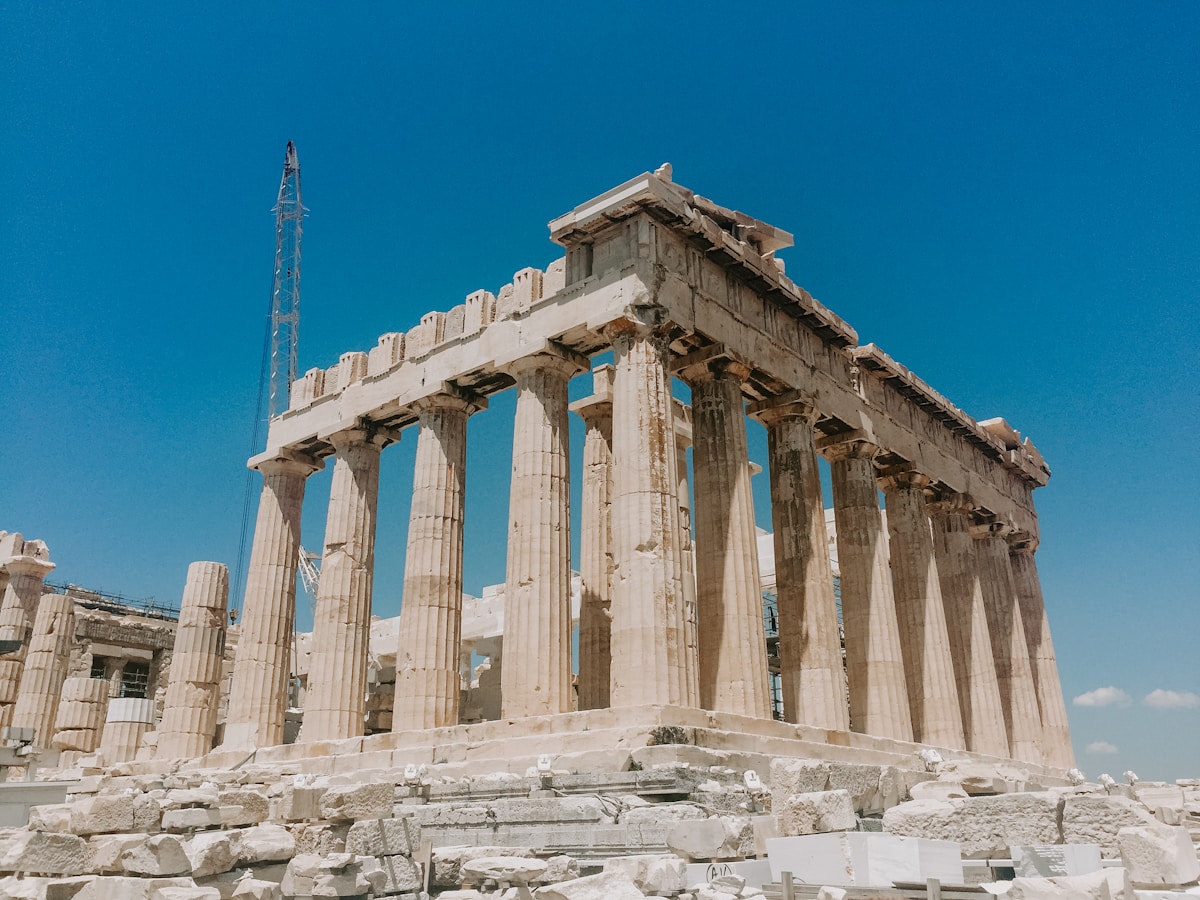
The Acropolis of Athens is the defining monument of Western civilisation - a 156m limestone outcrop that has been a religious and political focal point for 5,000 years. The buildings you see today date primarily from the 5th century BC (the classical period under Pericles), but the site was occupied in the Bronze Age and remained in continuous use through the Byzantine and Ottoman periods.
The Acropolis is not merely a ruin to visit - it is the single most significant archaeological site in Greece and one of the most important in the world. Understanding what you are looking at transforms the experience.
The Main Monuments
The Parthenon
The great temple of Athena - completed in 432 BC under the architects Iktinos and Kallikrates, with sculptural program overseen by the sculptor Phidias. The structure appears to have perfectly straight lines, but almost no true straight lines exist in it: the columns lean inward, swell at the centre (entasis), and the entire stylobate (platform) curves upward at the centre. These optical corrections, invisible individually, give the temple its uncanny visual perfection.
What to look for: The 92 metopes (carved panels) on the exterior - the surviving originals are in the British Museum and the Acropolis Museum. The friezes that once ran around all four sides were removed by Lord Elgin in 1801–1812 and remain contested (the “Elgin Marbles”).
Current state: Ongoing restoration work has been underway since 1975 - scaffolding is perpetually present on some part of the structure. The restoration corrects 19th-century damage (an explosion in 1687, during a siege, destroyed much of the cella).
The Erechtheion
The complex temple on the north side of the Acropolis, housing several sacred sites simultaneously: the ancient olive tree of Athena, the mark of Poseidon’s trident, the tomb of the mythological king Kekrops. The south porch is supported by six female figures (caryatids) - the originals are in the Acropolis Museum; the ones visible on site are copies.
The Propylaia
The monumental entrance gateway to the Acropolis, begun in 437 BC and never fully completed. Designed by the architect Mnesikles as a deliberate mirror of the Parthenon’s proportions.
The Temple of Athena Nike
The small Ionic temple on the southwest bastion of the Propylaia - completed around 420 BC. The temple was dismantled by the Ottomans in 1686 to build a gun emplacement; it was reconstructed twice (incorrectly, then correctly) in the 19th and 20th centuries.
The Acropolis Museum
The separate museum at the base of the hill (on Dionysiou Areopagitou Street, entry €10 adult, open 8am–8pm Mon and Thu–Sun, 8am–10pm Fri, 10am–6pm Tue–Wed, as of 2026) houses the original sculptural finds from the Acropolis - the caryatids from the Erechtheion, the Parthenon frieze sections, and the Archaic collection. The third floor is a glass-walled gallery specifically designed to be reunited with the British Museum’s Parthenon sculptures if they are ever returned.
We recommend visiting the museum before the Acropolis itself - understanding the sculptures and the building sequence makes the site far more legible.
Practical Information
Getting there: Metro Line 2 (Red) to Acropolis station (the most direct approach, emerges at the base of the hill). Walking from Monastiraki or Syntagma: approximately 15–20 minutes.
Tickets: Book online in advance at hhticket.gr - time-slot selection is now mandatory and the site is the only official channel. The daily limit is 20,000 visitors; in peak season (June–August) slots sell out 5–7 days ahead. Print or save your ticket to your phone.
Multi-site passes: The official Greek government combo ticket was discontinued in 2026. Third-party multi-site passes covering the Acropolis plus the Ancient Agora, Kerameikos, and other sites are still available through GetYourGuide and Tiqets - these can be better value if you plan to visit several sites.
Photography: Allowed throughout the site; no flash, no tripods (or they require a permit). The best photography positions are: the Propylaia steps (Parthenon framing), the Erechtheion from the north (caryatid porch), and the view south from the Parthenon toward the Theatre of Dionysos and the Saronic Gulf.
Heat: The Acropolis is fully exposed - no shade on the main plateau. In July and August, midday temperatures on the site can reach 38–42°C. Bring water, sunscreen, and a hat.
The South Slope: Theatre of Dionysos and Odeon of Herodes Atticus
The south slope of the Acropolis contains two major performance spaces:
Theatre of Dionysos: The oldest theatre in the world and the birthplace of Western drama - Aeschylus, Sophocles, and Euripides all premiered their plays here. The remains date to approximately 330 BC (the current stone theatre replaced an earlier wooden structure). The elaborate throne in the front row - carved for the priest of Dionysos - is still visible. Included in the combined Acropolis ticket.
Odeon of Herodes Atticus: A Roman concert hall (161 AD), donated to Athens by the wealthy benefactor Herodes Atticus - still in use for performances during the Athens Epidaurus Festival (June–August). Tickets for performances €25–120 depending on programme; check greekfestival.gr. The exterior is visible from the street; entry only during performances.
The Areopagus Hill
Directly west of the Acropolis - a bare rock outcrop that served as the court of ancient Athens, where the council of elders judged capital cases. The Apostle Paul preached here in 50 AD (Acts 17:22–34). Free access at all times. The rock is slippery when wet; use the carved steps. The view of the Acropolis from the Areopagus is excellent and often less crowded than the Acropolis itself.
The Parthenon Sculptures Controversy
The 160m frieze, 15 of 92 metopes, and the two pediment groups were removed by Thomas Bruce, 7th Earl of Elgin, between 1801 and 1812, under a disputed permit from the Ottoman authorities. They are now held by the British Museum in London. Greece has formally requested their return since 1983; the British Museum has declined every request. The Acropolis Museum’s third-floor gallery was explicitly designed to reunite the sculptures - the surviving Athenian pieces and plaster casts of the London pieces are displayed together to illustrate what a unified collection would look like.
The debate is ongoing and politically sensitive. Both the Greek government and the British Museum maintain their positions publicly.
Book Acropolis guided tours and skip-the-line tickets with GetYourGuide.
For the full Athens city guide including where to stay and eat, see our Athens travel guide. For tours, skip-the-line tickets, and activities, see our best tours in Athens guide. Planning your Athens days? The 2-day Athens itinerary and 3-day Athens itinerary cover the Acropolis alongside Plaka, the agora, and the National Archaeological Museum. For other major ancient sites, see our guides to Delphi, Mycenae, and Cape Sounion.
Search hotels in Athens on Booking.com
See Also
- Athens Travel Guide - city overview with where to stay, transport, and top attractions
- Things to Do in Athens - the Ancient Agora, Plaka, Lycabettus, and museums
- Best Tours in Athens - skip-the-line Acropolis tours, food walks, and guided excursions
- 2-Day Athens Itinerary - fitting the Acropolis into a 48-hour Athens visit
- 3-Day Athens Itinerary - a more relaxed pace including day trip options
- Cape Sounion Guide - the Temple of Poseidon, 70km south of Athens
- Ancient Delphi Guide - the oracle sanctuary, 177km from Athens