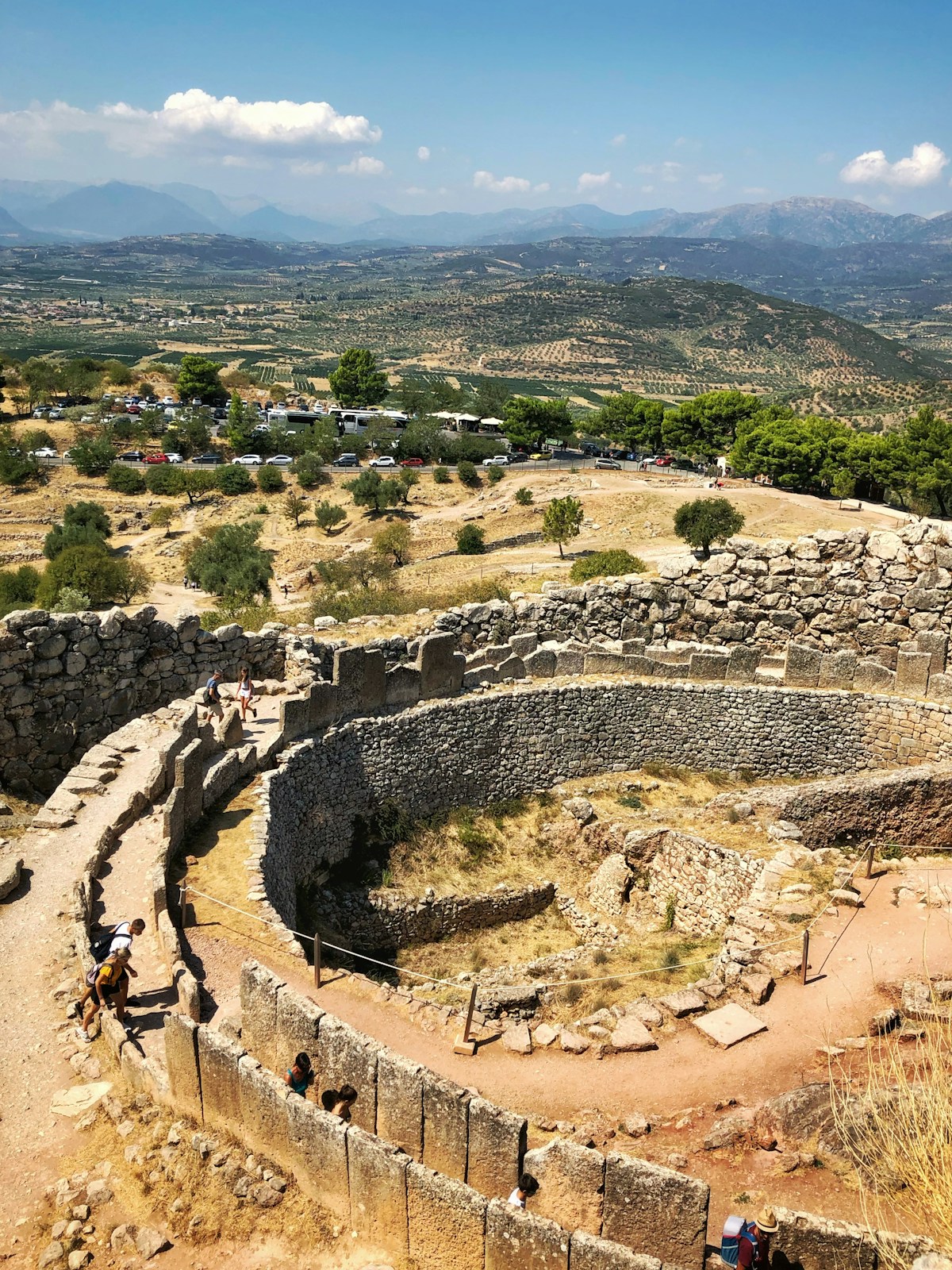
Mycenae is the site that connected myth to archaeology. When Heinrich Schliemann excavated the palace citadel in 1876, he found gold death masks, inlaid weapons, and royal burials so rich that they seemed to confirm the legends of the Homeric poems. The civilisation he uncovered - the Mycenaeans, who dominated the Bronze Age Aegean from approximately 1600–1100 BC - had been entirely forgotten. Mycenae was the most powerful of their palace-centres, and its remains are the most dramatic Bronze Age site on the Greek mainland.
The Main Site
The citadel sits on a natural rocky spur between two mountains (Mount Agios Ilias and Mount Zara), commanding the approach to the Argive plain. The massive Cyclopean walls (named by later Greeks who could not believe any human hands could have built them - only the Cyclopes could have lifted such stones) date from approximately 1350–1200 BC.
The Lion Gate: The main entrance to the citadel - the most famous Bronze Age monument in Europe. Two lions in relief above the lintel are the earliest monumental sculpture in European art. The architectural arrangement (threshold, jambs, lintel, relief block) is essentially intact after 3,000 years. The figures above are headless; the heads were probably bronze, separately attached.
Grave Circle A: Inside the Lion Gate, the most important find - six royal shaft graves discovered by Schliemann in 1876, covering the period approximately 1600–1500 BC. Schliemann found 19 bodies and 14kg of gold objects, including the gold death masks now in the Athens National Archaeological Museum. A later circle (Grave Circle B) is visible in the lower city.
The Palace: The upper terrace of the citadel. The layout follows the standard Mycenaean pattern - a great hall (megaron) with a central circular hearth flanked by four columns, a throne room, and a corridor around the courtyard. The floors were decorated with painted plaster; remains are visible.
The Granary: The building inside and to the right of the Lion Gate - used to store grain and clay tablets (the Linear B administrative records of the palace). The archives document wine, grain, and wool inventories.
Secret Cistern: A subterranean cistern at the northeast of the citadel, cut 18m into the rock and accessed via 99 steps - the water supply that allowed the citadel to withstand siege. You can descend with a torch (bring your own; the steps are slippery).
The Treasury of Atreus (Tomb of Agamemnon)
Located 500m from the main site entrance - a tholos (beehive) tomb of approximately 1250 BC, the finest Bronze Age architectural structure in Greece. The entrance passage (dromos) is 36m long and 6m wide; the doorway lintel weighs 120 tonnes; the domed chamber inside is 14.5m in diameter and 13.2m high - the largest domed space in the ancient world until the Pantheon in Rome.
The tomb was long ago looted; the objects originally buried here were probably comparable to the Shaft Grave finds. The engineering, however, is extraordinary - the dome is constructed without mortar, each ring of corbelled stone cantilevering inward. It has stood for 3,250 years. Entry included in the main site ticket.
The On-Site Museum
A small but well-organised museum at the entrance to the main site - contains architectural fragments, pottery, and some fresco fragments from the palace. The best Mycenaean finds (including Schliemann’s gold) are in the Athens National Archaeological Museum.
Context: The Athens National Archaeological Museum
The major Mycenaean collection is in Athens (Patission 44, entry €15 adult, open 8am–8pm Wed–Mon). The Mycenae room (Room 4) contains the gold death masks, the Vapheio cups, the gold and silver grave goods, and the inlaid bronze daggers from the shaft graves. If you are visiting Mycenae, budget time for this museum in Athens as well.
The Mycenaean Collapse
Mycenae was abandoned abruptly around 1100 BC, as part of the wider Bronze Age Collapse - a civilisation-ending disruption that destroyed or severely damaged virtually every major palace culture in the Eastern Mediterranean simultaneously (Egypt, Hittites, Ugarit, Cyprus). The causes are still debated: climate change, drought, internal rebellions, seismic activity, and external “Sea Peoples” invasions have all been proposed. The Linear B tablets - the last administrative records of the palace - show nothing unusual; the collapse appears to have been rapid and unexpected.
After the collapse, the site was continuously occupied on a smaller scale through the Classical period (a small city-state of Mycenae sent soldiers to Marathon and Thermopylae) before final abandonment. The ruins were visible throughout antiquity - Greek travellers like Pausanias described them in the 2nd century AD.
Visiting Mycenae Practically
From Nafplio: The most common base. Taxi approximately €20–25 one-way (25 minutes). KTEL bus approximately €3.50 each way, with limited services (check current timetable at ktelargolidos.gr). Several agencies in Nafplio run half-day tours to Mycenae from approximately €25–35 per person including transport.
From Athens: Day tour (approximately €65–95 per person) typically combining Mycenae with Epidaurus and Nafplio, departing 8–9am and returning by 7–8pm. Alternatively, self-drive from Athens (1.5 hours each way) allows more flexibility.
Time on site: 2–3 hours is adequate for the main site, Treasury of Atreus, and on-site museum. The site becomes busy 11am–1pm when tour groups converge - arrive at opening (8am) for the best experience.
Nearby
Tiryns: 12km from Mycenae, near Nafplio - a second Mycenaean palace-citadel, slightly smaller but with better-preserved Cyclopean walls and an accessible underground corridor. Entry €4 adult, free on Sundays November–March. Far fewer visitors than Mycenae.
Epidaurus (25km from Mycenae): The ancient theatre of Asclepius - the most acoustically perfect theatre in the ancient world, seating 14,000. Entry €12 adult. Easily combined with Mycenae on a day circuit.
Book Mycenae guided tours and day trips from Athens or Nafplio with GetYourGuide.
Search hotels in Nafplio, Greece on Booking.com
See Also
- Nafplio Travel Guide - the most beautiful Peloponnese base, 25km from Mycenae
- Day Trips from Nafplio - combining Mycenae with Epidaurus and Tiryns
- Epidaurus Guide - the ancient theatre, 30km southeast of Mycenae
- Ancient Olympia Guide - the Olympic sanctuary, 3 hours west on the Peloponnese
- Peloponnese Road Trip Itinerary - the full Peloponnese circuit through Mycenae and Nafplio
- Day Trips from Athens - Mycenae as part of an Athens day excursion
- Acropolis of Athens - Athens’s great Bronze Age site, 150km northeast