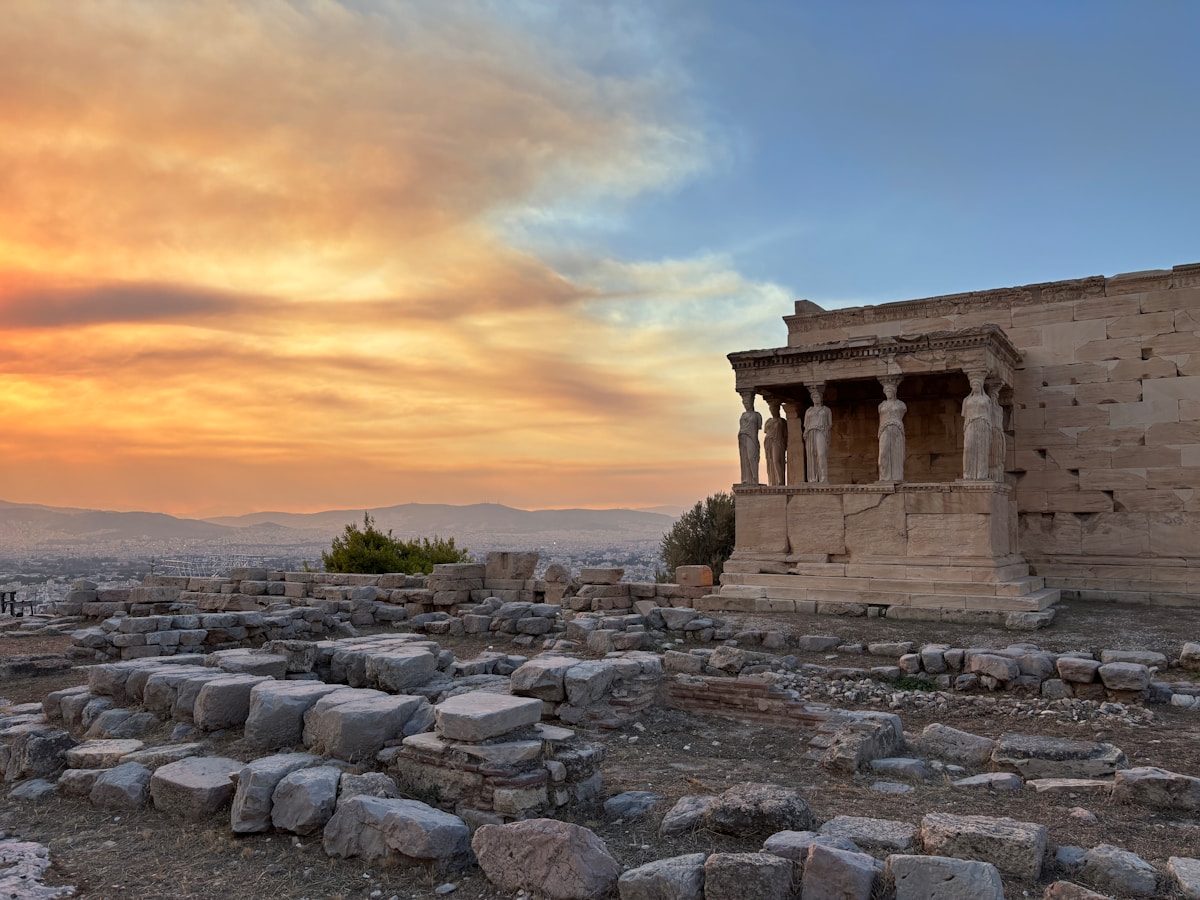
The sanctuary of Olympia in the Peloponnese was the religious and athletic centre of the ancient Greek world for more than a thousand years. The Olympic Games - held here every four years from 776 BC until their suppression by the Christian emperor Theodosius I in 393 AD - were the most important event in the Greek calendar. City-states at war called truces to allow their athletes to compete; the winners were celebrated as heroes. The games ran for 1,170 years before ending, and the site they left behind is one of the most atmospheric in Greece.
The Archaeological Site
The sanctuary (the Altis) is a roughly rectangular sacred precinct surrounded by a wall, with the remains of multiple temples, treasuries, and athletic facilities.
Temple of Zeus: The greatest temple at Olympia and once the most important sanctuary in Greece - a massive Doric structure completed around 456 BC. The temple housed the chryselephantine statue of Zeus (ivory and gold) by Phidias, considered one of the Seven Wonders of the Ancient World at approximately 13m tall. The temple was destroyed by earthquakes; 16 massive column drums remain where they fell. The capital of a collapsed column is displayed in the museum.
Temple of Hera (Heraion): Older than the Temple of Zeus (c.600 BC) - the oldest temple at the site and one of the oldest surviving Doric temples in Greece. The Olympic flame is still lit here by a parabolic mirror in the traditional ceremony before each modern Olympic Games.
The Palaestra: The wrestling school - a colonnaded square where athletes trained. The columns of the west and south porticoes are partially restored.
The Workshop of Phidias: The building where the gold-and-ivory statue of Zeus was constructed - later converted to a Christian church. The outline of the workshop is exactly the size of the temple’s cella, allowing the statue to be checked for fit. Phidias’s tools and moulds were found here; terracotta pieces of his name are in the museum.
The Stadium: A 192m sprint track with original starting blocks at both ends. The tunnel through which athletes and judges entered from the sanctuary is preserved. The embankment could hold approximately 40,000 spectators - no stone seating: the crowd sat on the grass slopes. Running the length of the track is a singular experience.
The Archaeological Museum
One of the most important archaeological museums in Greece, purpose-built to house the finds from the sanctuary.
The pediments of the Temple of Zeus: The most significant objects in the museum - the two pediment groups (marble sculptures from the temple’s east and west gables) are displayed in their entirety in a long gallery. The east pediment shows the chariot race myth of Pelops; the west pediment shows the Battle of Lapiths and Centaurs. The craftsmanship (c.456 BC) is extraordinary.
The Nike of Paionios: A large marble statue of the goddess of victory, originally mounted on a triangular base 9m high. The figure appears to be landing - the drapery is depicted in flight. One of the finest surviving Greek marble sculptures.
The Hermes of Praxiteles: A marble figure (c.330 BC) found in the Temple of Hera, widely regarded as an original work by Praxiteles (most Greek sculpture survives only in Roman copies). Displayed in a separate room.
Phidias’s tools: Terracotta moulds and a cup inscribed “I belong to Phidias” (PHEIDIO EIMI) found at the workshop.
The Museum of the History of the Olympic Games
A separate museum in the modern town of Olympia (not included in the combined ticket, entry €6, open 8am–3pm Wed–Mon) - good documentation of the ancient games’ history, rules, and the athletic events. Less spectacular than the archaeological museum but a useful complement.
Modern Olympia Village
The modern village is a single main street of hotels, tavernas, and tourist shops adjacent to the sanctuary.
Where to eat: Taverna Melathron (traditional Peloponnese food, approximately €15–22 per person), Kladeos (riverside garden, reliable grills and salads, approximately €18–28 per person).
Where to stay: Hotel Pelops (friendly, well-located, from approximately €70/night), Villa Mercouri (mid-range, good breakfast, from approximately €85/night), Hotel Europa (hilltop, pool, from approximately €110/night).
The Ancient Olympic Games
The Games were held every four years at the full moon nearest to the summer solstice - a date that remained fixed for more than a millennium. All free Greek men were eligible to compete (slaves and non-Greeks were excluded). The competitions originally consisted only of a single sprint race (the stadion, 192m); by the 5th century BC, the programme had expanded to include longer runs, wrestling, boxing, pankration (a brutal combination of the two), the pentathlon (sprint, discus, javelin, long jump, wrestling), chariot racing, and equestrian events.
Winners received a wreath of olive leaves cut from the sacred tree by the Temple of Hera - no money, no medal. The honour, however, was enormous: returning champions were greeted by their cities like gods, given free meals for life, and celebrated in odes by poets like Pindar.
The games were suppressed by the Christian emperor Theodosius I in 393 AD as part of his elimination of pagan religious practices. The site was subsequently used as a Byzantine settlement, then abandoned, then covered by alluvial deposits from repeated floods. Systematic excavation began by French and then German archaeologists in the 1870s; the German Archaeological Institute has continued excavations since 1936.
Practical Information
Opening hours: 8am–8pm daily (April–October), 8am–3pm Tue–Sun (November–March), closed Monday in winter.
Combined ticket: €18 adult (April–October), €12 (November–March, as of 2026). Covers the archaeological site, the Archaeological Museum, and the Museum of the History of the Olympic Games requires a separate ticket (€6).
Getting there by public transport: KTEL buses from Athens (Kifissos Terminal) take approximately 5 hours and cost €30–35. Two or three departures daily. From Pyrgos (the nearest railway station), local buses and taxis cover the 30km to Olympia in approximately 30 minutes (taxi approximately €20).
Guided tours from Athens: Day tours typically run €75–110 per person including transport, guide, and entry. Olympia is also combined with other Peloponnese stops on multi-day tours (from approximately €180 per person for 2-day circuits).
Planning a longer stay in the area? See our Olympia city guide for where to stay, eat, and what else to see.
Book Ancient Olympia guided tours and day trips with GetYourGuide.
For the full Olympia city guide including where to stay and eat, see our Olympia travel guide. For things to do in and around the site, see the Olympia things to do guide. For excursions from Olympia including the Temple of Apollo at Bassae, see our day trips from Olympia guide. Olympia sits on the standard Peloponnese circuit - see our Peloponnese road trip itinerary for the day-by-day plan combining Olympia with Nafplio, Mycenae, and Kalamata. For other major ancient sites, see our guides to Mycenae and Epidaurus.
Search hotels in Olympia, Greece on Booking.com
See Also
- Olympia Travel Guide - where to stay, where to eat, and practical visitor information
- Things to Do in Olympia - the sanctuary, stadium, museum, and torch ceremony
- Day Trips from Olympia - Temple of Bassae, Katakolon port, and the Peloponnese coast
- Peloponnese Road Trip Itinerary - the full 7–10 day circuit including Olympia
- Mycenae Guide - the Bronze Age citadel, 200km east on the Peloponnese
- Epidaurus Guide - the ancient theatre, 250km east on the Argolid coast
- Ancient Delphi Guide - the other great oracle sanctuary, 250km northeast