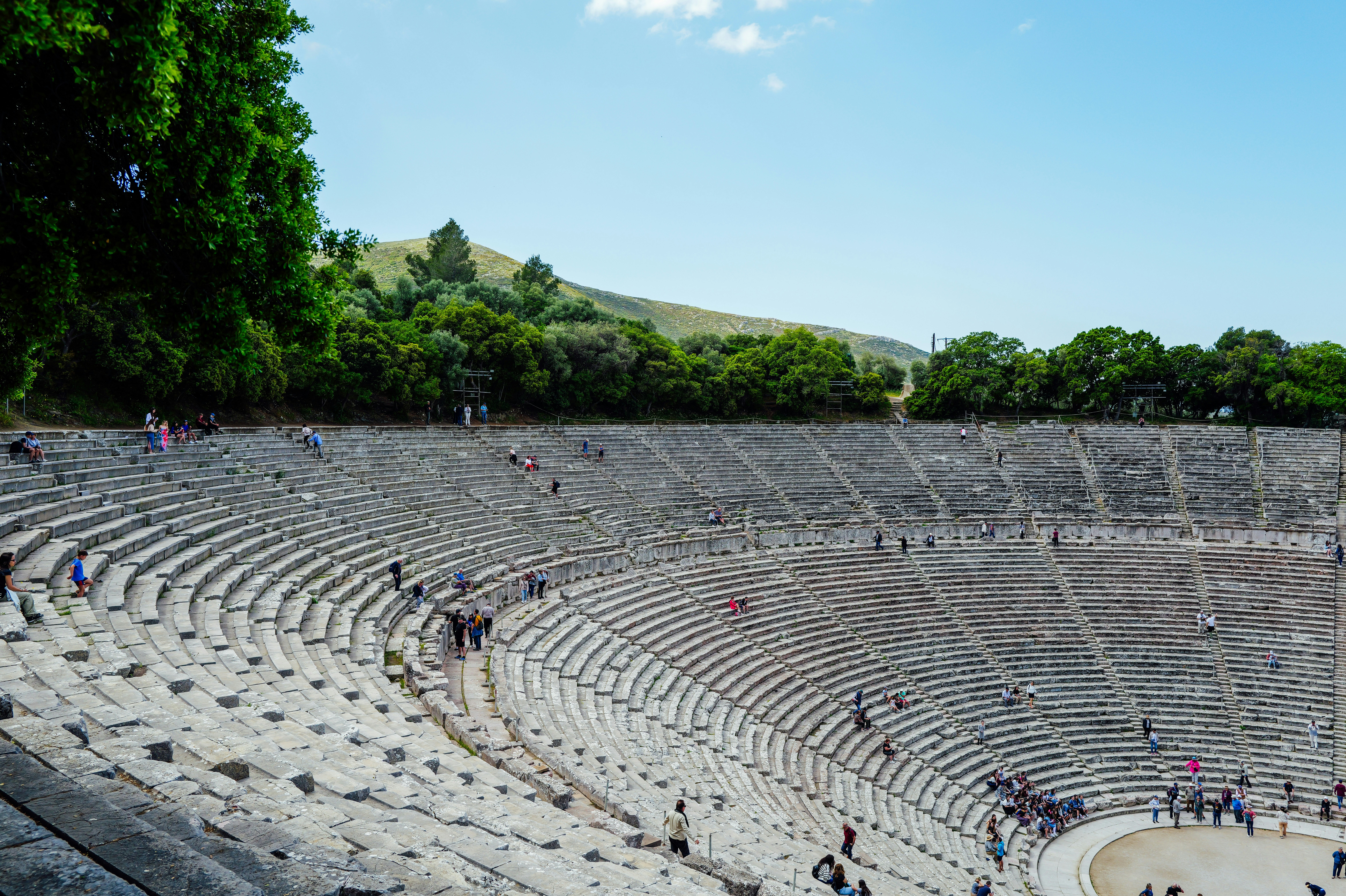
Epidaurus contains the best-preserved ancient Greek theatre in the world and one of the most important healing sanctuaries of antiquity. The theatre’s acoustics have made it famous for centuries; the Sanctuary of Asclepius that surrounds it was the ancient equivalent of an international medical centre, attracting pilgrims from across the Greek world seeking cures from the god of medicine.
The site is in the north-eastern Peloponnese, 150km south-west of Athens, in a valley surrounded by hills - which contributes to its preservation and to the sense of remoteness that makes it worth the journey from the capital.
The Theatre
The theatre at Epidaurus was built in the 4th century BC (around 340 BC) by the architect Polykleitos the Younger. It originally seated approximately 6,200 spectators; later Roman expansion increased capacity to approximately 14,000, with the upper seating tiers visible today added during this Roman phase.
The orchestra - the circular performance space at the base - is 20.28 metres in diameter. The skene (stage building behind the orchestra) survives in fragmentary form; the stage itself is a modern reconstruction used for performances.
The seating (theatron) rises 55 rows to the upper diazoma walkway, divided by 13 stairways into wedge-shaped sections (kerkides). The lower 34 rows are the original 4th-century construction; the upper 21 rows are Roman additions. Sitting in the upper rows gives the clearest acoustic demonstration and the best view of the full theatre.
The Acoustics
Epidaurus is famous for acoustics that allow a whisper in the orchestra to be heard in the top row. Stand in the centre of the orchestra circle when the theatre is quiet and speak at normal volume - the sound carries with extraordinary clarity to every part of the seating.
Research has attributed this to the specific characteristics of the limestone seats: the material absorbs low-frequency ambient noise (wind, crowd murmur) while transmitting the mid-to-high frequency range of the human voice. The result is a natural noise filter. The geometry - the precise angle of the seating relative to the orchestra - enhances this effect further.
The test most visitors run: drop a coin in the orchestra centre and listen from the top row. It works.
The Sanctuary of Asclepius
The theatre is the most visited part of Epidaurus but the Sanctuary of Asclepius that surrounds it is equally significant historically. Asclepius, the son of Apollo, was the Greek god of medicine and healing. His sanctuary here grew from the 6th century BC into one of the major pilgrimage centres of the ancient world - rivalling Delphi in importance.
Pilgrims came seeking cures for illnesses, injuries, and infertility. The treatment protocol involved ritual purification, fasting, prayer, and then spending the night in the abaton (a long dormitory hall) where the god would appear in dreams and prescribe a cure. The prescribed treatments were often practically medical - diet changes, herbal preparations, bathing.
Key structures in the sanctuary:
The Tholos (Rotunda): The most architecturally significant building on the site - a circular building of uncertain function (possibly connected to the healing cult’s most sacred rituals, possibly housing a snake pit sacred to Asclepius). Designed by Polykleitos the Younger, the same architect as the theatre. The elaborate stone floor remains partially in place; the structure once had concentric circular colonnades.
The Abaton: The long sleeping hall where pilgrims underwent incubation (ritual sleep for divine healing). The foundations are visible.
The Temple of Asclepius: The main temple to the god - Doric, dating to the 4th century BC. Substantial portions of the temple sculpture are in the National Archaeological Museum in Athens and in the Epidaurus Museum on site.
The Epidaurus Museum: On-site, holding finds from the excavations including architectural elements, votive offerings (anatomical models donated by healed pilgrims - clay hands, eyes, legs), and inscriptions recording cures. Entry included in the site ticket.
Athens Epidaurus Festival
Since 1955, the Ancient Theatre of Epidaurus has hosted the Athens Epidaurus Festival - an annual summer programme of ancient Greek drama (tragedy and comedy) performed in the theatre itself. Productions are typically high-quality, often with major Greek directors and international collaborations. The festival runs from late June to late August.
Tickets from approximately €20–120 depending on programme, seating tier, and whether it is a single production or a premium festival night. Book well in advance - popular productions sell out weeks ahead. Check greekfestival.gr for the current season’s programme.
Attending a performance at Epidaurus - the ancient texts performed in the space for which they were written, under open sky, with acoustics unchanged from 340 BC - is one of the most memorable experiences available in Greece.
Practical Information
Getting there from Athens: By hire car approximately 2 hours via E65 to Korinthos, then south through Nafplio. The toll road to Korinthos costs approximately €3. From Nafplio, Epidaurus is approximately 30km (45 minutes on local roads).
Public transport: KTEL buses run from Athens (Terminal A, Kifissou) to Nafplio, then a separate bus to Epidaurus in season. The journey involves a change and the bus to Epidaurus is infrequent - check current schedules at ktel.org. A taxi from Nafplio costs approximately €25–35 as of 2026.
From Nafplio: Nafplio (45 minutes by car) is the natural base for visiting both Epidaurus and Mycenae. A day trip covering both sites from Nafplio is practical.
Opening hours: 8am–8pm daily, April–October; 8am–3pm November–March. The site is open on performance evenings (the theatre is accessible earlier but the sanctuary section closes at normal hours).
Heat: The site is partially exposed. Summer mornings are best. Bring water; a cafe at the entrance sells drinks but nothing within the site.
Nafplio is the natural base for visiting Epidaurus - see our Nafplio travel guide for hotels, restaurants, and what to do in the city. Epidaurus and Mycenae are typically combined on a single day from Nafplio - see the Nafplio things to do guide and day trips from Nafplio guide for the practical details. For the full Peloponnese circuit that includes Epidaurus, see our Peloponnese road trip itinerary. For other Peloponnese ancient sites, see our guides to Mycenae and Ancient Olympia.
Book Epidaurus tours with GetYourGuide. Pick up a Greece eSIM before you fly - keeps you connected without roaming charges.
Search hotels in Epidaurus, Greece on Booking.com
See Also
- Nafplio Travel Guide - the best base for visiting Epidaurus, 35km west
- Day Trips from Nafplio - combining Epidaurus with Mycenae on a single Peloponnese day
- Mycenae Guide - the Bronze Age citadel, 25km northwest of Nafplio
- Ancient Olympia Guide - the birthplace of the Olympic Games, 3 hours west
- Peloponnese Road Trip Itinerary - the full Peloponnese circuit including Epidaurus
- Athens Travel Guide - the natural starting point for Peloponnese trips
- Best Tours in Athens - guided day trips to Nafplio, Mycenae, and Epidaurus