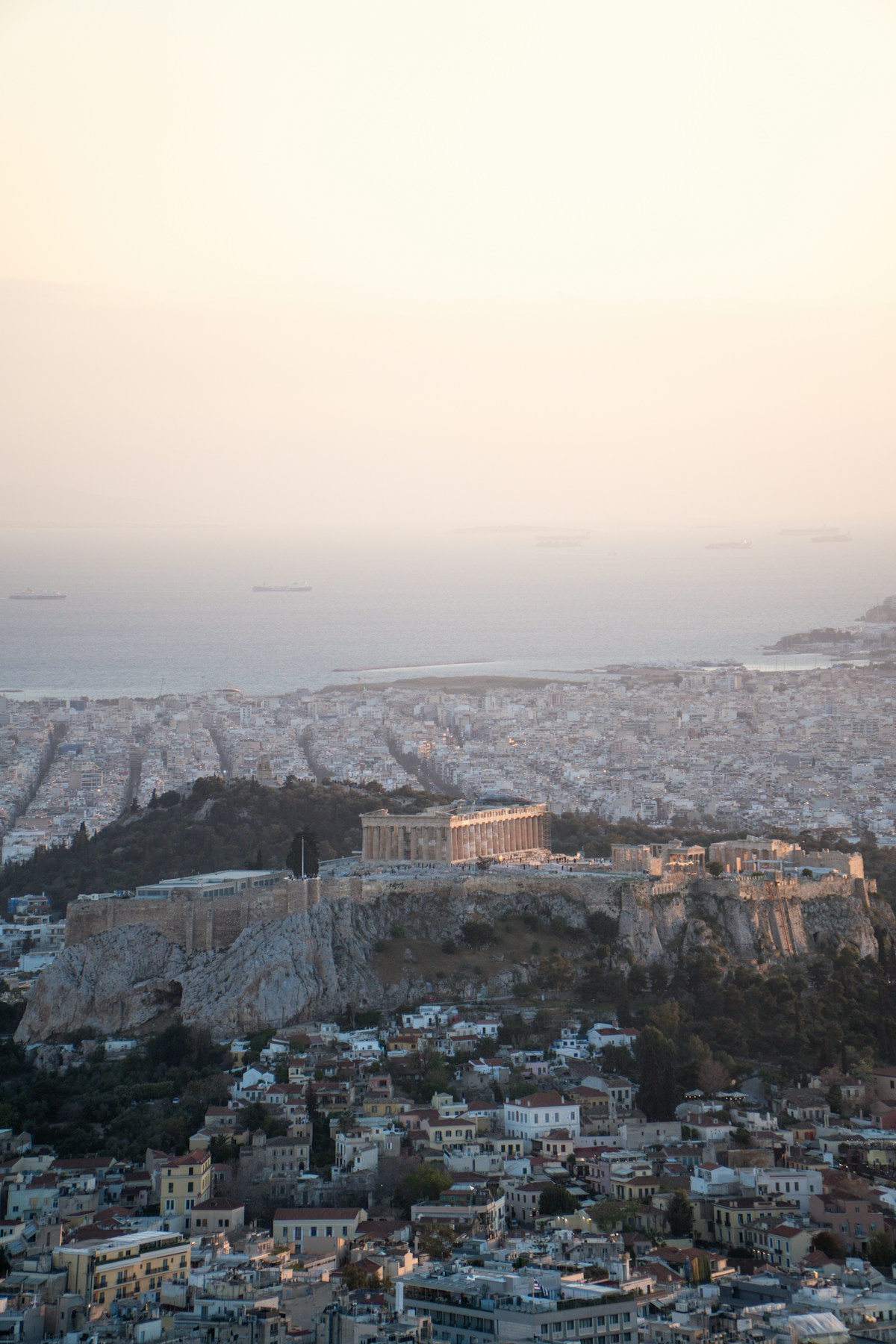
Two days gives you just enough time to cover Athens properly - the Acropolis and its museum, the Ancient Agora, Plaka’s Byzantine lanes, and Monastiraki’s market energy - without burning through it. Many visitors use Athens as a gateway before heading to the islands; this itinerary is designed for exactly that context. Two days well spent before a ferry, or a standalone long weekend.
Book your Acropolis time slot at hhticket.gr before you do anything else. As of 2026, time slots are mandatory and sell out 5–7 days ahead in summer.
Day 1: The Acropolis, Ancient Agora, and Plaka
Morning: The Acropolis (book the 8am slot)
Start at the Acropolis the moment it opens. The 8am slot is the single best decision you can make for the whole trip - the site is yours for the first hour before the tour groups arrive, the light is softer, and the heat is manageable.
Allow 2–2.5 hours on the hill itself.
Walk up via the main Propylaia entrance (the west face). The sequence to follow:
- Propylaia - the monumental gateway, begun 437 BC, never finished. Stand in the central opening: the Parthenon frames exactly as Pericles intended.
- Temple of Athena Nike - the small Ionic temple on the right bastion, completed around 420 BC, dismantled by Ottomans in 1686, reconstructed twice in the 19th–20th centuries.
- The Parthenon - the great temple of Athena, completed 432 BC. The columns lean inward by design; the platform curves upward at the centre. Walk the full perimeter rather than photographing from one angle.
- Erechtheion - north side of the plateau. The south porch with the six caryatids (the ones on site are copies; originals are in the Acropolis Museum). The complex served multiple sacred sites simultaneously: Athena’s olive tree, Poseidon’s salt spring, the tomb of king Kekrops.
- View south from the Parthenon: the Theatre of Dionysos and Odeon of Herodes Atticus on the south slope, the Saronic Gulf on clear days.
The Theatre of Dionysos on the south slope is included in the Acropolis ticket - worth 15 minutes to see the ornate front-row throne carved for the priest of Dionysos. The Areopagus (the bare rock outcrop to the west, where Paul preached in 50 AD) is free access and gives an excellent elevated view of the Acropolis - stop here on the way down.
Late Morning: Acropolis Museum (10am–12:30pm)
Walk down to Dionysiou Areopagitou Street. The Acropolis Museum (entry €10 adult, as of 2026) is directly below the hill and is not optional. Visit it after the site, not before - having seen the stones in place makes the sculptural finds infinitely more legible.
The key sections:
- Ground floor (Archaic): korai (statues of maidens), kouroi, and the Moschophoros (calf-bearer, circa 570 BC)
- Slope gallery: objects found on the Acropolis slopes
- Level 2: the Parthenon frieze rooms - 160m of frieze panels from the building’s exterior. The originals in Athens are displayed alongside plaster casts of the sections held by the British Museum, with gaps left where the originals are absent. The case for reunification is laid out in the architecture itself.
- Erechtheion Caryatids: the five surviving originals (one is in the British Museum), displayed at the level they stood on the building.
Opening hours: 8am–8pm Monday and Thursday–Sunday; 8am–10pm Friday; 10am–6pm Tuesday–Wednesday (as of 2026 - verify at theacropolismuseum.gr).
Lunch: Koukaki or Makriyianni
The streets immediately south of the museum - Drakou, Veikou, Falirou - have good neighbourhood tavernas away from the tourist-price zone directly outside the museum entrance. A sit-down lunch of mezedes (small plates to share) runs €10–14 per person. Grilled octopus, taramasalata, and kolokithokeftedes (courgette fritters) if they’re on the board.
Afternoon: Ancient Agora (2pm–4:30pm)
The Ancient Agora was the civic and commercial centre of classical Athens - the marketplace, law courts, administrative buildings, and philosophical meeting places were all here. Socrates taught here. Entry: €10 adult (verify current rate), or covered by some third-party multi-site passes.
The Hephaisteion (Temple of Hephaestus) on the west hill is the best-preserved Doric temple in the Greek world - more complete than any temple on the Acropolis itself. It dates to 449 BC. Walk the full perimeter and look at the frieze sections still in place on the building.
The Stoa of Attalos (a covered colonnade reconstructed in the 1950s) houses the Agora museum: everyday objects from 700 years of Athenian civic life - ostraka (pottery shards used to vote out politicians), weights and measures, votive offerings, and a bronze ballot box.
Allow 1.5–2 hours.
Evening: Monastiraki and Psyrri
From the Agora, walk north 5 minutes into Monastiraki. The flea market area (particularly Ifestou Street) is best in the late afternoon when traders are still out. The square itself is always busy - the old mosque (Tzistarakis Mosque, 1759) and the metro entrance visible from every angle.
For dinner, cross the train tracks into Psyrri - the grid of streets between Monastiraki and Athinas Street. This is the more local eating district: tavernas with tray displays, small wine bars, and grills. A meal here runs €12–18 per person for a full dinner with wine. Avoid Monastiraki Square itself for dining - the tables on the square are tourist-priced.
Rooftop drinks afterward: several bars along Adrianou Street (looking back toward the Acropolis) and on Miaouli Street in Monastiraki have Acropolis views and are open until 2am.
Day 2: Acropolis Museum Details, Plaka Walk, and Neighbourhood Exploration
Morning: Plaka and Anafiotika (9am–11:30am)
Start the day walking Plaka’s Byzantine lanes before the midday heat. From Monastiraki metro, take Adrianou Street east toward the Acropolis base.
Anafiotika - the cluster of whitewashed houses built into the north face of the Acropolis rock by Cycladic craftsmen brought to Athens by King Otto in the 1830s. It is the only neighbourhood in Athens that looks like it belongs on a Cycladic island: small cubic houses, blue doors, cats on steps, bougainvillea over walls. It is not signposted - enter from Stratonos Street at the base of the Acropolis rock.
Plaka’s main streets - Kydathineon, Adrianou, and the side lanes between them - have the highest concentration of Byzantine churches in Athens, several predating the Ottoman period:
- Church of Aghii Asomati (11th century)
- Church of Aghia Ekaterini (Byzantine, with visible excavations in the courtyard)
- Lysikrates Monument (334 BC) - the oldest complete marble building in Athens using the Corinthian order externally
Allow 2.5 hours to walk this area without rushing.
Mid-Morning: Syntagma and the Changing of the Guard
Walk 10 minutes east to Syntagma Square. The Evzone guard change at the Tomb of the Unknown Soldier happens every hour on the hour - the full ceremonial change with both guards and an escort happens Sunday at 11am. The movements are deliberately strange: part ritual, part theatrical.
The National Garden behind the parliament building is worth 20 minutes - shaded, quiet, and has a small café.
Lunch: Kolonaki or Exarchia
Walk north from Syntagma into Kolonaki (upmarket) or Exarchia (alternative, lived-in). Kolonaki has good coffee and pastry options; Exarchia has cheaper tavernas and a student-neighbourhood feel. Budget €8–12 for lunch in Exarchia, €14–20 in Kolonaki.
Afternoon: National Archaeological Museum (2pm–5pm)
The best museum in Greece and one of the best in the world. Entry €15 adult (as of 2026). Take metro Line 2 from Syntagma to Omonia (2 stops), then walk 5 minutes north.
Plan for 2.5–3 hours minimum. Key collections:
- Prehistoric - Mycenaean hall: the gold death mask of Agamemnon (a misnomer - it predates Agamemnon by 300 years but is how it’s known), bronze daggers inlaid with hunting scenes, the golden cup of Nestor
- Archaic sculpture: the Dipylon kouros, the Marathon kouros
- Classical: the bronze Poseidon (or Zeus) of Artemision - found in the sea off Cape Artemision, one of the finest surviving Greek bronzes
- The Antikythera collection: bronze Youth of Antikythera, and the Antikythera Mechanism on display (the world’s oldest known analogue computer, circa 100 BC)
- Cycladic collection (separate wing): marble figurines from 3200–2000 BC
Leave by 5pm to beat rush hour on the metro.
Evening: Dinner and the Central Market
If you have time before dinner, the Athens Central Market (Varvakios Agora, on Athinas Street) is open until 3pm for the fish/meat halls but the surrounding grocery stalls stay later. The market area has some of the most authentic tavernas in the city - notably along the side streets off Athinas, where you’ll find the type of places that serve wine from the barrel.
For dinner, return to Psyrri or try Thisseion - the streets above the Agora that look back up at the Acropolis, with good mezedopoleio (small-plate) restaurants.
Practical Notes for 2 Days in Athens
Getting around: Athens has a good metro (Lines 1, 2, 3). A single ticket costs €1.40 (as of 2026). The central area - Acropolis, Agora, Plaka, Monastiraki, Syntagma - is walkable between all points in 10–20 minutes. Taxis are metered and reasonable; Bolt and Uber operate.
Heat: July and August midday temperatures regularly reach 38°C. Schedule outdoor sites for before 11am and after 5pm. The Acropolis has no shade.
Acropolis time-slot booking: hhticket.gr - mandatory as of 2026. The 8am slot is quietest. Book before you travel; peak season slots sell out 5–7 days ahead.
Pickpockets: The Monastiraki flea market and the tourist-heavy Plaka streets have active pickpockets. Keep bags in front. The rest of Athens is straightforward.
Water: Athens tap water is drinkable and cold. Carry a bottle - fountain water is available inside the Agora.
Book guided Acropolis tours and skip-the-line tickets with GetYourGuide.
Extend Your Athens Visit
- 3 Days in Athens - add the National Museum and day trip options
- Athens Things to Do - full activities guide including lesser-known sites
- Athens Restaurants - neighbourhood-by-neighbourhood eating guide
- Day Trips from Athens - Cape Sounion, Delphi, Nafplio, and Aegina
- Where to Stay in Athens - Monastiraki, Koukaki, and Kolonaki compared
Search hotels in Athens on Booking.com
Book Your Trip
- Flights - Flights to Greece guide · Find the best fares to Greece
- Travel Insurance - Greece travel insurance guide · Get covered before you go
- eSIM - Greece eSIM guide · Stay connected from landing
- Airport Transfers - Pre-book your transfer from Athens or Thessaloniki
- Car Rental - Greece car rental guide · Compare prices across providers
- Tours & Activities - Browse Greece tours on GetYourGuide