Corfu and Zakynthos (also known as Zante) are the two most popular Ionian islands for British and northern European tourists. Both have verdant green landscapes, clear Ionian Sea water, and a history marked by Venetian and British occupation. They suit different types of travellers.
Quick Verdict
| Category | Corfu | Zakynthos |
|---|---|---|
| Beach drama | ★★★★ | ★★★★★ |
| Beach variety | ★★★★★ | ★★★ |
| Scenery | ★★★★ | ★★★★ |
| Historic capital | ★★★★★ | ★★★ |
| Nightlife | ★★★ | ★★★★ |
| Family-friendly | ★★★★★ | ★★★ |
| Budget value | ★★★★ | ★★★ |
| Quieter areas | ★★★★★ | ★★★★ |
Go to Corfu if you want a historic capital city, more diverse landscapes, better family options, and a wider range of accommodation. Go to Zakynthos if Navagio Shipwreck Beach is on your list, you want dramatic cliff scenery, or you’re looking for a party scene (Laganas) or loggerhead sea turtle watching.
Beaches
Corfu
Corfu has dozens of beaches covering all moods:
- Paleokastritsa: The most famous - a series of six small coves in a bay of extraordinary blue-green water, backed by forested hills and an 800-year-old monastery. Very crowded in July and August but genuinely beautiful.
- Glyfada: The largest sand beach on the west coast, organised with sunbeds and water sports, popular with families.
- Canal d’Amour (Sidari): Sandstone rock formations with channels carved by the sea; the legend holds that swimming through the canal guarantees you’ll find love.
- Agios Gordios: A long sandy beach with a relaxed atmosphere and good tavernas.
- Avlaki: A quieter pebble beach in the north, popular with people who want to escape the crowds.
- Halikounas/Lake Korision: A sand spit beach backed by a freshwater lagoon - one of the best kite-surfing spots in Greece.
Zakynthos
Zakynthos has fewer beaches but more dramatic ones:
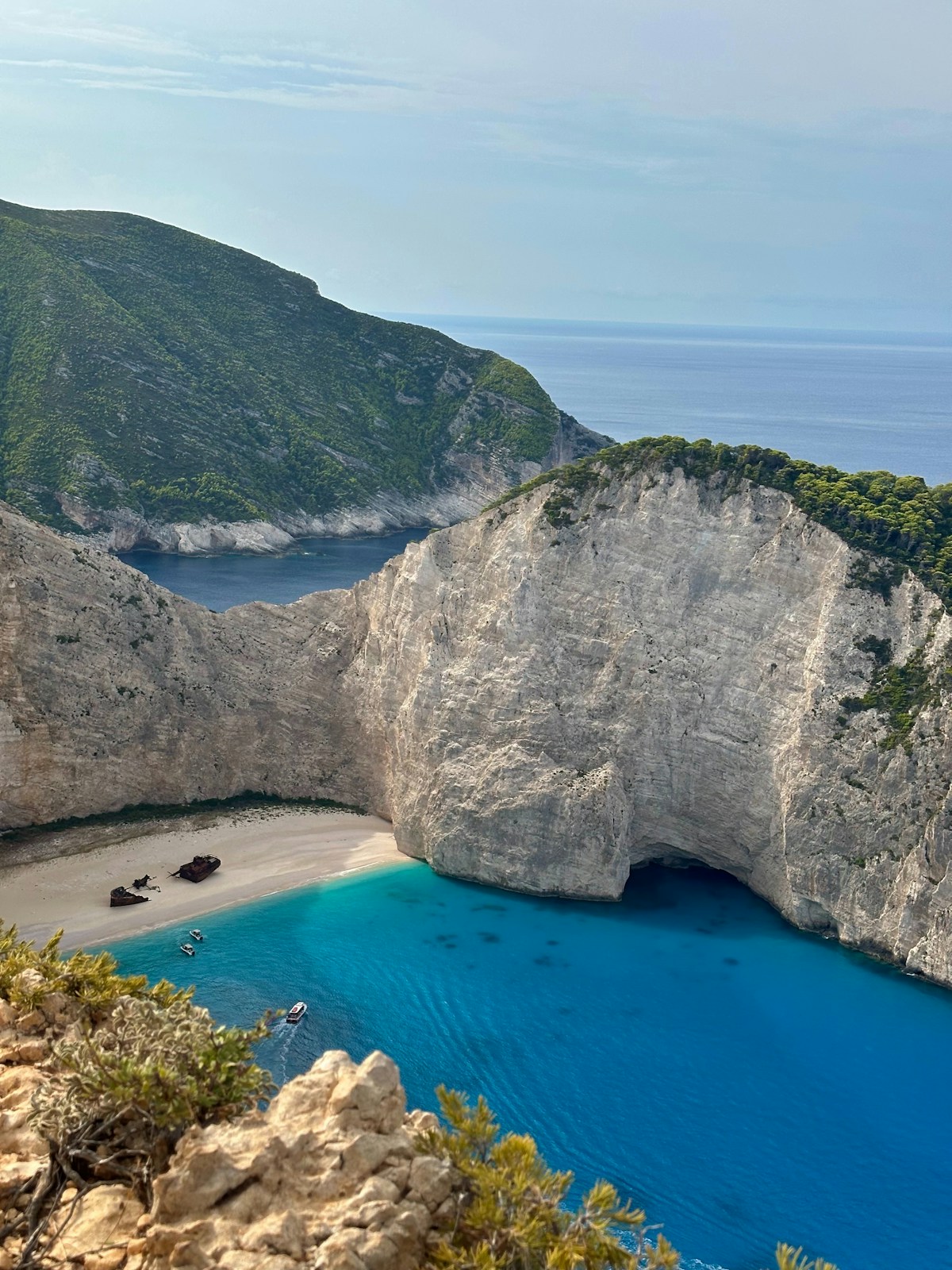
- Navagio (Shipwreck Beach): The iconic view - a rusting shipwreck on a perfect white sand crescent, accessible only by boat. One of the most photographed spots in all of Greece. Boat trips from Porto Vromi cost approximately €20–25 per person return.
- Navagio viewpoint: The cliff top view of Navagio is also accessible by road - one of the best views in Greece, free to access.
- Xi Beach: A red-sand beach in the south, unusual and photogenic.
- Makris Gialos / Planos area: Good beaches in the north with clear water and less development.
- Laganas: The main party beach - long, sandy, and very busy. The broader bay is a protected area for loggerhead sea turtles (nesting May–October). Water sports, banana boats, and nightlife bars abound.
- Porto Zoro: A quiet cove with excellent water clarity in the south.
Verdict: Zakynthos for individual beach drama; Corfu for overall variety.
Corfu Town vs Zakynthos Town
This is where Corfu has a clear advantage. Corfu Town (Kerkyra) is one of the most beautiful towns in Greece - a UNESCO World Heritage Site with a Venetian Old Town, two fortresses, elegant 18th-century buildings along the Liston (a colonnaded arcade modelled on the Rue de Rivoli in Paris), and a network of narrow lanes called kantounia. The quality of the town as an independent destination adds real value to the island.
Zakynthos Town (Chora) was largely destroyed in the 1953 earthquake and rebuilt in a functional style. It has pleasant waterfront restaurants and some art museums, but lacks the historic architecture and character of Corfu Town.
Nightlife
Corfu has two distinct and geographically separate nightlife zones. Kavos, at the island’s southern tip, is one of the most intense British-focused party scenes in Greece - a roughly 3km strip of bars, clubs, and beach venues running until dawn. Rescue Nightclub, Club Banana, and Deano’s Bar are among the most frequently visited spots; drinks are cheap (€3–5 during happy hours, which can run from 4pm to 10pm). Kavos is entirely separate from the rest of the island - Corfu Town and Paleokastritsa are completely different in character. Sidari in the north also has a lively but more relaxed bar strip. Corfu Town itself has a pleasant evening scene along the Esplanade and in the Liston arcades, with cocktail bars charging €8–12.
Zakynthos/Laganas is the Ionian equivalent of Kavos: a concentrated beach-road party strip with late-night bars, club music, and a predominantly young British package-holiday crowd. San Marco Bar, Rescue Club, and Cameo Island (a small island connected to the road by a causeway, popular for sunset drinks) are the most-cited spots. Happy hours from 5pm (€4–6 cocktails); most clubs have no cover charge but drink minimums after midnight. Tsilivi and Vassilikos are significantly quieter than Laganas.
Verdict: Both islands have intense party zones and quiet alternatives. Corfu’s Kavos is physically separated from its most beautiful areas; Zakynthos’s Laganas is more central. For those who actively want the party scene, both deliver it.
Scenery and Interior
Both islands are unusually green by Greek standards - the Ionian humidity supports lush olive groves, cypress trees, and wildflowers that give both islands a different character from the drier Cyclades.
Corfu has the more varied and interesting interior. Mount Pantokrator (906m) in the north offers panoramic views across to Albania and southern Italy on clear days; the road up passes through deserted stone villages. The Ropa Valley in the west is the island’s agricultural heartland - vineyards, olive groves, and a natural freshwater lake. Lake Korision in the south is a protected lagoon surrounded by dunes and pine forest. Aggelokastro, a Byzantine castle on a cliff on the northwest coast, is one of Corfu’s most atmospheric ruins. The island is large enough (592 sq km) that two weeks of exploring by car would still leave corners unvisited.
Zakynthos is smaller (406 sq km) and flatter in the east. The western coast has extraordinary cliff scenery - sheer white limestone faces dropping straight into turquoise water - but this is almost entirely inaccessible by land and must be seen by boat. The Vasilikos peninsula in the south-east is the island’s quietest region, with pine-backed beaches and the best turtle-watching conditions. The Blue Caves in the far north (boat trip required) are extraordinary - sea-carved caverns where turquoise light filters through the water.
Verdict: Corfu wins for interior scenery and landscape variety. Zakynthos has more dramatic coastal scenery, best seen by boat.
Wildlife
Zakynthos is Greece’s most important nesting site for the loggerhead sea turtle (Caretta caretta). The National Marine Park of Zakynthos protects Laganas Bay, where females come ashore to nest from May through August; hatchlings emerge from July to October. Boat trips from Agios Sostis and Porto Roma at dusk specifically target turtle watching - keep your distance, no flash photography, no touching. Early morning walks along the Laganas shore before 9am sometimes reveal nest activity in the sand. A visitor centre near Laganas explains the protection programme and feeding grounds. This is a rare and genuine wildlife experience, and for many visitors it’s the primary reason to choose Zakynthos over its Ionian neighbours.
Corfu is the better birdwatching destination. Lake Korision in the south is a protected lagoon that attracts migratory wading birds on the Adriatic flyway - grey herons, egrets, and occasionally greater flamingo pass through in spring and autumn. The extensive olive groves support a significant population of scops owl, audible at dusk in rural villages. The wetlands around Lefkimmi in the south are also productive for birding. Snorkelling is excellent off the northern beaches and sea caves around Paleokastritsa; sea turtles occasionally appear in Corfu’s waters but the island is not a significant nesting site.
Verdict: Zakynthos for sea turtles - a unique wildlife draw that Corfu cannot match. Corfu for birdwatching and more varied coastal wildlife.
Cost Comparison
| Category | Corfu | Zakynthos |
|---|---|---|
| Midrange hotel (per night) | €60–160 | €70–180 |
| Villa/apartment (per week) | €600–2,000 | €700–2,200 |
| Dinner per person | €20–40 | €22–45 |
| Boat trip (Navagio/Paleokastritsa) | €15–30 | €20–30 |
| Car hire (per day) | €35–65 | €35–70 |
Both islands are in a similar price bracket. Corfu is marginally cheaper in the midrange category. Both are significantly cheaper than the Cycladic islands.
Accommodation
Corfu
- Kontokali Bay Resort & Spa - 5-star, private beach on the north-east coast, €200–500/night as of 2026
- Ikos Dassia - all-inclusive resort, Dassia Bay, €350+/night
- Bella Venezia Boutique Hotel - midrange boutique, Corfu Town centre, €90–160/night
- Pink Palace - backpacker hostel, Agios Gordios beach, from €25/night
Book July and August accommodation at least 6–8 weeks ahead on Corfu. The island handles a large volume of direct charter flights from the UK and northern Europe, and mid-range accommodation in Corfu Town and Paleokastritsa fills well ahead. Best areas: Corfu Town if you want to explore the UNESCO historic centre on foot; Paleokastritsa for beach-focused stays (quieter north coast resorts); Benitses or Moraitika for value mid-range options on the east coast with easy access to the main road.
Search all Corfu hotels on Booking.com
Zakynthos
- Lesante Cape Resort & Villas - 5-star, private villas, cape location in the west, €400+/night
- Ionian Blue Hotel - midrange, Alykanas north coast, €90–180/night
- Zante Maris Hotel - affordable option, from €70/night
On Zakynthos, base location matters more than on Corfu because the island is smaller and less serviced by public transport. Laganas (south coast) is the party zone - budget hotels, beach bars, and nightlife; not for families or those wanting peace. Tsilivi and Alykanas (north coast) are quieter with good beaches and a local-facing restaurant scene. The Vasilikos peninsula (south-east) has some of the island’s best beaches and least development, and is the best choice for those primarily interested in Navagio boat trips and turtle watching without the Laganas crowds.
Search all Zakynthos hotels on Booking.com
Getting There
Corfu: Corfu Town (Kerkyra) airport (CFU) receives direct charter flights from UK airports including Gatwick, Manchester, Birmingham, Leeds, and Edinburgh from April to October - flight time approximately 2.5–3 hours. Multiple UK tour operators (Jet2, TUI, easyJet) offer package and flight-only options. Year-round connections via Athens with Aegean Airlines or Sky Express (45 minutes). By sea, the mainland ferry from Igoumenitsa takes 1.5 hours and runs frequently year-round; the overnight Patras–Corfu ferry (7 hours, from approximately €35 in a seat) is useful for travellers arriving via Adriatic ferry from Italy. Corfu is the most straightforward Ionian island to reach from multiple directions.
Zakynthos: Direct charter flights from Gatwick, East Midlands, Bristol, Glasgow, and Manchester from April to October, approximately 3 hours. Year-round connections via Athens (approximately 45 minutes). By sea, the ferry from Kyllini on the Peloponnese takes 1.5 hours - but reaching Kyllini by road from Athens adds 2.5 hours of driving; for most UK travellers, flying direct or via Athens is faster. By bus, the Athens–Patras–Kyllini route takes around 5 hours total. There is no direct ferry between Corfu and Zakynthos.
Verdict: Both islands are well-served by direct UK charters in summer. Corfu is slightly easier to reach year-round due to more frequent mainland ferry links.
Our Verdict
For most travellers, Corfu offers more. A UNESCO historic capital, greater beach variety, more accommodation options, better family credentials, and an island large enough to explore over 1–2 weeks without exhausting it.
Zakynthos wins if Navagio Shipwreck Beach is a priority, if you want to see loggerhead turtles, or if you specifically want Laganas nightlife. It’s a smaller island that can feel limited if you’re there for a week without a car.
See our complete island guides: Corfu and Zakynthos.
Search flights to Greece across multiple airlines in one place. Pick up a Greece eSIM before you fly - keeps you connected without roaming charges. Sort out travel insurance for Greece before you leave.
Book Corfu tours and excursions - boat trips to Paleokastritsa sea caves, Venetian fortress visits, and Old Town walking tours. Book Zakynthos tours - Navagio Shipwreck boat trips from Porto Vromi (approximately €20–25 per person return), loggerhead turtle watching excursions from Laganas, and sea kayaking on the west coast cliffs.
Related Island Comparisons
- Corfu vs Crete - comparing the Ionian and the Mediterranean
- Where to Stay in Corfu - Old Town, Paleokastritsa, and north coast
- Corfu Things to Do - beaches, castles, and Venetian heritage
- Best Greek Islands Guide - comparing all major islands
- Kefalonia vs Zakynthos - the third Ionian option compared
- Which Greek Island Should You Visit? - the full decision guide
Plan Your Trip
✈️ Book your flights to Greece 🛡️ Get travel insurance for Greece 📱 Stay connected with a Greece eSIM 🚗 Rent a car in Greece