Patmos Travel Guide: Sacred Island of St John
Guide to Patmos: UNESCO Monastery of Saint John, Cave of the Apocalypse, white Chora mansions, quiet beaches, and ferry routes to this Dodecanese island.
Guides for Patmos
Patmos is the only Greek island that would be a major pilgrimage site even without its beaches. The small, rocky Dodecanese island about 160km south of Samos is where the Apostle John wrote the Book of Revelation - a fact that gives it a weight and significance entirely out of proportion to its size (approximately 34 km² and 3,000 permanent residents). The Monastery of Saint John the Theologian has dominated the hilltop for nearly a thousand years; the island has been a place of Christian pilgrimage for almost two millennia.
What makes Patmos remarkable is that the sacred history coexists with a genuinely beautiful island - white Chora mansions, quiet beaches, exceptional water, and an unhurried atmosphere that attracts a sophisticated yacht crowd alongside the religious visitors. It’s not a party island and it never will be - there’s an informal agreement among islanders to keep it that way.
The Cave of the Apocalypse
The most visited site on the island. The cave sits on the hillside between Skala and Chora, incorporated since the 12th century into the Monastery of the Apocalypse. Inside the natural grotto, three features are highlighted for visitors: the silver halo marking where St John is said to have laid his head, the rock shelf that supported the scribe Prochoros as he transcribed John’s words, and a three-part crack in the ceiling said to symbolise the Trinity, through which God’s voice came.
The cave is small - groups of 10–15 at a time, with a monk or guide present. The atmosphere is genuinely devotional rather than touristic; incense, candlelight, and the sound of Byzantine chant from recordings create an unexpectedly affecting experience. Even secular visitors find it more moving than expected.
Entry free. Open daily except Monday mornings (approximately 8am–1:30pm and 4pm–6pm; verify current hours at the monastery). Dress code: shoulders covered, no shorts.
The Monastery of Saint John the Theologian
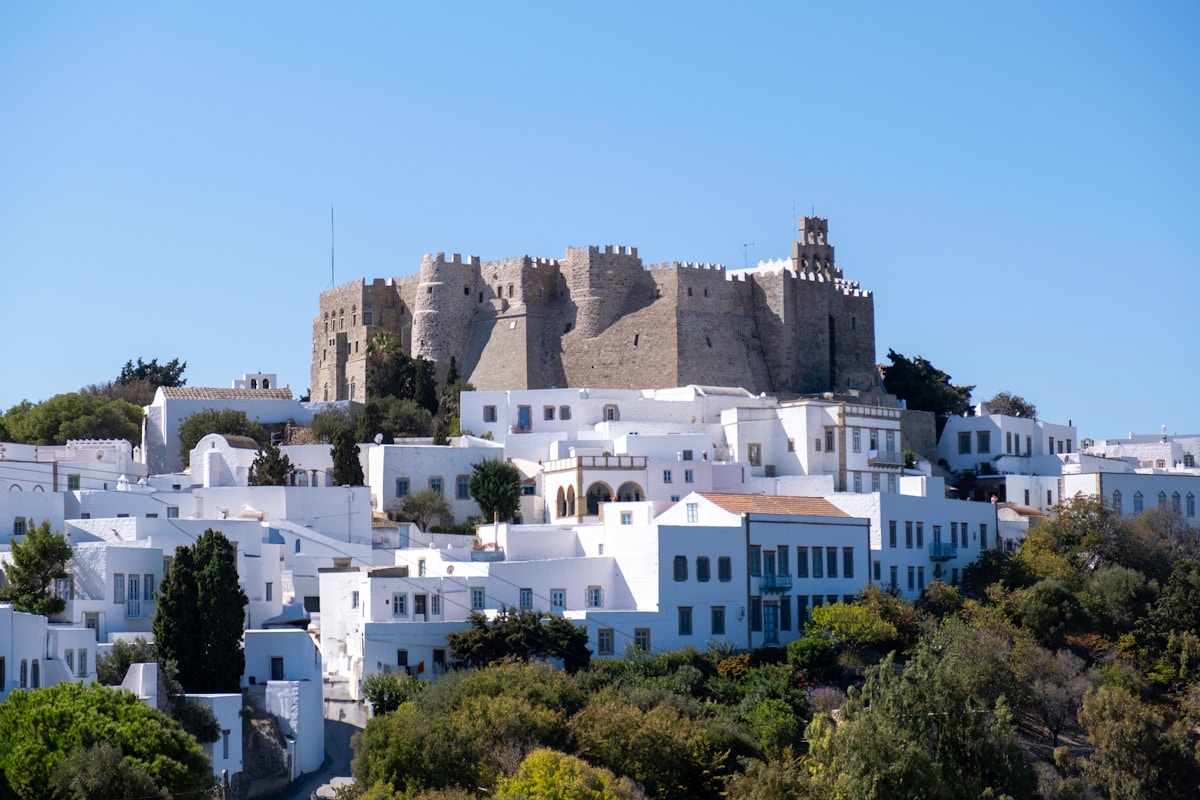
The monastery at the top of the hill is one of the most important Byzantine monuments in the world. Founded in 1088 by the monk Christodoulos, it looks from a distance like a medieval fortress - high walls and towers built for defence against piracy. Inside the walls is a complex of courtyards, churches, and buildings that have accumulated over 900 years.
The main church (catholicon) is covered in 12th-century frescoes, many well-preserved. The monastery treasury is the main draw for art historians - it holds 330 manuscripts (including the full 6th-century Gospel of St Mark), thousands of Byzantine coins, and ecclesiastical treasures spanning ten centuries.
Entry: approximately €5 for the museum; the church and courtyard are free. Open Monday–Saturday approximately 8am–1:30pm; additional afternoon opening on some days. Photography is not permitted in the church or museum. The views from the outer walls down to Skala and across the Dodecanese are extraordinary.
Both the monastery and the cave are designated UNESCO World Heritage Sites (listed 1999, along with the historic centre of Chora).
Chora
The white-walled village below the monastery is one of the most architecturally consistent settlements in Greece. Chora developed under the monastery’s protection and was designed to make navigation difficult for pirates - the lanes are labyrinthine, often covered by the second-floor overhangs of adjacent houses, with dead ends and false turns. Most of the significant mansions date from the 17th and 18th centuries when Patmos was a prosperous centre for trade and education.
Walking through Chora is the main pleasure - no specific sites to tick off, just lanes, doorways, cats on walls, and the occasional glimpse of the sea between houses. The main plateia has two cafés and a good restaurant. In the evening, Chora is quiet and beautiful; the monastery is lit from below and the village has a medieval atmosphere that is unlike anywhere else in the Aegean.
A handful of notable family mansions have been restored and converted to private accommodation or boutique hotels.
Skala
The port of Patmos and the main commercial centre. Skala has most of the island’s restaurants, shops, and mid-range hotels. The waterfront is pleasant in the early morning and evening; at midday in summer it can feel busy when cruise ships tender passengers ashore. The quayside cafés are good for watching the ferry traffic.
Skala has a small Archaeological Museum (open Tuesday–Sunday approximately 8am–2pm, free) with finds from the island’s ancient pre-Christian period, including ceramics from the site of the ancient city (Kasteli hill).
Beaches
Patmos is not primarily a beach island, but the swimming is excellent.
Psili Ammos: The finest beach on the island - a long stretch of very fine golden sand on the south coast, accessible by boat (from Skala, approximately 20–25 minutes, approximately €8–12 per person return) or by a 45-minute walk. No road access. A seasonal taverna operates from approximately June to September. The water is exceptionally clear and the beach doesn’t feel overcrowded even in summer because access is controlled by the boat trip.
Lambi: Pebble beach on the north coast, famous for its multicoloured pebbles - smooth, polished, and in a range of grey, green, and pink tones. Accessible by car (30 minutes from Skala). A simple taverna at the beach. The pebbles are protected - taking them is illegal.
Kambos: The main family beach, on the north-east coast, with a mix of sand and pebble, sun loungers, beach bar, and calm shallow water. Accessible by bus or car. The largest settled beach area on the island.
Grikos: Sheltered bay on the east coast with a mix of sand and pebble. Several tavernas and water sports. More development here than other beaches. Good for families.
Atmosphere and Visitor Profile
Patmos has deliberately maintained a different atmosphere from most Greek island destinations. There are no nightclubs and the bar scene is very limited - by informal agreement among local businesses and the municipality, loud music venues are not welcome. This, combined with the UNESCO status and the pilgrimage profile, has attracted a yacht crowd, educated independent travellers, and Greek intellectuals and artists rather than the party-holiday demographic.
The result is an island that is calm, beautiful, and slightly expensive by Greek standards. The best accommodation is boutique rather than resort-style; the best restaurants serve serious food. It’s not cheap, but it’s not trying to be Mykonos.
Getting to Patmos
Overnight ferry from Piraeus: The most common approach - ferries (Blue Star, Anek) depart Piraeus in the late afternoon and arrive at Skala the following morning. Journey time approximately 8–9 hours, from approximately €40 deck class or €80–120 for a cabin. The overnight is efficient as it doesn’t use a day of your holiday.
Via Kos: Fly to Kos (from Athens approximately 50 minutes, from approximately €35) then take a Dodekanisos Seaways catamaran north to Patmos. Journey time approximately 2.5 hours, from approximately €30 one-way.
Via Samos: Samos has an airport with connections from Athens. Ferry from Pythagoreio (Samos) south to Patmos takes approximately 1.5–2 hours.
Where to Stay in Patmos
Skala (the port) is the most practical base with the ferry connections, the main tavernas, and bus access to Chora and the beaches. Chora (the hilltop village) is more atmospheric and closer to the Monastery of Saint John, though it requires transport to the port and beaches. Grikos Bay and Meloi Beach have quieter beachside options.
Budget (from approximately €60–85/night)
Pension Sydney in Skala is a clean and centrally located guesthouse in the port village, one of the most accessible budget options on an island that skews toward boutique and mid-range pricing. From approximately €65/night as of 2026.
Blue Bay Hotel in Skala offers a waterfront position at budget prices, with the advantage of easy walking access to the tavernas and ferry dock. Rooms are basic but well kept. From approximately €75/night as of 2026.
Guesthouses near Grikos Bay provide simple rooms close to the beach at prices below the Skala centre options. From approximately €65/night as of 2026.
Mid-range (from approximately €100–180/night)
Hotel Romeos in Skala is a comfortable mid-range hotel with a pool and well-equipped rooms. It works well as a base for visiting both the monastery (by bus to Chora) and the beaches. From approximately €125/night as of 2026.
Grikos Hotel at Grikos Bay is a beachside property with a relaxed atmosphere and direct access to the bay’s clear water. It suits visitors whose trip centres on swimming and quieter evenings rather than nightlife. From approximately €115/night as of 2026.
Villa Knossos in Skala offers apartment-style accommodation with a garden, suited to those planning a longer stay who want more space than a standard hotel room. From approximately €100/night as of 2026.
Luxury (from approximately €230/night)
Porto Scoutari at Meloi Beach is Patmos’s most prestigious luxury property, with a private beach, pool, and well-appointed suites in a secluded setting that reflects the island’s unhurried character. From approximately €350/night as of 2026.
Patmos Aktis Suites at Grikos Bay offers sea-view suites with private terraces, a pool, and a standard of finish appropriate for the island’s premium market. From approximately €240/night as of 2026.
Search hotels in Patmos, Greece on Booking.com
Where to Eat
Benetos (Sapsila Bay): One of the best restaurants in the Dodecanese, run by a Greek-American couple using produce from their own garden. Mediterranean-Greek fusion, exceptional quality. Book well ahead in summer. Approximately €45–65 per person.
Tzivaeri (Chora): Village taverna in Chora’s main plateia, reliable traditional cooking with good local wine. Open evenings. Approximately €22–35 per person.
Hilomodo (Skala): Good waterfront option with fresh seafood and mezedes. Popular with both visitors and returning ferry passengers. Approximately €25–40 per person.
Best Time to Visit
May to mid-June and September to early October. The cave and monastery are best visited in quieter months when crowds are small and the devotional atmosphere is intact. Easter on Patmos is considered one of the most moving Holy Week observances in Greece - the midnight Resurrection service at the monastery is attended by visitors from across the world, but accommodation must be booked a year in advance.
July and August are the busiest months; cruise ships and day visitors can make Skala feel crowded at midday. Patmos never reaches the extremes of Santorini or Mykonos, but the difference between June and August is notable.
Prices listed are approximate as of 2026 - verify current rates before booking.
Browse tours, monastery visits, and Dodecanese excursions with GetYourGuide.
Patmos is part of the Dodecanese chain - see our Kos travel guide and Rhodes travel guide for the other main islands in the group, both accessible by fast ferry. For a guide to another sacred Greek island, see our Delos guide (sacred island of Apollo, reachable from Mykonos). Planning your wider Greece trip? See best Greek islands, Greek island ferry guide, and Greek island hopping itinerary.
See Also
- Kos Travel Guide - the Dodecanese island with the best beaches, further south
- Rhodes Travel Guide - the main Dodecanese island with the medieval Old Town
- Symi Travel Guide - the beautiful harbour island on the Rhodes-to-Patmos route
- Delos Guide - the sacred island of Apollo, reachable from Mykonos
- Greek Island Hopping Guide - Patmos in a Dodecanese circuit
- Greek Island Ferry Guide - ferries from Piraeus and Kos to Patmos
- Best Greek Islands Guide - spiritual and quiet island alternatives
- Best Time to Visit Greece - Patmos is best in May, June, and September
Frequently Asked Questions
- Why is Patmos considered a sacred island?
- Patmos is where the Apostle John - believed to be the author of the Book of Revelation - was exiled by the Roman Emperor Domitian in around 95 AD. According to tradition, he wrote the Book of Revelation in a cave on the island (now called the Cave of the Apocalypse). The island became a place of Christian pilgrimage, and the Monastery of Saint John was founded in 1088 by the monk Christodoulos, who received the island as a gift from Byzantine Emperor Alexios I Komnenos. Both the monastery and the Cave of the Apocalypse are listed as UNESCO World Heritage Sites (1999).
- How do I get to Patmos from Athens?
- Ferry from Piraeus (Athens port): the journey takes approximately 7–9 hours on overnight ferries (from approximately €40 deck class). Faster day catamarans (Dodekanisos Seaways from Rhodes or Kos) take approximately 2.5–3 hours from Kos. There is no airport on Patmos - the nearest airports are Kos (approximately 2.5 hours by high-speed ferry) and Leros (approximately 1 hour). Many visitors fly to Kos or Rhodes and take the ferry north.
- What is the Cave of the Apocalypse?
- The Cave of the Apocalypse (Spilios tis Apokalypsis) is a natural grotto on the hillside between Skala (the port) and Chora. According to tradition, St John received the visions described in the Book of Revelation here. The cave has been incorporated into a monastery (the Holy Monastery of the Apocalypse) and is accessible to visitors. Inside, a silver halo marks the spot where John is said to have rested his head, and a crack in the rock is said to be where God's voice came through. Entry is free; dress code strictly enforced. Open daily except Monday mornings and certain feast days.
- Is Patmos only for religious visitors?
- No. The island attracts a broad mix of visitors, including a significant yacht and upmarket travel crowd. Patmos has a reputation for being calmer and more refined than many Greek islands - it has no loud bars or clubs (by local agreement), limited tourist infrastructure by Cycladic standards, and a village character that has been carefully maintained. The combination of UNESCO heritage, excellent swimming, beautiful Chora architecture, and calm atmosphere makes it appealing well beyond religious pilgrimage tourism.
- Can I visit both the monastery and the cave in one day?
- Yes. The Cave of the Apocalypse is approximately halfway between Skala and Chora on the main road - a 20-minute walk from either. The Monastery of Saint John is at the top, a further 15 minutes from the cave. Many visitors walk up from Skala, visit the cave and monastery, and walk or take the bus back down. Allow 1.5–2 hours total for a comfortable visit to both sites. The monastery museum has an important collection of Byzantine art and manuscripts.
Book an experience
Top experiences in Patmos
Explore the best tours and activities in Patmos, with instant confirmation and free cancellation on most bookings.