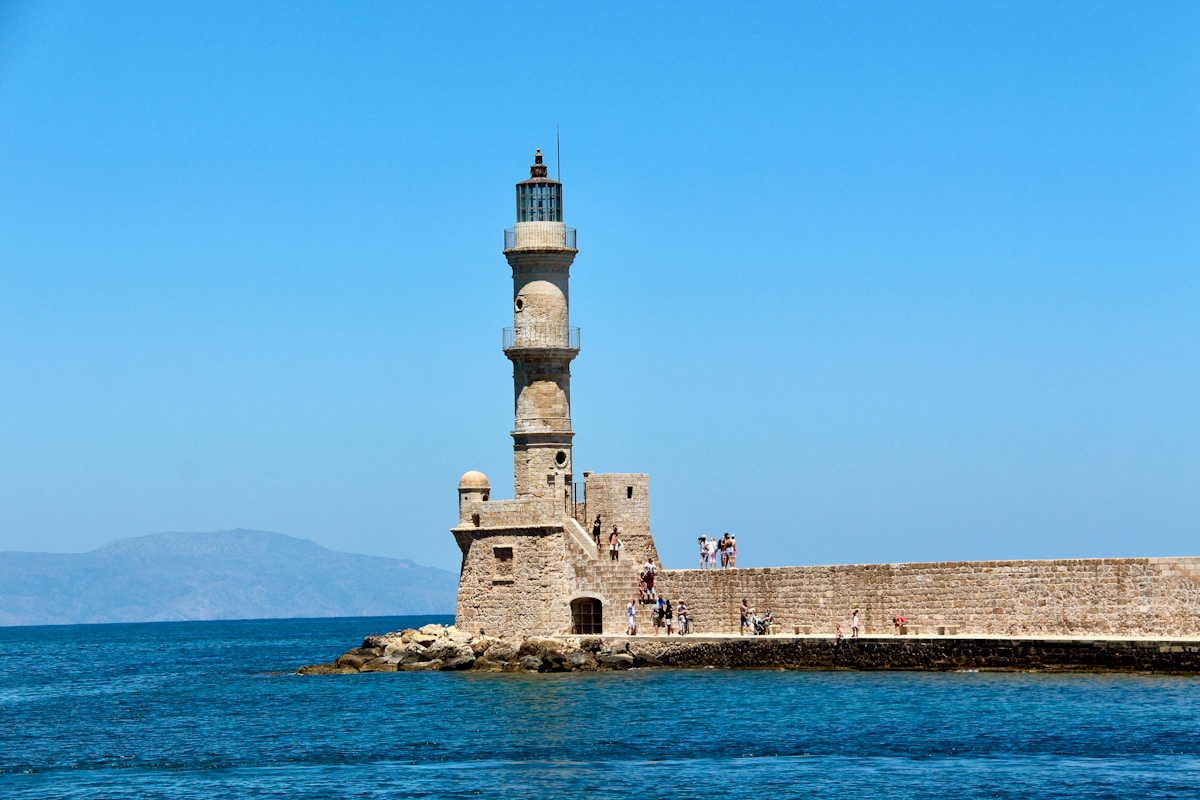
Chania’s position at the western end of Crete puts it within reach of some of the island’s most distinct landscapes and towns. To the east: Rethymno and Heraklion, with their Minoan sites and major museums. To the west: the far tip of Crete, with pink-sand beaches and Venetian fortresses accessible only by rough track or boat. To the south: the White Mountains, the Samaria Gorge, and the isolated Sfakia coast. Here is what is worth the journey from Chania, with transport details and timing for each. All prices are approximate as of 2026.
Top Day Trips at a Glance
| Destination | Distance | Price (from) | Transport | Highlights |
|---|---|---|---|---|
| Samaria Gorge | 43km | from EUR 25/person | Coach + ferry | Europe’s longest gorge, 16km descent, Libyan Sea beach |
| Balos Lagoon and Gramvousa | 55km | from EUR 22/person | Ferry from Kissamos | Turquoise lagoon, Venetian fortress island |
| Knossos and Heraklion | 140km | from EUR 50/person | Coach | Minoan palace (EUR 15 entry), Heraklion Museum (EUR 12) |
| Elafonisi Beach | 75km | from EUR 25/person | Coach | Pink-sand tidal island, shallow lagoon |
| Rethymno Old Town | 60km | from EUR 20/person | Coach | Venetian Fortezza (EUR 4), Ottoman old town, harbour |
Browse all Chania day trips → GetYourGuide
Samaria Gorge
Distance: 43km south of Chania | Time needed: Full day (8–9 hours total)
The Samaria Gorge - 16km long, up to 600m deep - descends from the Omalos plateau through a national park to the Libyan Sea beach at Agia Roumeli. It is the longest gorge in Europe and one of the most dramatic walks in Greece. The path drops 1,200 metres over the descent. The famous Iron Gates, where the gorge narrows to three metres wide, are in the lower section.
The gorge is open from approximately May to October, closing after heavy rain due to flash flood risk. Capacity limits apply in peak season - arrive at the start point early (the gates open at 6am).
How to get there independently: KTEL buses depart Chania bus station for Xyloskalo (the gorge entrance above Omalos) from 6am, with multiple services in summer. Cost approximately EUR 7.50 each way. The return circuit goes by ferry from Agia Roumeli to Hora Sfakion (approximately EUR 14) then KTEL bus from Hora Sfakion to Chania (approximately EUR 7). Total independent transport: approximately EUR 36.
Entry: Approximately EUR 5 per person (as of 2026), paid at the Xyloskalo entrance.
By tour: Full-day guided tours from Chania including transport both ways run approximately EUR 25–40 per person. The tour bus waits at Hora Sfakion for the walk to complete rather than running to a specific timetable - useful if your group includes slower walkers.
What to bring: Proper walking shoes with ankle support (the path is rocky), minimum 2 litres of water per person, sun protection, and snacks. There are limited water points in the upper gorge.
Balos Lagoon and Gramvousa
Distance: 55km west of Chania | Time needed: Full day
Balos is the most photographed beach in western Crete - a pale turquoise lagoon separated from the open Aegean by a narrow sandbar, with the ruined Venetian fortress of Gramvousa visible on the island across the water. The colour of the water is exceptional.
Two access options exist. The boat from Kissamos port (approximately EUR 22 return as of 2026, running June to October) takes about 1 hour each way and allows 3–4 hours at the lagoon. The overland route uses an 8km rough unpaved track from the main road near Kaliviani - a regular car can manage it slowly but the journey takes 45 minutes from the turn-off.
Gramvousa Island: The boat from Kissamos typically includes a stop at Gramvousa, where the 16th-century Venetian fortress sits 137m above the sea on a near-vertical cliff. It is accessible only by the ferry. The climb to the fortress takes 20 minutes from the landing point.
Crowds: July and August see large numbers at Balos. Early arrivals (before 10am) or September visits are significantly better.
Rethymno
Distance: 60km east of Chania | Time needed: Half day to full day
Rethymno has the best-preserved Ottoman and Venetian old town in Crete after Chania itself - arguably more compact and walkable. The Venetian Fortezza (fortress) dominates the headland above the harbour; its scale is striking from inside. The old town’s loggia, lighthouse, and minaret are within easy walking distance.
The city’s beach runs along the northern waterfront east of the harbour and is popular with families. The Rethymno Archaeological Museum (approximately EUR 4 as of 2026) has a well-displayed collection covering the Bronze Age to Roman periods, with strong Minoan material.
How to get there: KTEL buses run frequently between Chania and Rethymno (approximately 1.5 hours, EUR 8 each way). By car, the E75 motorway covers the 60km in about 50 minutes.
Fortezza entry: Approximately EUR 4 as of 2026. Open daily in summer.
Knossos and Heraklion
Distance: 140km east of Chania | Time needed: Full day
This is the longest but most historically significant day trip from Chania. The Palace of Knossos - the largest Bronze Age archaeological site on Crete - is 5km south of Heraklion city centre. The Heraklion Archaeological Museum in the city holds the definitive collection of Minoan artefacts including the bull-leaping fresco, the snake goddess figurines, and the Phaistos Disc.
The correct order is museum first (context), then Knossos (the site itself). Allow at least 2 hours for each.
How to get there: KTEL buses run from Chania to Heraklion every 30 minutes from early morning (approximately 2.5 hours, EUR 14 each way). From Heraklion bus station, take bus 2 to Knossos (approximately 20 minutes, EUR 1.70). By car, the E75 takes 2 hours.
Knossos entry: Approximately EUR 15 standard (as of 2026). Combined ticket with the Heraklion Museum is approximately EUR 20.
Heraklion Museum entry: Approximately EUR 12 as of 2026.
By guided tour: Full-day tours from Chania to Knossos and Heraklion run approximately EUR 50–70 per person. The guided interpretation at Knossos is valuable - the reconstructed frescoes and Evans’ controversial restorations require context to understand properly.
Elafonisi Beach
Distance: 75km southwest of Chania | Time needed: Half day minimum, full day recommended
Elafonisi is famous for its pink-tinged sand, shallow lagoon, and crystalline water. The beach is technically a tidal island connected to the mainland by a walkable sandbar at low tide. The combination of shallow water on the lagoon side and open sea waves on the other makes it one of the more versatile beaches on the island.
How to get there: KTEL seasonal buses run from Chania bus station (approximately 1.5 hours each way). By car, 1.5 hours via Paleochora. Day-trip coaches from Chania run approximately EUR 25–35 per person including transport.
Crowds: The busiest beach on Crete in July and August. Early June and September are the right times to visit with manageable crowds.
The Sfakia Coast
Distance: 75km south of Chania | Time needed: Full day
The Sfakia coast is the stretch of the Libyan Sea south of the White Mountains, accessible either by the mountain road to Hora Sfakion or by the ferry that connects coastal villages. Loutro is the most isolated - no road access at all, just a small village of white houses accessible by boat. Agia Roumeli is the end point of the Samaria Gorge walk (see above). Hora Sfakion itself is the ferry hub.
For a day without gorge-walking, the ferry from Hora Sfakion west to Loutro and back (approximately EUR 8 return as of 2026) gives you 3–4 hours in one of the quietest places on Crete - good swimming, one or two simple fish tavernas, and no cars.
How to get to Hora Sfakion: KTEL bus from Chania (approximately 1.5 hours, EUR 7.50 each way).
For guided day trips covering multiple destinations from Chania, see our Crete tours guide. For the full Chania city overview, read our Chania travel guide.
Book Crete tours and excursions with GetYourGuide. Compare car hire options in Greece - essential for exploring beyond the main towns. Pick up a Greece eSIM before you fly - keeps you connected without roaming charges.
Search hotels in Chania on Booking.com
See Also
- Chania Travel Guide - full city guide
- Things to Do in Chania - attractions and experiences within the city
- Best Restaurants in Chania - dining before or after your day trips
- Crete Travel Guide - the full island including east and west Crete
- Best Beaches in Crete - Balos and Elafonisi in context of the island’s best
- Best Tours in Crete - organised tours for Samaria Gorge and Balos
- Greece Hiking Guide - the Samaria Gorge in the context of Greek hiking
- Heraklion Travel Guide - combining Chania with Crete’s capital