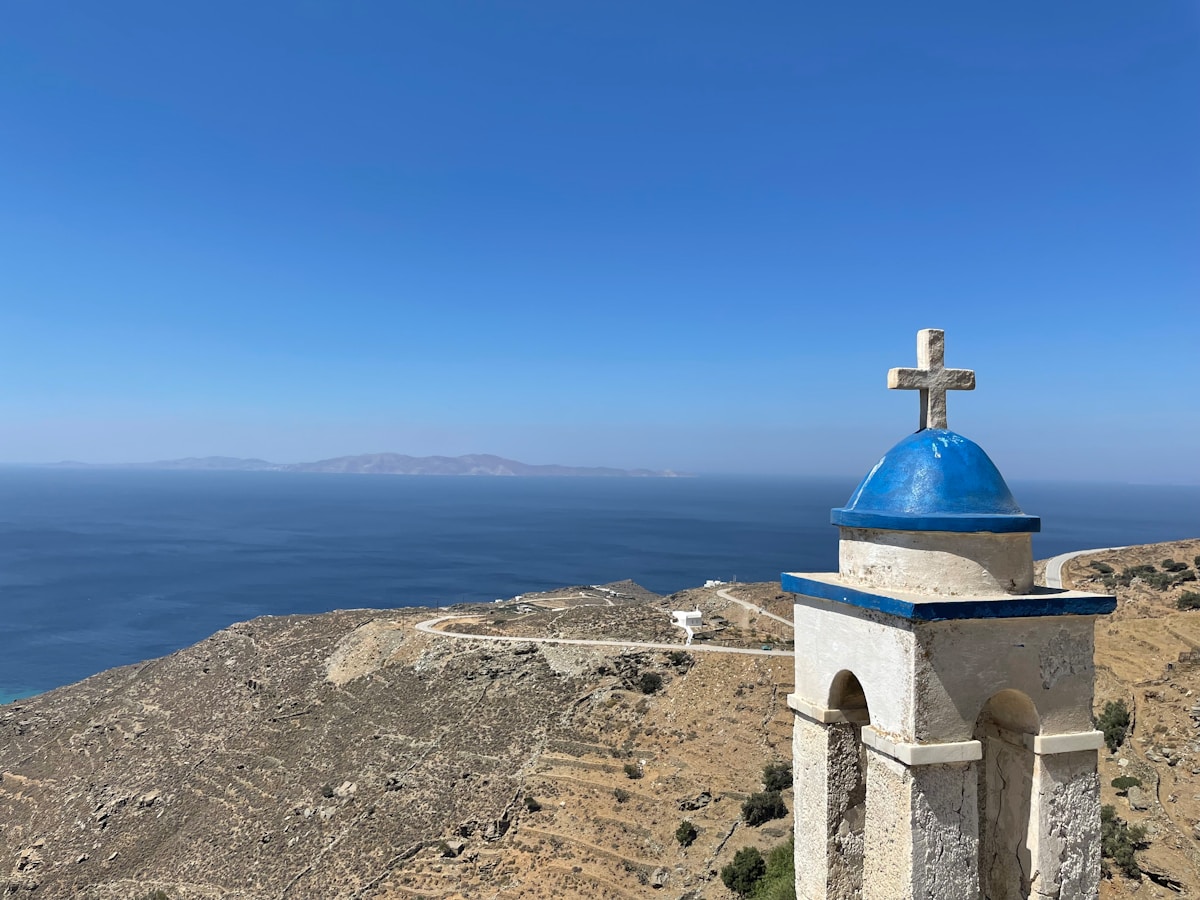
Tinos Travel Guide: Pilgrimage, Villages and Food
Guide to Tinos: pilgrimage church, marble villages, Venetian dovecotes, and an exceptional food scene. How Tinos differs from neighbouring Mykonos.
Guides for Tinos
Tinos is the most underrated island in the Cyclades. It sits in the middle of the island group, 15 minutes by ferry from Mykonos, and yet it is a completely different world: quieter, cheaper, more traditionally Greek, with better food and a cultural depth that its party-island neighbour doesn’t have. The reason it stays below the radar is partly its identity as a pilgrimage island - the Church of the Panagia Evangelistria draws hundreds of thousands of Greek Orthodox visitors each year, which tends to keep the backpacker and party-tourism demographics away, to the island’s benefit.
What remains is an island with marble-carving villages, 40 traditional dovecotes from the Venetian period, excellent local food and wine, and a landscape of terraced hills and quiet coves that has changed slowly.
Panagia Evangelistria
The centrepiece of Tinos Town and the most visited pilgrimage site in Greece. The Church of the Virgin Mary was built in 1823 over the site where an icon of the Annunciation was discovered following visions experienced by the Blessed Pelagia, a local nun. The icon is housed in an elaborate golden case in the lower church and is credited with miraculous healings.
The church itself is a grand neoclassical building at the top of a wide processional street (Megalocharis) paved in marble - pilgrims crawl this street on their knees on feast days. The treasury holds a remarkable collection of gold and silver votive offerings (tamata) given by those seeking or giving thanks for healing, including ship models, jewellery, and representations of body parts that were healed. Worth visiting even for non-religious visitors.
Entry is free. Dress code strictly enforced - shoulders and knees covered. Open daily; hours vary by season.
15 August: The Feast of the Dormition of the Virgin Mary is the largest pilgrimage day. The town becomes extraordinarily crowded, accommodation is fully booked months ahead. A remarkable cultural experience if you plan early; impossible to visit spontaneously.
Pyrgos and the Marble Tradition
Pyrgos, in the north of the island, is the centre of Tinos’s marble-carving tradition. The village has produced sculptors for centuries - most famously Yannoulis Halepas (1851–1938), whose expressionist marble work was revolutionary in Greek sculpture. His home is now a small museum. The Museum of Marble Crafts (run by the Piraeus Bank Foundation) is excellent - it documents the full process from quarrying to finished sculpture, with working demonstrations. Open Tuesday–Sunday, approximately €4 adult as of 2026.
Marble workshops line the main street of Pyrgos; you can watch craftsmen at work and buy directly. Quality ranges from tourist pieces to serious sculpture.
Pyrgos also has a village plateia with a good kafeneion and several traditional houses that give a sense of how the island looked before mass tourism reached the Cyclades.
Venetian Dovecotes
Tinos has approximately 40 traditional dovecotes (peristereones) scattered across the island, built during Venetian rule (1207–1715) as a source of fertiliser and food. They are distinctive multi-storey tower structures with intricately patterned stone walls - the decorative work was done to attract the doves, with no two patterns identical. The most concentrated cluster is in the area between Tinos Town and Arnados. Several are preserved and open to view, though none are in regular use today.
The dovecotes are one of the most distinctive visual elements of Tinos’s landscape - look for them on hillsides as you drive around the island.
Volax
An extraordinary village built among huge smooth granite boulders that look as if they were dropped there by a giant. The boulders are geologically distinct from the marble that defines the rest of the island’s landscape. Volax has about 30 permanent residents, a central plateia with an ancient tree, a small amphitheatre used for summer events, and several basket-weaving workshops that maintain a tradition older than the buildings. The village is accessible by car (narrow roads) or on foot from the surrounding trails. Very quiet and worth the detour.
Food Scene
Tinos has developed one of the best food scenes in the Cyclades, built on exceptionally good local produce: kopanisti (a sharp, pungent spreadable cheese), louza (air-dried cured pork), sun-dried capers, artisan olive oil, and a honey tradition that dates to the 18th century. These products have attracted serious chefs and attracted food-focused visitors who would previously have gone to Mykonos or Santorini.
Several restaurants now offer menus built entirely around local Tinian produce. The combination of good ingredients and increasingly sophisticated cooking has created something genuinely worth travelling for.
Beaches
Kolimbithra: Twin coves on the north coast, accessible by car. One sheltered bay, one open-sea bay. Good water, less crowded than south-coast beaches. A seasonal taverna operates at the main cove.
Porto (Agios Ioannis Porto): Long beach on the east coast, organized with sunbeds and beach bars. The largest and most popular beach on the island. Gets crowded in high summer but the beach is long enough to find space.
Pahia Ammos: East-coast beach, a mix of sand and fine pebble, good snorkelling. Less crowded than Porto.
Livada: Small quiet beach near Tinos Town, easy to reach by foot or taxi. Good for an evening swim.
Getting to Tinos
Ferry from Piraeus: Conventional ferry approximately 3.5–4.5 hours, from approximately €22 deck class. High-speed catamaran approximately 2.5 hours in summer, from approximately €45. Most services stop at Syros first.
From Mykonos: Fast catamaran approximately 15–20 minutes, from approximately €12 one-way. Easy day-trip connection, though Tinos deserves more than a day.
From Rafina: Alternative Athens-area port, similar journey time to Piraeus ferries. Rafina port is accessible from Athens airport directly (bus approximately 1 hour, approximately €3).
Where to Stay in Tinos
Tinos Town is the main base with the pilgrimage church, the ferry connections, and the widest range of accommodation and restaurants. The villages of the interior (Pyrgos, Volax, Kardiani) suit those with a hire car who want to explore the marble carving tradition and the dovecotes. The north coast around Kolimbithra has beach-adjacent accommodation.
Budget (from approximately €65–90/night)
Tinos Habitat in Tinos Town offers good-value central rooms close to the pilgrimage church and the port. It is a clean and practical choice for those who want to minimise accommodation costs while exploring the island. From approximately €72/night as of 2026.
Porto Raphael Hotel near Porto Beach provides simple rooms close to a quiet beach on the east coast at prices below the town centre properties. From approximately €75/night as of 2026.
Budget rooms in Tinos Town near the harbour are available from various owners, offering basic accommodation within walking distance of the church, the market, and the evening restaurants. From approximately €68/night as of 2026.
Mid-range (from approximately €100–170/night)
Tinos Eco Lodges in Tarampados are restored stone houses in an inland village that provide the most characterful mid-range accommodation on the island. The Cycladic stone architecture and the village setting make them a genuinely different experience from the town hotels. From approximately €145/night as of 2026.
Alonia Hotel at Kolimbithra on the north coast is a good family option close to the island’s most popular beach, with comfortable rooms and a relaxed atmosphere. From approximately €115/night as of 2026.
Kavos Boutique Hotel near Agios Ioannis has an infinity pool with sea views and well-appointed rooms at a price point that reflects the quality of the setting. From approximately €165/night as of 2026.
Luxury (from approximately €250/night)
Cosme Hotel on the Tinos Town outskirts is a contemporary design hotel with a pool and suites that represent the island’s most complete luxury offering. It opened relatively recently and brings a level of finish to Tinos that was previously absent. From approximately €360/night as of 2026.
Domus Renier in Tinos Town is a luxury property in a historic building with well-appointed rooms and a central location near the pilgrimage church. From approximately €260/night as of 2026.
Search hotels in Tinos on Booking.com
Where to Eat
Marathia (Tinos Town): One of the most celebrated restaurants on the island - a small space serving food built entirely on Tinian produce. Tasting menu style with local cheeses, louza, and seasonal vegetables. Book ahead. Approximately €45–65 per person.
Thalassaki (Ormos Isternion Bay): Excellent seafood in a remote bay on the north coast. Worth the drive. Fresh catch daily, simple preparation. Approximately €28–42 per person.
Symposion (Tinos Town): Long-running café-restaurant near the pilgrimage church, good traditional lunch dishes including local cheese and louza platters. Approximately €18–28 per person.
Best Time to Visit
May to mid-June and September for most visitors. The weather is good, the food and accommodation scene is running, and the island is not at capacity. Avoid 15 August (Dormition Day) unless you specifically want the pilgrimage experience - it’s the single busiest day in the Greek island calendar. July and August are busy but manageable - Tinos never reaches Mykonos-level crowding.
Prices listed are approximate as of 2026 - verify current rates before booking.
Browse tours and activities on Tinos and throughout the Cyclades with GetYourGuide.
Tinos sits between Mykonos (30 minutes by ferry, famous for beaches and nightlife) and Syros (the administrative capital of the Cyclades). For the broader Cyclades context and island-hopping itineraries, see our Cyclades overview and Greek island hopping itinerary. For Greek food culture rooted in island traditions, see our Greek food guide. Planning your trip? See best time to visit Greece.
See Also
- Mykonos Travel Guide - the famous island 30 minutes south by ferry
- Cyclades Guide - the full Cyclades overview with all islands covered
- Folegandros Travel Guide - another quiet Cycladic alternative
- Sifnos Travel Guide - the gourmet western Cyclades island
- Greek Food Guide - Tinos is one of the great food islands of Greece
- Greek Island Hopping Guide - building a Cyclades circuit that includes Tinos
- Greek Island Ferry Guide - ferries from Piraeus, Mykonos, and Rafina to Tinos
- Best Greek Islands Guide - authentic alternatives to the tourist trail
- Best Time to Visit Greece - Tinos is excellent in late spring and early autumn
Frequently Asked Questions
- How is Tinos different from Mykonos?
- Tinos and Mykonos are 15 minutes apart by ferry but feel like different worlds. Mykonos is built on nightlife, luxury hotels, and high-end tourism. Tinos is a pilgrimage island with a deeply Catholic (Frankish-era Venetian) and Orthodox population, a village marble-carving tradition, and a food scene that is increasingly recognised as among the best in the Cyclades. It has no significant club scene and the accommodation leans toward boutique and mid-range. It's quieter, cheaper, and far more authentically Greek.
- What is the Panagia Evangelistria?
- The Church of the Virgin Mary (Panagia Evangelistria) in Tinos Town is the most important Orthodox pilgrimage site in Greece. It houses the icon of the Annunciation, discovered in 1823 following a series of visions by a local nun. Every year on 15 August (the Dormition of the Virgin Mary) tens of thousands of pilgrims travel to Tinos, many crawling on their knees from the harbour up the marble-paved street to the church. The icon is said to have healing properties. The church itself is a grand 19th-century building with a renowned treasury of offerings.
- What are the marble villages of Tinos?
- Tinos has a centuries-old tradition of marble sculpting - the island's marble quarries supplied material for Cycladic figurines in the Bronze Age and continue to produce sculptors today. The main marble villages are Pyrgos (in the north) and Volax (a village built among giant granite boulders, with marble workshops). Pyrgos has a Museum of Marble Crafts and a gallery of the sculptor Yannoulis Halepas. The craftsmanship ranges from traditional grave markers and decorative screens to contemporary sculpture.
- How do I get to Tinos?
- Ferry from Piraeus (Athens port): approximately 3.5–4.5 hours on conventional ferry (from approximately €22 deck class) or approximately 2.5 hours by high-speed catamaran in summer (from approximately €45). Most ferries stop at Syros first, adding 30–45 minutes. From Mykonos: a short fast ferry hop of approximately 15–20 minutes (from approximately €12). There's no airport on Tinos - the nearest is Mykonos.
- Is Tinos worth visiting for food?
- Very much so. Tinos has developed a food reputation that now attracts visitors specifically for eating. The island produces artisanal cheeses (louza - dried cured pork, and the spreadable kopanisti), excellent olive oil, sun-dried capers, and local wine. Several restaurants on the island are genuinely exceptional, and the combination of good local produce with a growing number of serious chefs has created a food scene that rivals any island in Greece. It's not a secret any more - book ahead in summer.
Book an experience
Top experiences in Tinos
Explore the best tours and activities in Tinos, with instant confirmation and free cancellation on most bookings.