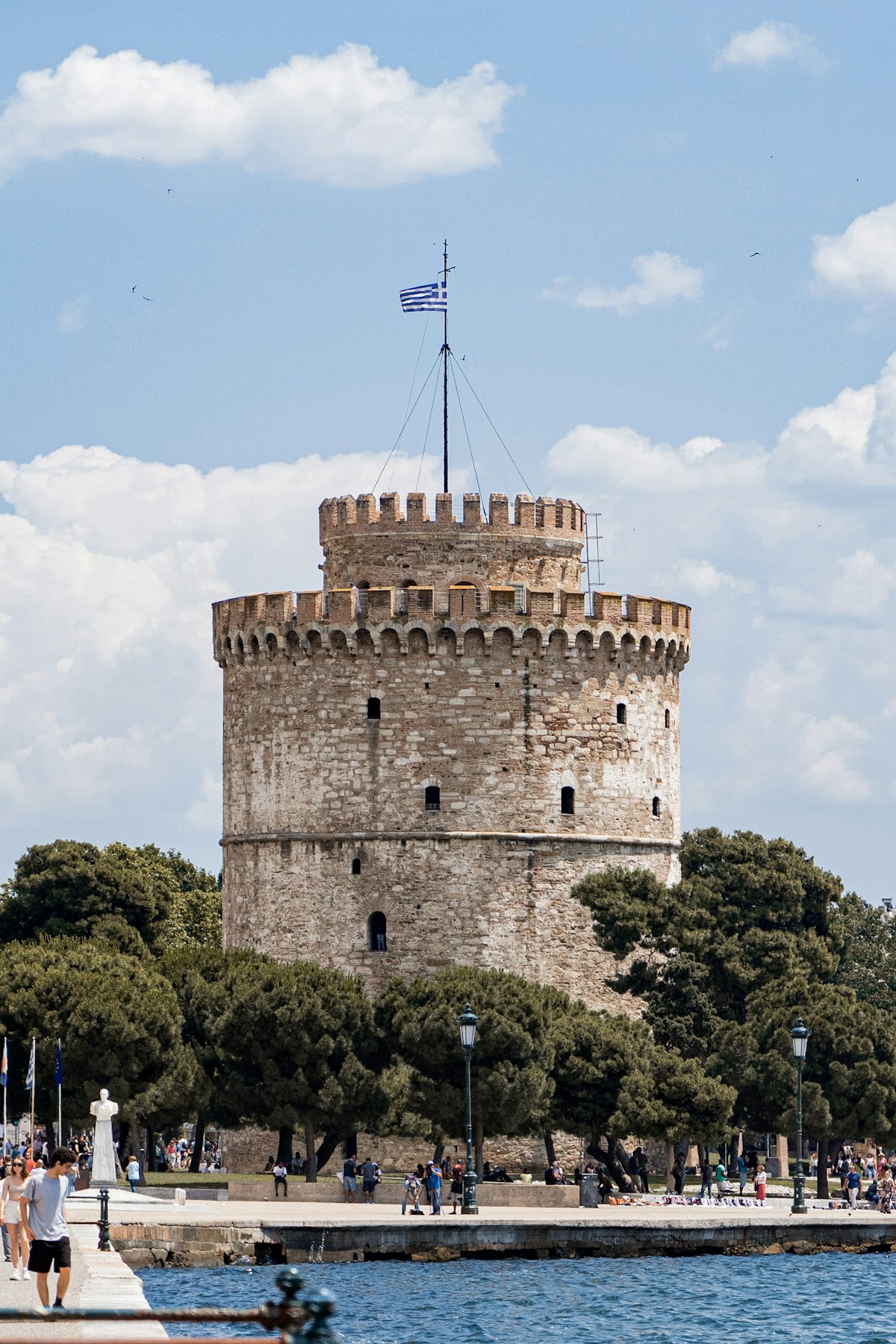
Thessaloniki is not a city you skim. Greece’s second city has been continuously inhabited for over 2,300 years, has the highest concentration of Byzantine churches outside Istanbul, and is widely regarded as the food capital of Greece. The Thermaic Gulf waterfront - 3km of promenade uninterrupted by cars - is the daily social artery of the city. Here are the twelve experiences that matter most, with practical details for each. All prices are approximate as of 2026.
Top Guided Tours in Thessaloniki
| Tour | Duration | Price (from) | Group Size | Highlights |
|---|---|---|---|---|
| Byzantine Thessaloniki Walking Tour | 3 hrs | from EUR 25/person | Small group | Rotunda, Arch of Galerius, Byzantine churches, Ano Poli |
| Thessaloniki Food Tour | 3.5 hrs | from EUR 40/person | Small group | Modiano Market, bougatsa, local meze, Ladadika district |
| White Tower + Archaeological Museum Tour | 4 hrs | from EUR 35/person | Small group | White Tower (EUR 4 entry), Archaeological Museum (EUR 12), Macedonian gold |
| Ano Poli and Old Town Walk | 2.5 hrs | from EUR 20/person | Small group | Ottoman quarter, Heptapyrgion, Byzantine walls, panoramic views |
Browse all Thessaloniki tours → GetYourGuide
White Tower (Lefkos Pyrgos)
The White Tower is the symbol of Thessaloniki - a 15th-century Ottoman fortification standing at the eastern end of the waterfront that has served as a citadel, prison, and massacre site before its current function as the city’s history museum. The tower is more compelling from inside than it appears from outside: six floors of exhibits trace Thessaloniki’s Byzantine and Ottoman history, with surviving mosaics, coins, maps, and documentation of the 1917 fire that destroyed most of the city’s pre-modern fabric.
Entry: Approximately EUR 4 standard, EUR 2 reduced (as of 2026).
Opening hours: Tuesday to Sunday 8am–8pm in summer (May–October), 9am–4pm in winter (November–April). Closed Mondays.
Practical tip: The sixth-floor panorama gives the best overview of the waterfront layout and the city’s relationship with the Thermaic Gulf. On a clear day you can see Mount Olympus across the water.
Aristotelous Square
Aristotelous Square is the formal centre of Thessaloniki - a broad neoclassical square facing the waterfront, designed by French architect Ernest Hébrard after the 1917 fire. The colonnaded buildings, the view down to the sea, and the evening promenade crowd make it the most theatrical public space in the city.
The square isn’t a sightseeing destination in itself - it’s more useful as a base point, an orientation anchor, and the meeting place of choice for Thessalonikians before they head elsewhere. The cafes on the arcaded ground floor charge central-square prices; the real coffee culture is on the side streets north of the square.
Cost: Free. Coffee at a square cafe approximately EUR 3.50–5 (as of 2026).
Rotunda (Church of Agios Georgios)
The Rotunda is a Roman domed building erected around 306 AD by Emperor Galerius - originally intended as an imperial mausoleum but never used as such. Over 1,700 years it was converted to a church, then a mosque (its minaret survives), and is now a UNESCO World Heritage monument with spectacular late Roman and early Byzantine mosaic fragments on its interior dome.
The mosaics, dating from the 4th and 5th centuries, are among the most significant early Christian artworks in existence. The building’s scale - 24.5 metres in diameter, with walls 6 metres thick - is also simply impressive as architecture.
Entry: Approximately EUR 6 as of 2026.
Opening hours: Tuesday to Sunday 8am–8pm in summer. Located on Galerius Street near the Arch of Galerius (Kamara), also worth viewing - free, accessible at all hours.
Archaeological Museum of Thessaloniki
The Archaeological Museum holds the objects from the royal Macedonian tombs at Vergina (Aigai), which was the original capital of the Macedonian kingdom before Pella. The centrepiece is the gold larnax (burial casket) found in the main tomb at Vergina - almost certainly containing the cremated remains of Philip II of Macedon, father of Alexander the Great.
The collection extends well beyond the Vergina material: Bronze Age finds from the region, Greek and Roman sculpture, gold jewellery from across Macedonia, and the Derveni Krater (a 4th-century BC bronze ceremonial vessel, one of the most technically accomplished objects to survive from antiquity).
Entry: Approximately EUR 12 as of 2026. Budget at least two hours.
Opening hours: Tuesday to Sunday 8:30am–8pm in summer, 9am–4pm in winter. Closed Mondays.
Location: Manolis Andronikos Street, a 10-minute walk east of Aristotelous Square.
Ano Poli (Upper Town)
Ano Poli is the Ottoman hilltop quarter above the modern city - the one part of Thessaloniki to survive the catastrophic 1917 fire largely intact. Walking through Ano Poli is a genuine encounter with the pre-fire city: wooden-balconied houses on steep cobbled lanes, Ottoman-era fountains, Byzantine churches still in use, and the massive Byzantine land walls that once enclosed the entire city.
The Heptapyrgion (Seven Towers) fortress at the top of Ano Poli was used as a prison until 1989 and is now open as a museum (entry approximately EUR 4 as of 2026). The views from the walls over the city and the Thermaic Gulf are the best in Thessaloniki.
Getting there: Walk from Navarinou Square (20 minutes uphill) or take bus 23 from Kamara. The neighbourhood is best explored on foot - the streets are too narrow and steep for comfortable driving.
Cost: Free to walk; Heptapyrgion approximately EUR 4.
The Waterfront Promenade (Nikis Avenue)
Thessaloniki’s waterfront stretches 3km along Nikis Avenue from the port in the west to the Concert Hall in the east. Unlike most urban waterfronts, it’s genuinely pleasant at any hour: wide paved walkways, no barrier between the city and the sea, and a constant flow of locals jogging, cycling, walking dogs, and sitting on the stone benches watching container ships cross toward Mount Olympus.
The White Tower anchors the eastern section; the Culture Pier (Pier 1, the converted dock building that now houses concert and exhibition spaces) anchors the western end. The Alexander the Great equestrian statue at the east end of the main promenade is an obligatory reference point and a reliable indicator of tourist density.
Cost: Free. The best time is early morning or the hour before sunset.
Museum of Byzantine Culture
The Museum of Byzantine Culture, a five-minute walk from the Archaeological Museum, holds the most comprehensive Byzantine collection in Greece outside the Byzantine and Christian Museum in Athens. The permanent exhibition covers every major period from Early Christian to Late Byzantine, with frescoes, mosaics, textiles, icons, and funerary objects displayed in a purpose-built 1990s building of quiet architectural quality.
Entry: Approximately EUR 8 as of 2026.
Opening hours: Tuesday to Sunday 8am–8pm in summer. Closed Mondays.
Worth knowing: The collection includes original fresco panels removed from threatened Byzantine churches in the broader Thessaloniki region - the context they provide for the city’s churches makes a visit here useful before exploring Ano Poli’s church network.
Ladadika District
Ladadika was the oil and spice warehouse district of Ottoman Thessaloniki, built in the late 19th century near the port. The 1917 fire spared this corner of the city, and the stone buildings were restored in the 1990s into what is now the densest concentration of restaurants and bars in Thessaloniki.
During the day, Ladadika is worth a walk for the architecture - compact stone buildings on a tight street grid, with a few remnants of the original wholesale market function visible in the signage and facade details. The neighbourhood’s character changes completely in the evenings, particularly Thursday to Saturday, when the streets fill with local Thessalonikians eating, drinking, and listening to live music.
Location: Behind the port, 15 minutes’ walk west of Aristotelous Square.
Budget: Dinner with wine approximately EUR 25–40 per person depending on venue.
Modiano and Kapani Markets
The Modiano Market is a covered market in the city centre, built in the 1920s, that still operates as a food market selling fish, meat, cheese, spices, and local produce. The surrounding streets (particularly Ermou Street east of the market) extend the market function into a network of stalls and small shops that gives central Thessaloniki much of its ground-floor character.
Adjacent to Modiano is the Kapani Market (Agoras Street), a slightly older, more chaotic version of the same thing - fishmongers, butchers, and produce stalls that have been in the same locations for decades. Both markets are at full activity between 7am and 2pm.
Cost: Free to browse. The Modiano building itself is worth entering for the architecture even if you don’t buy anything.
Church of Agios Dimitrios
Agios Dimitrios is the largest church in Greece and the principal Byzantine church of Thessaloniki, built on the site of a Roman bath where the city’s patron saint was martyred in 306 AD. The current structure dates largely from the 5th century, though it was rebuilt after the 1917 fire. The surviving mosaic panels - seven 5th-century mosaic fragments showing the saint and donors - are among the finest Early Christian works in the country.
The crypt beneath the church (accessible from inside) contains the foundations of the Roman bath and a small collection of early Christian objects. Entry to the church is free; a donation is customary.
Entry: Free. Crypt entry approximately EUR 2 (as of 2026).
Opening hours: Daily 8am–10pm, though hours vary. Best visited outside peak tourist periods for a quiet interior.
Thessaloniki Street Food
Thessaloniki has a distinct street food culture with several things worth seeking out:
Bougatsa: The most important thing to eat in Thessaloniki. A pastry of semolina cream (or cheese or meat) wrapped in thin phyllo dough and baked, then cut and served with powdered sugar and cinnamon. The two most celebrated bougatsa shops in the city are Bougatsa Bantis (Eleftherias Square, open 24 hours) and Bougatsa Giannis (near the Rotunda). Approximately EUR 2–2.50 per portion as of 2026.
Koulouri Thessalonikis: The Thessaloniki-style koulouri is fatter and more heavily seeded than the Athens version, sold from morning carts across the city. Approximately EUR 0.50 each.
Trigona Panoramatos: Honey-drenched pastry triangles from the Panorama neighbourhood above the city. Available at most Thessaloniki patisseries.
Thessaloniki Concert Hall and Culture Pier
For the city’s performing arts programme, the Thessaloniki Concert Hall (Megaron Mousikis) at the east end of the waterfront hosts the city’s classical music and opera season. The Culture Pier (Pier 1) in the port handles contemporary art exhibitions and cinema events.
Both venues post schedules online, and ticket prices vary widely - from approximately EUR 10 for smaller events to EUR 50+ for major orchestral performances.
For a full city orientation including where to stay and how to get around, read our Thessaloniki city guide. For guided tours covering the Byzantine and Ottoman highlights, see our Thessaloniki tours guide. For the best restaurants to fuel your sightseeing, see our Thessaloniki restaurant guide.
Book Thessaloniki tours and excursions with GetYourGuide. Pick up a Greece eSIM before you fly - keeps you connected without roaming charges.
Search hotels in Thessaloniki on Booking.com
See Also
- Thessaloniki Travel Guide - city overview with accommodation, transport, and the best neighbourhoods
- Best Restaurants in Thessaloniki - bougatsa at dawn, tavernas in Ladadika, and fine dining
- Day Trips from Thessaloniki - Vergina, Pella, Meteora, and Halkidiki
- Best Tours in Thessaloniki - guided Byzantine tours, food walks, and excursions
- Thessaloniki Food Guide - a neighbourhood-by-neighbourhood dining guide
- Halkidiki Travel Guide - the beach peninsula 75km south
- Athens vs Thessaloniki - comparing Greece’s two great cities