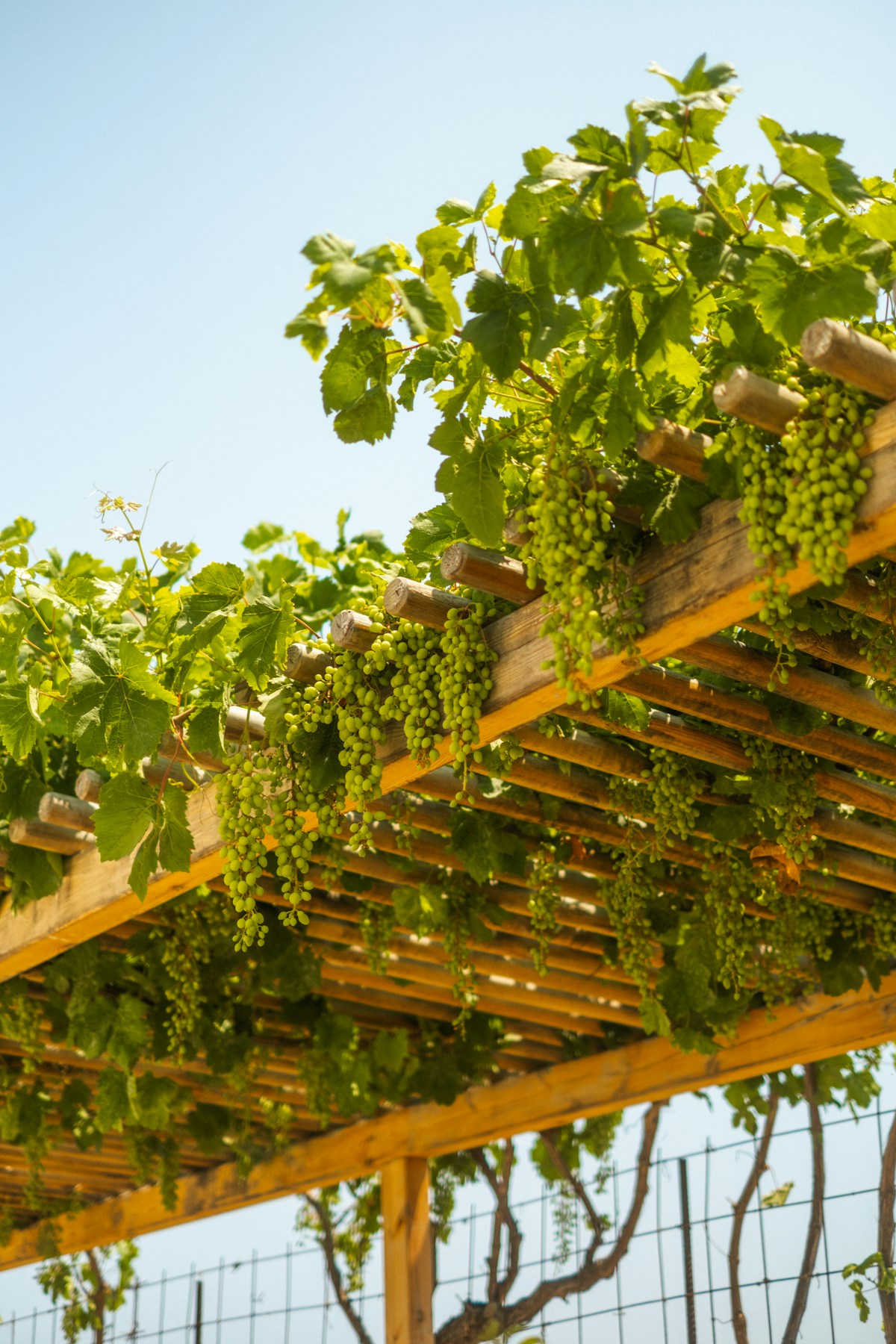
Greek wine is one of the oldest wine traditions in the world, and also one of the least understood outside Greece itself. The country grows more than 300 indigenous grape varieties, most of which exist nowhere else on earth. The result is a wine culture that rewards curiosity: the labels are unfamiliar, the grape names are unpronounceable at first glance, and the best bottles cost a fraction of equivalent wines from France or Italy.
This guide covers where the most important wines come from, what makes each region distinctive, how to read a label, and how to order wine in a Greek restaurant without defaulting to house red.
The Major Wine Regions
Santorini: Assyrtiko and Volcanic Whites
Santorini is Greece’s most globally recognised wine island, and Assyrtiko is the reason. The grape grows in basket-trained vines called kouloures, twisted low to the ground to protect against the strong Aegean winds. The volcanic soil (black pumice and ash from the island’s ancient eruption) gives the wine a distinctive mineral quality that is genuinely hard to replicate anywhere else.
Santorini Assyrtiko is bone dry with piercing acidity, citrus on the nose (lemon, grapefruit), and a persistent saline finish. Good examples from producers such as Sigalas, Hatzidakis, and Estate Argyros range from approximately EUR 15 to EUR 50 per bottle at retail, depending on whether the wine has seen oak. The basic entry-level Assyrtiko is delicious; the single-vineyard and barrel-fermented versions reward spending a little more.
The island also produces Nykteri, a higher-alcohol white traditionally made from Assyrtiko and two other indigenous varieties, and Vinsanto, a naturally sweet wine made from sun-dried grapes. Both are worth seeking out at a Santorini winery.
Naoussa: Xinomavro and Northern Reds
Naoussa, in the Imathia region of northern Greece (Macedonia), produces what many consider Greece’s finest red wine. The grape is Xinomavro, which translates roughly as “acid-black,” an accurate description. High tannins, high acidity, and low colour depth make Xinomavro look lighter in the glass than it tastes on the palate. The flavour profile runs toward tomato, olives, dried herbs, and leather, with good examples developing complexity over five to ten years of ageing.
Xinomavro also grows in Amyndeon (further northwest, at higher altitude) and Goumenissa, where it is blended with the local Negoska grape to produce a softer style. The Amyndeon appellation also produces sparkling Xinomavro that is worth trying if you encounter it.
Budget EUR 12 to EUR 25 for a solid Naoussa PDO from producers including Kir-Yianni, Thymiopoulos, and Boutari.
Nemea: Agiorgitiko and Peloponnese Reds
Nemea, in the northeastern Peloponnese, is planted almost entirely with Agiorgitiko (also known as St George). The grape produces red wines ranging from light and fruity at lower elevations to structured and age-worthy from the high-altitude vineyards above 600 metres, where the wines carry more acidity and firmer tannins.
Agiorgitiko is generally more approachable than Xinomavro. Think dark cherry, plum, and soft spice with moderate tannins. It pairs well with lamb dishes, grilled meats, and hard cheeses such as graviera. Nemea PDO wines from producers including Gaia, Skouras, and Palivos Estate start from around EUR 10 to EUR 18 per bottle.
Macedonia and Other Northern Regions
Beyond Naoussa and Amyndeon, Macedonia produces wines from a broader range of varieties. Muscat of Alexandroupoli, Malagousia (an aromatic white variety that nearly went extinct and was revived in the 1990s), and Limnio (one of the oldest documented grape varieties in the world) all grow in this region.
Malagousia deserves particular attention. It is a high-aromatic white with notes of citrus blossom, peach, and white pepper. It is gentler in acidity than Assyrtiko and less structured, which makes it a natural match for grilled vegetables, soft cheeses, and lighter seafood dishes. Expect to pay EUR 10 to EUR 20 per bottle from producers such as Domaine Gerovassiliou (who helped revive the variety).
Reading a Greek Wine Label
Greek wine labels follow EU designations:
PDO (OPAP/OPE in Greek): Protected Designation of Origin. The grape variety, geographic zone, and production method are all regulated. Santorini, Naoussa, Nemea, Mantineia, and Muscat of Samos are among the most important PDO appellations. When you see PDO on the label, you know the wine is from that specific region and meets production standards.
PGI (PGE in Greek): Protected Geographical Indication. A broader category allowing more flexibility. Many of the most interesting experimental and single-varietal wines from Greece carry a PGI designation because the winemakers are using grape varieties or production methods outside the strict PDO rules.
The vintage year is always worth noting. Assyrtiko is best drunk young (within three to five years) to preserve its acidity and freshness. Xinomavro from Naoussa rewards patience.
Ordering Wine in Greek Restaurants
Most traditional tavernas offer house wine by the carafe alongside a short list of bottled wines. The carafe is usually a local wine sourced informally from a nearby producer or cooperative. Ask the waiter where it comes from. In the islands you will often get an honest answer and an interesting story.
Carafes typically come in 500ml and one-litre sizes. A 500ml carafe starts from approximately EUR 6 as of 2026 in a standard taverna. In tourist areas on Santorini or Mykonos, the same carafe may cost EUR 10 to EUR 14. A bottled named wine from a Greek producer starts from about EUR 12 and runs to EUR 30 for mid-range selections. Fine wine from Naoussa or single-vineyard Assyrtiko will cost EUR 30 to EUR 60 at a good restaurant.
Retsina, the resin-flavoured wine that often provokes strong reactions, is worth trying once in context. It is made by adding pine resin during fermentation, a technique with roots in ancient winemaking. Served well chilled alongside fried fish or grilled octopus, it makes sense in a way it never does as a curiosity purchase from a wine shop.
Take a Guided Wine Tour in Greece
Greece’s wine regions are spread across terrain that most visitors never see - Santorini’s volcanic basket-woven vines, the Xinomavro vineyards on the slopes above Naoussa in Macedonia, the Assyrtiko producers of Drama near the Bulgarian border. Guided wine tours make these accessible in a way that reading about them doesn’t: a half-day visit to a Santorini winery includes walking the vineyard, understanding why the basket-trained vines survive without irrigation in a volcanic landscape with minimal rainfall, and tasting the range from young Assyrtiko through sun-dried Vinsanto. In northern Greece, wine tours from Thessaloniki cover the Naoussa and Amyndeon appellations in a day. For the wine-curious traveller, a structured tasting with a regional expert covers more ground in three hours than a restaurant wine list does in a week.
Browse Greek wine tours and vineyard tastings → GetYourGuide
Food Pairings
Greek wine and Greek food evolved together and the pairings work naturally:
Assyrtiko with grilled fish, octopus, shrimp saganaki, taramasalata, fried zucchini, or a simple feta and tomato salad. The acidity and saline quality complement any dish where olive oil and lemon are prominent.
Agiorgitiko with lamb chops, moussaka, pastitsio, or a cheese plate featuring aged graviera. The fruit-forward character bridges the gap between the richness of braised meat dishes and the salt of aged cheese.
Xinomavro with slow-cooked lamb, kokkinisto (braised meat in tomato sauce), or dishes from the northern Greek kitchen where the wine originates. The high acidity handles tomato-based sauces better than most full-bodied reds.
Malagousia with mezedes spreads, particularly dips, grilled vegetables, and soft white cheeses. It is an excellent introduction to Greek white wine for anyone who finds Assyrtiko too austere.
Retsina with fried fish, fried cheese, or anything heavily olive-oil dressed. Serve it very cold.
The simplest approach is to order local. If you are eating on Santorini, order Santorini wine. If you are in Thessaloniki, try a Xinomavro or a Malagousia from a Macedonian producer. Greek wine is designed to be drunk where it is grown.
Book Greek wine tours and vineyard tastings with GetYourGuide. Find hotels in Greece on Booking.com.