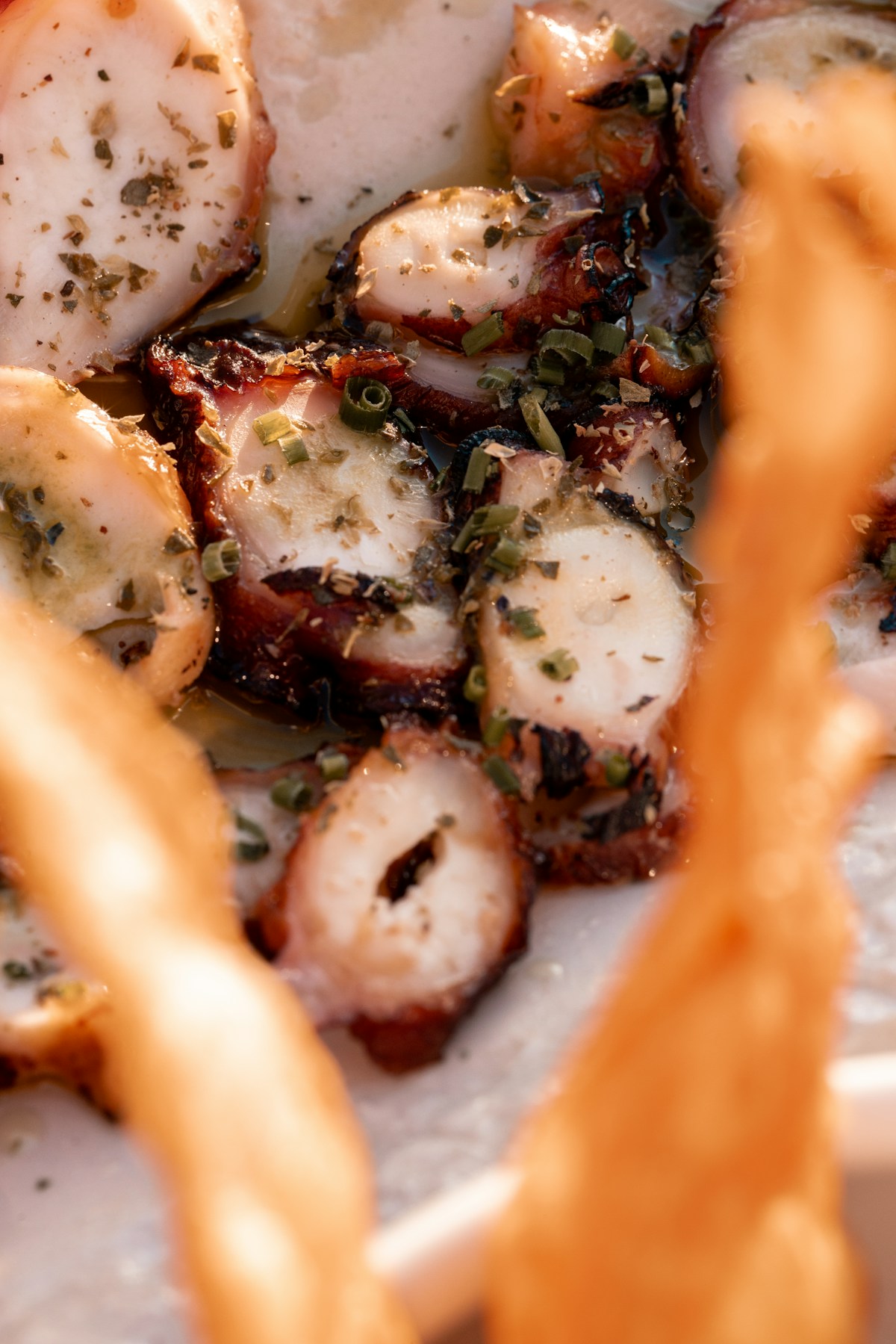
Seafood in Greece is not always cheap. Fresh whole fish charged by the kilo at a harbourside taverna can cost as much as a mid-range restaurant meal anywhere in Europe. What Greece offers instead is provenance, preparation, and setting that most European alternatives cannot match - octopus hung from a wire in the morning sun, fish grilled over charcoal minutes after it was swimming, lobster pasta served on a terrace with the fishing boats fifty metres away.
Understanding how the Greek fish taverna (psarotaverna) works changes how well you eat.
Fish Taverna Culture: How It Works
The psarotaverna is a specific type of restaurant, distinct from a general taverna in its specialisation. The best ones are located near harbours, operate on a short menu based on the morning’s catch, and price fresh fish by weight.
When you sit down, the waiter should come to the table relatively quickly and tell you what is available. The display of whole fresh fish - visible in a refrigerated case at the front of the restaurant or on ice on a platter the waiter brings to the table - is how the better tavernas communicate today’s catch. You choose the fish, they weigh it, tell you the price, and cook it.
The standard preparations are: grilled whole (stin schara), baked in the oven with olive oil and lemon (sto fourno), fried (tiganito) for smaller fish, and occasionally baked in a salt crust (sto alati) for special occasions. Almost always, the simplest preparation - grilled whole with good olive oil, lemon, and fresh herbs - is the right choice for fresh fish.
Seafood meze arrives before the main fish: grilled octopus, calamari, shrimp saganaki, fish roe taramasalata. These plates are priced separately and add significantly to the bill. Order selectively rather than accepting everything the waiter suggests.
The Essential Dishes
Grilled octopus (htapodi scharas) is the signature Greek seafood dish. The preparation matters more than almost any other variable - octopus that has been properly beaten, dried in the sun, and grilled over charcoal is genuinely one of the best things you can eat in Greece. Octopus that was frozen or skipped the drying step is noticeably inferior. The giveaway: good octopus caramelises at the edges, has visible charring, and the flesh inside is deep purple. EUR 12–18 per plate.
Fresh sea bream (tsipoura) and sea bass (lavraki) are the most common whole fish at Greek tavernas. Both are mild, white-fleshed fish that suit the simple Greek preparation - grilled and dressed with ladolemono (olive oil and lemon emulsion). A 400g fish serves one person and costs approximately EUR 18–30 depending on the island and taverna. The farmed versions (available everywhere) are noticeably blander than wild-caught. Ask specifically for psarolouro (wild caught).
Grilled calamari (kalamarakia scharas) is distinct from the fried version (kalamarakia tiganita) in that it requires fresh squid - frozen squid cannot hold together on a grill the way it can in a deep fryer. At a taverna with genuinely fresh squid, the grilled version shows it. At a tourist taverna using frozen, you will always see the fried version promoted. Order accordingly.
Red mullet (barbounia) is the fish many Greeks consider the finest local species. Small and intensely flavoured, it is almost always fried - the flesh is too delicate for the grill at small sizes. A portion of four or five fish costs EUR 14–22. The best red mullet come from the Aegean, particularly around the northern islands.
Lobster pasta (astakomakaronada) is not the most famous Greek seafood dish, but it may be the most satisfying. A whole lobster is split and cooked in tomato sauce with white wine and herbs, then combined with long pasta - spaghetti or linguine - in the sauce. Served on an enormous platter that technically feeds two but that one person will attempt to finish alone. EUR 40–65 per portion depending on lobster size and island. Order it for a special occasion.
Sea urchin (achinoi) is an acquired taste but worth trying once at the right place. Sea urchin is opened tableside and the orange roe is eaten raw with bread and lemon, or stirred through spaghetti with olive oil and capers. Naxos is the best island for fresh sea urchin. EUR 8–15 depending on portion size.
Best Islands for Seafood
Naxos offers the combination that works best: a local fishing fleet that sells directly to the harbourside tavernas, competitive pricing because the island has a large enough local population to keep tourist markup reasonable, and a tradition of fish tavernas in Naxos Town (Chora) that date back generations. The tavernas along the inner harbour - not the ones on the photogenic waterfront - are the best performers. Budget EUR 25–38 per person for a proper seafood meal.
Crete has the widest variety of seafood in the Aegean because of its position at the southernmost point of Greece and its size. The ports of Heraklion, Chania, and Rethymno all have dedicated fish taverna districts. The Venetian Harbour area of Chania has the most restaurants but also the highest tourist markup; the fishing harbour at Koum Kapi (east of Heraklion) has better value. Expect EUR 22–35 per person for fresh fish.
Rhodes has the advantage of being close to Turkish waters, where the fishing grounds produce a different mix of species than the Cyclades. The old town fishing harbour has several genuine psarotavernas; the beach resort strip at Faliraki is not where to look for serious seafood. Budget EUR 25–40 per person.
Sifnos is the small Cycladic island with the strongest food culture relative to its size. The fish tavernas at Kamares (the port) and Apollonia use local catch and have a reputation among Greek food writers that exceeds what the tourist market has discovered. EUR 25–35 per person.
Naxos sea urchin season runs from late winter through spring (February to April), when the roe is richest. If you are visiting outside this window, ask rather than assuming they are serving fresh local product.
Guided Seafood Tours and Fishing Experiences
The best way to eat seafood in Greece is with someone who knows the harbour - which boats came in that morning, which taverna buys from them, and what the fish is actually called on the boat versus what it’s called on the menu. Guided seafood tours in the major island destinations cover the morning fish market, a guided tasting of the main types of Aegean seafood with proper preparation and wine pairing, and sometimes a boat excursion to the fishing grounds. In Crete, Rhodes, and Athens, specialist operators offer market-to-table experiences that go from the fish counter at the central market to a full lunch. These are particularly useful for visitors who want to go beyond grilled octopus and understand the full depth of what the Aegean table offers.
Browse Greek seafood tours and fishing experiences → GetYourGuide
Ordering Tips
Ask the total weight price before they take the fish to cook it. This is normal practice and any good taverna expects it. The waiter weighs the fish at the display, tells you “this one is 450 grams, EUR 22” and you confirm before they proceed.
Order fewer meze plates than the waiter suggests. The standard pitch at a busy fish taverna is to start you with four or five meze plates before the fish arrives, which significantly increases the final bill. Two meze plates for two people - perhaps grilled octopus and a green salad - is enough.
Bring cash. Many harbourside psarotavernas in smaller ports and villages still do not accept cards, particularly in the Cycladic islands outside the major tourist hubs.
The best value moment to eat seafood in Greece is lunch rather than dinner. The same taverna, the same fish, often 15–20% less expensive at 1pm than at 8pm. The table next to you will probably be the fisherman who caught your meal.
Book seafood tours and fishing experiences in Greece with GetYourGuide across the Greek islands. Find hotels in Greece on Booking.com.