Monemvasia Travel Guide: The Medieval Rock Town of Laconia
Monemvasia guide: the car-free medieval rock town, upper fortress, how to get there from Athens, where to stay, eat and swim on the Laconian coast.
Guides for Monemvasia
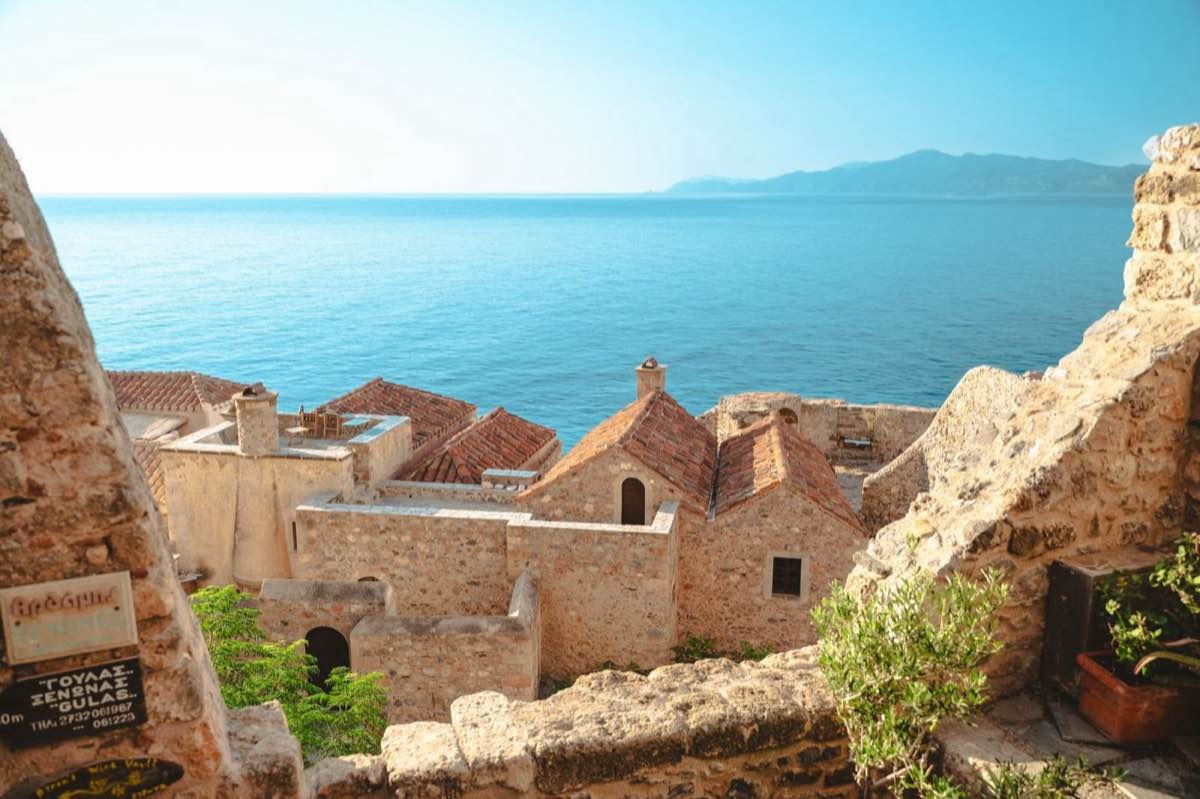
Monemvasia is a medieval fortified town built on a huge rock that sits just off the south-east coast of the Peloponnese. A short causeway links the rock to the mainland, and the only way in is through a single gate, which is where the name comes from (roughly “single entrance”). Inside the walls there are no cars: just stone lanes, small Byzantine churches, restored mansions and terraces that look straight out over the Myrtoan Sea. Above it, on the plateau of the rock, sits the ruined upper town and the cliff-edge church of Agia Sophia.
If you are building a route through southern Greece, it is one of the few places in the Peloponnese that rewards a night rather than a quick photo stop. Our Peloponnese travel guide shows how it fits with Sparta, Mystras and the Mani, and the Peloponnese road trip itinerary places it on a seven-day loop.
Quick facts
| Region | Laconia, south-east Peloponnese |
| Distance from Athens | Approximately 300km, 3.5 to 4 hours by car |
| Distance from Sparta | Approximately 100km, 1.5 hours |
| Best base | Lower town of the rock (atmosphere) or Gefyra on the mainland (beach and convenience) |
| Time needed | One night; two if you add the coast and Elafonisos |
| Best months | April to June and September to October |
A short history
The rock was an island until an earthquake in AD 375 is thought to have separated it from the mainland, and the settlement dates from the sixth century, when people from the surrounding area took refuge here. Under the Byzantines it became a major fortress and trading port, then passed between Franks, Byzantines, Venetians and Ottomans over the following centuries. It was famous for exporting Malvasia (Malmsey) wine across Europe, and the English word malmsey comes from the town’s name.
The poet Yannis Ritsos was born here in 1909, and the town appears in the work of several Greek writers. Today the lower town is a protected settlement, so building work is strictly controlled, which is why it still reads as a medieval town rather than a resort.
The lower town (Kato Poli)
After the gate, the main lane runs through the lower town to the central square. Here stands the church of Christ Elkomenos (Christ in Chains), a Byzantine church with a bell tower that is the town’s best-known landmark, and nearby is the Panagia Chrysafitissa. Small museums and workshops are dotted along the lanes, and several mansions have become guesthouses and restaurants with sea terraces.
Walk the lower town in the early morning or after about 6pm in summer. In the middle of the day the lanes fill with day trippers and the stone is hot. Allow 1.5 to 2 hours to wander, eat and look at the churches, and add time if you want to walk down to the sea platforms on the south side, where people swim from the rocks.
The upper town and Agia Sophia
A zigzag path climbs from the lower town to the plateau, roughly 20 to 30 minutes on foot. The upper town has traditionally been open access with no ticket, but confirm hours and any charge on arrival, as they can change. The plateau holds the ruins of the upper town, cisterns and fortifications, and the 12th-century church of Agia Sophia, which stands on the cliff edge with a long drop to the sea below.
Wear sturdy shoes and bring water, as there is almost no shade. Sunset is the best time for the views, but the path back down is uneven, so carry a small torch. We would allow 2 to 3 hours for the climb, the ruins and the descent.
Gefyra, beaches and the coast
Gefyra is the modern settlement on the mainland, at the foot of the causeway. It is where most cars, shops and the main restaurants are, and the area has small beaches within walking distance. Pori beach, a short drive away, has pebbles and clear water and is more relaxed than the rock itself. For longer beach days, the coast south toward Elafonisos (reached by a short ferry from Pounta) has some of the best sand in the Peloponnese.
Where to eat
Restaurants in the lower town tend to be small, seasonal and priced for visitors: expect approximately EUR 20 to 35 per person for a seafood or grill dinner with wine (as of 2026). Gefyra has more everyday tavernas at lower prices. Try local specialities such as lamb, citrus dishes, local honey and the sweet Malvasia wine that made the town famous. Our Greek wine guide explains the style.
Where to stay
The lower town has stone guesthouses and small hotels, many built into old mansions, with sea-view terraces. Rooms are limited and book out in summer, so reserve early. Gefyra has more apartments and family-run hotels and is easier if you have a car and want a beach. Prices rise sharply in July and August and around Greek Easter and the August 15 holiday. You can search hotels in Monemvasia to compare current availability and rates for your dates.
Getting there and around
- By car: The most practical option. Roads in Laconia are good but narrow near the coast, and the Sparta to Monemvasia route has tight bends, so avoid it after dark. Our Greece car rental guide covers hire basics, insurance and tolls.
- By bus: KTEL services connect Athens and Sparta with Molaoi and Monemvasia, but the schedule is thin outside summer. Check the timetable on the day.
- By transfer: A private transfer from Athens is expensive for this distance but works for a group.
- Parking: There is a car park at the causeway; leave the car there and walk. On busy days in August, expect to park further out.
How long to stay and what to combine
Many visitors do Monemvasia as an overnight between Mystras and the Mani. If you only have one night, arrive in the late afternoon, walk the lower town at dusk, climb to the upper town the next morning, and leave by about 11am before the heat. For longer stays, add the beaches of Pori and Elafonisos or the villages inland.
Combine it with Sparta and Mystras to the north-west, or continue to the Mani peninsula and Kalamata on the west coast. Our things to do in Monemvasia guide gives a stop-by-stop plan. You can also compare Monemvasia tours and day trips if you prefer a guided visit.
Practical tips
- Bring cash for small cafes and parking.
- Luggage can be heavy on cobbles, so pack light or ask your host for help.
- In midsummer, midday heat on the rock is intense; do the climb early or late.
- Official regional information is available from Visit Greece, and the Ministry of Culture lists archaeological sites at odysseus.culture.gov.gr.
- Prices in this guide are approximate and current as of 2026.
Frequently Asked Questions
- Is Monemvasia worth visiting?
- Yes. It is one of the best-preserved medieval fortified towns in Greece, with a car-free lower town of stone lanes, Byzantine churches and sea-facing terraces, plus a ruined upper town on the plateau above. It is far quieter than Nafplio or Mystras, especially after the day visitors leave, so an overnight stay is the best way to see it.
- How do I get to Monemvasia from Athens?
- By car it is approximately 300km and 3.5 to 4 hours via Corinth, Tripoli and Sparta or the coastal road through Molaoi. KTEL buses run from Athens Kifissos terminal, usually with a change at Sparta or Molaoi, and take around 5 to 6 hours. A car is far easier because services are limited outside summer.
- Can you drive into Monemvasia?
- No. The old town on the rock is closed to normal traffic. You park on the mainland side or at the car park near the causeway and walk the last stretch through the gate. Residents and hotel luggage vehicles have limited access, so ask your host about luggage before you arrive.
- Is Monemvasia a day trip or an overnight stay?
- It works as a day trip from Sparta or Gytheio, but we recommend one night. The rock is calmest early morning and in the evening, and the upper town takes 2 to 3 hours with the climb. If you stay in the lower town you also avoid the midday crowds.
- What is Monemvasia famous for?
- Its fortified rock island, joined to the mainland by a causeway, and its medieval history as a Byzantine and Venetian stronghold. The name roughly means single entrance. The sweet Malvasia wine, exported across Europe in the Middle Ages, takes its name from the town.
Book an experience
Top experiences in Monemvasia
Explore the best tours and activities in Monemvasia, with instant confirmation and free cancellation on most bookings.
Planning to visit?Browse hotels in Monemvasia, free cancellation on most bookings.