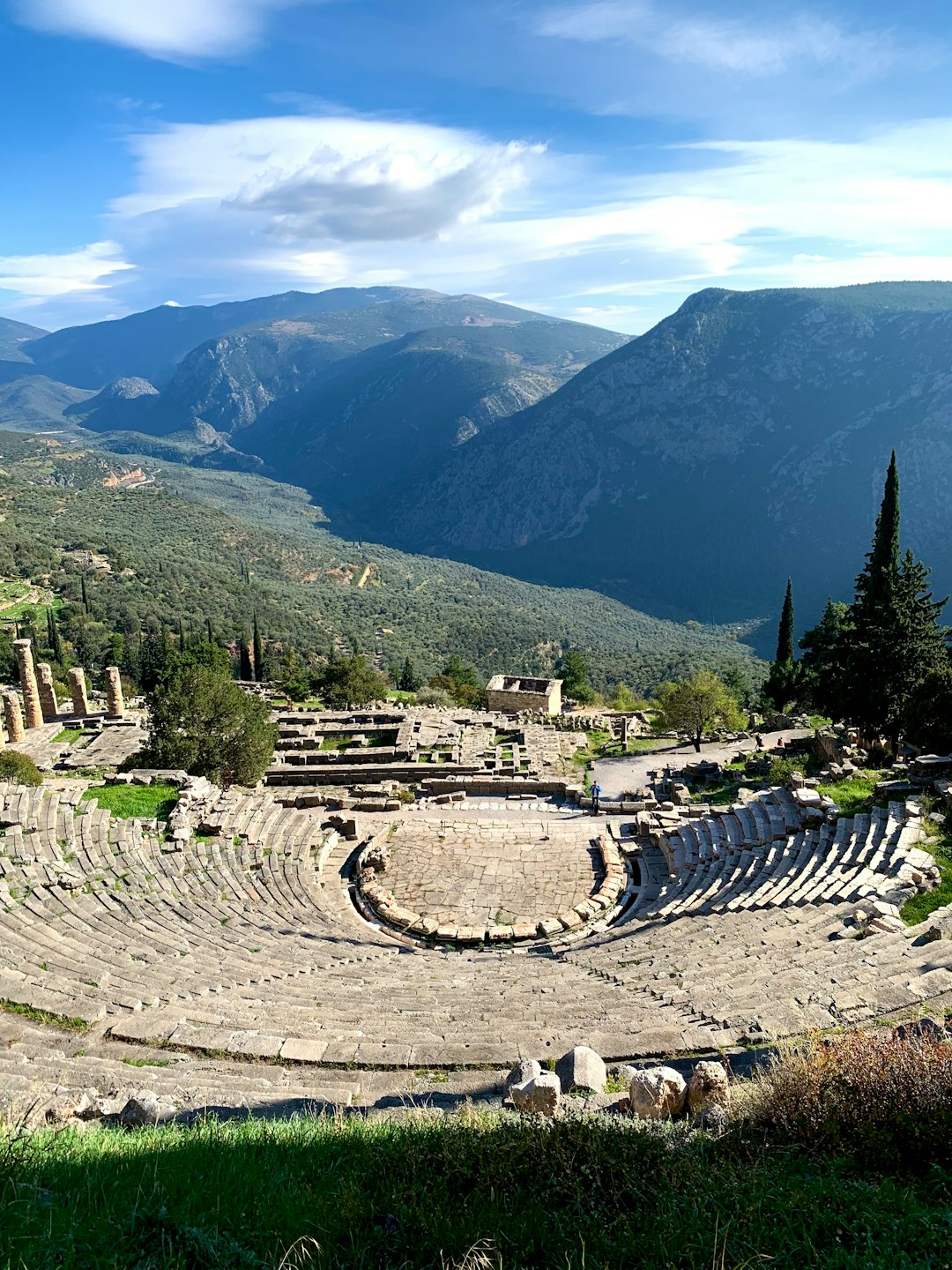
Delphi was, for approximately a thousand years, the most important religious site in the ancient Greek world. The Greeks considered it the centre of the earth - marked by a sacred stone called the omphalos, the navel - and the seat of the Oracle whose pronouncements shaped the decisions of city-states, kings, and generals across the Mediterranean. The sanctuary sits on the south slopes of Mount Parnassus at 570 metres above sea level, above a dramatic gorge filled with olive trees that stretches to the Gulf of Corinth 11km below.
Today Delphi is both a UNESCO World Heritage Site and a genuinely impressive physical place: the ruins are extensive, the museum is excellent, and the landscape justifies the journey on its own terms. Here is what to see and do, with entry fees and practical details. All prices are approximate as of 2026.
Top Tours at a Glance
| Tour | Duration | Price (from) | Group Size | Highlights |
|---|---|---|---|---|
| Delphi Full-Day Tour from Athens | 9 hrs | from €45 | Small group | Temple of Apollo, museum, Arachova stop, coach transport |
| Athens: Delphi & Arachova Day Trip with Entry Ticket | 9 hrs | from €55 | Up to 20 | Entry ticket included, English guide, Charioteer of Delphi |
| Athens: Mythology of Delphi Guided Tour | 10 hrs | from €60 | Small group | Ancient theatre, stadium climb, museum highlights |
| Delphi Private Full-Day Tour from Athens | 9 hrs | from €85 | Private | Private guide, flexible pace, all sites included |
Browse all Delphi tours → GetYourGuide
The Delphi Archaeological Site
The main sanctuary complex - officially the Sanctuary of Apollo - occupies a terraced hillside between the modern village of Delphi and the Phaedriades cliffs above. The Sacred Way (the processional path) winds uphill through the ruins from the entrance gate.
The Treasury of the Athenians: One of the best-preserved structures at Delphi, a small marble building constructed by Athens around 490 BCE to house offerings to Apollo after the Battle of Marathon. The reconstruction (completed in 1906) gives a good sense of how the sanctuary originally looked when dozens of similar treasuries lined the Sacred Way. The exterior walls are inscribed with ancient Greek musical notation - the Delphic Hymns, among the earliest surviving pieces of notated music in the world.
The Temple of Apollo: The centrepiece of the sanctuary and the location of the Oracle. The surviving columns (six of the original 38) mark the outline of the 4th-century BCE temple. Within the inner sanctum (adyton), the Pythia - the Oracle’s medium, a woman of no particular social standing - would inhale vapours from a fissure in the rock and deliver ambiguous pronouncements that priests then interpreted and sold to visitors. The geological fissure and the vapours (now identified as ethylene from fault-line outgassing) are not visible today, but the scale and setting of the temple remains striking.
The Ancient Theatre: Built in the 4th century BCE with seating for approximately 5,000, the theatre sits directly above the Temple of Apollo and is the finest viewpoint in the sanctuary complex. The tiered stone seating is largely intact; performances continue here on special occasions. From the top tier, the full extent of the site and the valley below is visible.
The Ancient Stadium: A 10-minute climb above the theatre on a narrowing path, the Delphi stadium is the best-preserved ancient stadium in Greece - 178 metres long, with original stone seating for approximately 6,500 on the north side. The starting line stone blocks, with the grooves for runners’ feet, are still in place. The Pythian Games - equivalent in prestige to the Olympic Games - were held here every four years.
Entry to the archaeological site: Approximately EUR 12 as of 2026 (combined ticket with the museum). Combined tickets are recommended.
Opening hours: Daily 8am–8pm (summer), 8am–3pm (winter). Hours vary by season - confirm before visiting.
Time needed: Allow 2–3 hours for the site alone. The climb to the stadium adds 30–45 minutes.
Delphi Archaeological Museum
Immediately adjacent to the main sanctuary entrance, the Delphi Museum is one of the finest archaeological museums in Greece - comparable in quality to Athens and Thessaloniki, and much smaller and more navigable. Everything on display was found at Delphi.
The Charioteer of Delphi: The museum’s centrepiece - a full-length bronze figure of a charioteer, cast around 478 BCE to commemorate a victory at the Pythian Games. It is one of the best-preserved examples of ancient Greek bronze sculpture anywhere in the world. The eyes (intact glass and stone inlays) give the figure an unsettling directness. Do not rush past it.
The Omphalos: The sacred stone marking the centre of the world - or rather, a Roman-era copy of the original. The carved rope-net pattern on its surface is highly distinctive.
The Sphinx of Naxos: A 2.2-metre sphinx (head of a woman, body of a lion, wings of an eagle) atop a 12-metre column, dedicated by the island of Naxos around 570 BCE. The scale of the assembled monument - sphinx plus column - is difficult to grasp from photographs; it dominated the sanctuary processional path.
Frieze panels: The Siphnian Treasury frieze (560 BCE) shows scenes from the Gigantomachy and the Trojan War with detailed individual figures. One of the finest examples of Archaic Greek sculpture.
Entry: Included in the combined ticket with the archaeological site (approximately EUR 12 as of 2026).
Opening hours: Same as the site.
The Sanctuary of Athena Pronaia (Marmaria)
Below the main Delphi site, 800 metres east along the road towards Arachova, is a second sanctuary complex dedicated to Athena Pronaia. Its most famous structure is the Tholos - a 4th-century BCE circular temple with three surviving Doric columns and a partial entablature, set on a circular platform against the Phaedriades cliffs. The Tholos is the most photographed structure at Delphi and appears on most official Delphi promotional imagery, though it is architecturally separate from the main Apollo sanctuary.
Entry: Included in the combined site ticket.
The Castalian Spring
Between the main sanctuary and the Marmaria complex, a small sanctuary around a natural spring was the location where all visitors to Delphi were required to purify themselves before entering the Oracle precinct. The Castalian Spring still flows; the carved niches in the rock wall where offerings were placed are visible. The setting - a narrow cleft in the cliff face - is evocative.
Entry: Free, accessible from the road.
Hiking on Mount Parnassus
Mount Parnassus rises to 2,457 metres above the Delphi sanctuary. The ski resort of Kelaria/Fterolakka (approximately 25km by road from Delphi) is the main winter destination; in summer the upper slopes are accessible for hiking through the Corycian Cave area and across the high plateau.
From Delphi itself, the path up to the Corycian Cave (a large cave sacred to Pan and the Nymphs in antiquity) takes approximately 3–4 hours return and rises through phrygana scrubland and pine forest. The cave is large enough to stand in. Guided hiking tours from Delphi run approximately EUR 30–50 per person.
For where to eat in Delphi and nearby Arachova, see our Delphi restaurants guide. To plan a visit that includes Delphi alongside Athens, see our day trips from Athens guide - Delphi is a common and practical Athens day trip. For a dedicated guide to the site itself, see our Ancient Delphi history guide.
Book Delphi tours and day trips with GetYourGuide. Pick up a Greece eSIM before you fly - keeps you connected without roaming charges.
Search hotels in Delphi, Greece on Booking.com
See Also
- Delphi Travel Guide - full overview with accommodation and getting there
- Best Restaurants Near Delphi - where to eat in the village and Arachova
- Day Trips from Delphi - Hosios Loukas, Galaxidi, and Arachova
- Ancient Delphi Guide - in-depth history of the oracle sanctuary
- Day Trips from Athens - Delphi as an Athens day trip
- Athens Travel Guide - the most common starting point for visiting Delphi
- Meteora Travel Guide - the other great mainland pilgrimage site
- 1-Week Greece Itinerary - fitting Delphi into a broader Greece trip