Greek culture is warm and generous, but it has unwritten rules that visitors often stumble over. Knowing them before you arrive prevents awkward moments at the Acropolis entrance, confusion over a taverna bill, or an unintentional insult in someone’s home.
Dress Codes
Religious Sites
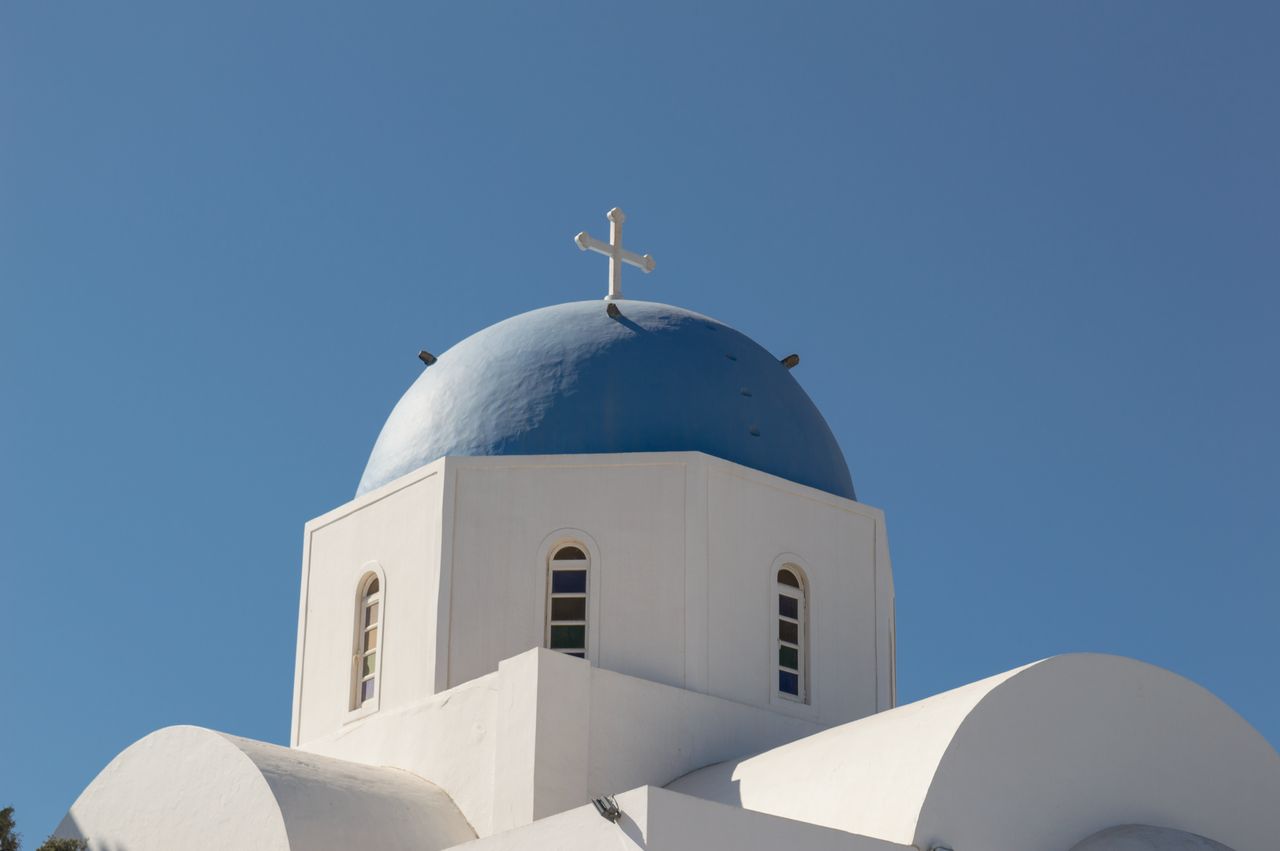
Greece has hundreds of active Orthodox churches and monasteries, and all expect modest dress. Covered shoulders and knees are required for both men and women before you enter. At the Meteora monasteries in Thessaly, the Monastery of the Apocalypse on Patmos, and Osios Loukas near Delphi, this is enforced at the gate. Wardens will turn you away or offer a wraparound skirt from a crate near the entrance.
Key rules:
- Shoulders must be covered. Sleeveless tops are not acceptable inside.
- Knees must be covered. Shorts are not permitted; long trousers or a skirt are required.
- Hats and sunglasses should come off on entering.
- At some Meteora monasteries, women in trousers rather than skirts may still be refused entry. Check the specific monastery’s website before visiting.
The dress code applies equally at tourist-facing sites and small village churches. If you are unsure whether a church is active, dress as if it is.
Beaches
Greek beaches are relaxed. Topless sunbathing is common on island beaches in Mykonos, Ios, and Paros. Designated nudist beaches exist on several islands, including Paradise Beach on Mykonos and a section of Elafonisi on Crete. Neither is considered offensive in the right setting.
That said, walking through a town or entering a shop in just a swimsuit is considered disrespectful. Cover up once you leave the sand.
Restaurants and Tavernas
There is no formal dress code at most Greek tavernas. Smart casual is appropriate for higher-end restaurants in Athens, such as Nolan on Voulis Street or Varoulko Seaside in the Mikrolimano neighbourhood of Piraeus. Beachside spots are fine with shorts and a t-shirt. The only consistent expectation is that you do not arrive in swimwear.
Tipping Culture
Greece is not a strong tipping culture in the way the United States is, but tips are appreciated in tourist areas and expected in proportion to service quality.
- Restaurants: 5 to 10 percent of the bill is standard. If service was attentive, rounding up generously is normal. You are not expected to tip if service was poor.
- Taxis: Round up to the nearest euro. Athenian cab drivers do not expect a percentage; keeping the change is sufficient.
- Hotels: Leave 1 to 2 euros per night for housekeeping staff, placed on the pillow or at the desk at checkout.
- Tour guides: On guided tours in Greece, for a full-day private tour, 10 to 15 euros per person is appreciated. For shared group tours, 5 euros per person is the going rate.
- Cafes and bars: Leaving the coins from your change is common; a full percentage tip is not expected at a counter-service cafe.
One legitimate charge worth knowing: many Greek restaurants include a small cover of 0.50 to 1 euro per person for bread and table setting. This appears on the bill and is not a scam.
Social Customs
Greetings
Greeks greet warmly. A handshake is standard in business and first-meeting situations. Among friends and after a proper introduction, two kisses on the cheek (left cheek first) is normal. If you are introduced to a Greek family, expect enthusiasm and genuine hospitality. Philoxenia — the Greek concept of welcoming strangers — is a cultural value with ancient roots, not a tourist-facing performance.
Saying “Yassas” (formal plural) or “Yassou” (informal) goes a long way. Even a stumbled attempt at Greek tends to get a warm response from locals.
Bargaining
Bargaining is not part of mainstream Greek retail culture. In shops, cafes, and restaurants, the price is the price. At street markets (the weekly laiki agora in most towns) and flea markets such as the Monastiraki Flea Market in Athens, negotiating the price of secondhand items is acceptable. Haggling at a taverna or over a museum admission is not.
Photography
Photography rules in Greece vary and are worth paying attention to:
- Most archaeological sites, including the Acropolis and Ancient Delphi, allow personal photography without flash. Tripods usually require a permit from the site administration.
- Many museums, including the National Archaeological Museum in Athens, restrict or prohibit photography in certain galleries. Check the signage at the entrance rather than assuming permission.
- Inside churches and monasteries, photography is restricted during services and sometimes entirely. If a sign says no cameras, this applies to phones too.
- Photographing military installations, naval ports, and border facilities is prohibited by law.
- Always ask before photographing individuals, particularly in rural villages and at religious festivals.
Religious and Cultural Sensitivities
Greece is approximately 90 percent Greek Orthodox. Easter is the most significant religious event of the year, carrying more cultural weight than Christmas. During Holy Week, particularly between Good Friday and Easter Sunday, many businesses close, town squares fill for candlelit processions, and the overall atmosphere becomes noticeably quieter. The midnight Easter service on Saturday, followed by fireworks and outdoor celebrations, is one of the most memorable events you can witness in Greece.
Name days are widely celebrated and can matter more to a person than their birthday. When you learn a Greek acquaintance has a name day, “Chronia Polla” (many years) is the correct response.
The Elgin Marbles dispute remains a genuinely sensitive subject. Making dismissive remarks about Greek history, the civilisation’s legacy, or the British Museum’s possession of the Parthenon sculptures is likely to damage an otherwise good conversation.
Dining Etiquette
Greek meals are long and social. Dinner at a taverna is not something locals rush through.
- Dishes are often shared. Ordering a spread of mezedes (small plates) for the table is common. Do not assume your plate is off-limits to others unless the context makes it clear.
- Bread arrives at the start and is typically included in the cover charge on the bill.
- Greeks eat late. Lunch runs from around 2pm to 4pm. Dinner rarely starts before 9pm in summer, and 8pm is considered early.
- Finishing everything on your plate is not required; leaving food is acceptable.
- Declining food in an informal or home setting can be taken as a rebuff. If you are offered something, take a small portion rather than refusing outright.
- When Greeks invite you somewhere, they often intend to pay. Offer to contribute, but do not fight them for the bill. You can reciprocate on the next occasion.
- Water is either bottled (charged) or tap (free in most places). Ask: “Nero apo ti vrysi?” to request tap water.
Behaviour in Greek Homes
An invitation to a Greek home is a genuine expression of warmth. Bring a gift: a bottle of good wine, pastries from a local bakery, or flowers. Avoid chrysanthemums, which in Greece are associated with funerals and mourning.
Arriving on time is fine; arriving 15 to 20 minutes late is equally acceptable. Greeks are not rigid about punctuality in social settings, and showing up precisely on the dot can occasionally feel too formal.
Remove your shoes if you see a row of them at the door or if your host removes theirs. Otherwise, follow their lead.
Expect to be fed regardless of the hour. A flat refusal on the first or second offer of food feels abrupt. Accept coffee or tea when offered; declining both can seem dismissive.
Do not wander into private areas of the home unless you are invited. Accept the hospitality extended to you and respond with genuine interest in the family, the food, and the conversation. That is the etiquette that matters most.