Greece is one of Europe’s busiest cruise destinations, with over five million passengers arriving by ship each year. The four main cruise ports - Piraeus (gateway to Athens), Santorini, Mykonos, and Corfu - each call for a different strategy. Here is what to expect at each, with the best ways to use your time ashore.
Piraeus: Gateway to Athens
Piraeus is Greece’s main commercial port and the largest cruise terminal hub in the eastern Mediterranean. It handles more than 1.5 million cruise passengers annually. The port itself is purely functional - you want to get to Athens as quickly as possible.
Getting from the port to Athens: Metro Line 1 (Green Line) from Piraeus station runs directly to central Athens. Monastiraki station is the most useful stop - it’s a 5-minute walk from the Ancient Agora, 15 minutes from the Acropolis entrance, and within easy reach of Plaka. Journey time is approximately 25 minutes, fare EUR 1.40 as of 2026. The station is a 10-minute walk from the main cruise terminals (Gate E11 and E12); follow the signs to the Metro.
Taxis are available at the port gates. Expect EUR 20–30 to central Athens, 20–40 minutes depending on traffic. Pre-booked private transfers run EUR 40–60 one-way.
What to prioritise with one day in Athens:
The Acropolis is the essential stop. Entry EUR 30 (combined ticket, as of 2026, includes seven sites). Arrive by 8:00am to avoid the worst of the crowds and the midday heat - queues at the south slope entrance can be 30–45 minutes long by 10:00am in July and August.
After the Acropolis, the Acropolis Museum (EUR 15, open 8:00am–8:00pm in summer) is directly below - one of the finest museum experiences in Europe. Allow 90 minutes minimum.
For lunch, Tzitzikas kai Mermigas (Mitropoleos 12, Syntagma) does excellent modern Greek meze at EUR 8–14 per plate. To Kafeneio in Plaka is slower-paced and traditional, EUR 12–20 per person.
If time permits after the Acropolis and museum: the Ancient Agora (included in combined ticket), Monastiraki flea market, and the rooftop bars along Adrianou Street with Acropolis views.
Best shore excursion: A full-day Athens highlights tour from a reputable operator (approximately EUR 60–80 per person) covers the Acropolis, Acropolis Museum, and Plaka with a guide, including port transfers. Worth considering in July–August when managing transport independently takes more time.
Port logistics: Ships dock at Gate E11 or Gate E12. Allow 30 minutes return journey to reach the Metro station plus the ride. A standard call time of 8:00am–6:00pm gives around 9 hours ashore; use the first and last 30 minutes for transit.
Santorini: Caldera Villages and the Caldera Experience
Santorini is the most photographed cruise stop in Greece - white Cycladic buildings stacked above a vast volcanic caldera. The island is built on the rim of a collapsed volcanic crater; the dramatic cliff scenery is the result of a catastrophic eruption around 1600 BC that destroyed a Bronze Age civilisation.
Getting ashore: Ships anchor in the caldera and run tender boats to the Old Port below Fira. Most lines begin tenders around 7:30am and collect passengers until late afternoon. Allow 20–30 minutes each way including queuing, particularly in peak season when multiple ships may be anchored simultaneously.
From Old Port to Fira: Three options. The cable car (EUR 6 one-way, approximately 3 minutes) is the fastest; queues can be 20–30 minutes in high season. The donkey path is 587 steps; manageable but steep. Donkey rides (EUR 5–10) are available but discouraged by animal welfare organisations. The cable car is the standard choice.
What to prioritise with one day:
Fira is directly above the cable car arrival point. The caldera walk from Fira to Oia (9 km, 2.5–3 hours one way) offers continuous views over the crater. The classic sunset from Oia’s castle ruins is iconic, though it requires good timing relative to your ship’s departure.
Oia is 11 km from Fira by road - bus EUR 2.30, 20 minutes; taxi EUR 15–20, 15 minutes; ATV rental EUR 25–35 per day. The village’s narrow alleys, blue-domed churches, and caldera views are everything the photographs suggest. The main drawback is crowds - Oia is very busy from 10:00am to 5:00pm.
Akrotiri archaeological site (EUR 12 as of 2026, open 8:00am–8:00pm in summer) is 14 km from Fira - 25 minutes by bus, 20 minutes by taxi (EUR 18–22). This Minoan settlement was buried by the volcanic eruption and preserved in ash; multi-storey buildings, indoor plumbing, and sophisticated wall paintings survived. One of the most important prehistoric sites in Europe. Allow 90 minutes.
Best shore excursion options:
A catamaran caldera cruise (from EUR 45 per person) covers the caldera, the volcanic hot springs at Palea Kameni, and a swim stop - all from the water, giving a completely different perspective than the clifftop view. Half-day tours run 4 hours. Book in advance for July–August.
A Santorini wine tasting tour (from EUR 55 per person) visits two or three wineries - Santo Wines (Pyrgos), Venetsanos, and Estate Argyros are the best-known. Assyrtiko is the signature variety, grown in basket-trained vines that sit low to the ground against the volcanic pumice. The tasting experience is genuinely interesting and the wines are excellent.
Port logistics: Santorini is very popular - ships sometimes anchor 8–10 simultaneously in peak season (July–August), which can mean tender queues of 30–45 minutes. If the ship offers an early dedicated tour, that can be worth it to get ashore ahead of the main rush.
Mykonos: Cosmopolitan Villages and Beaches
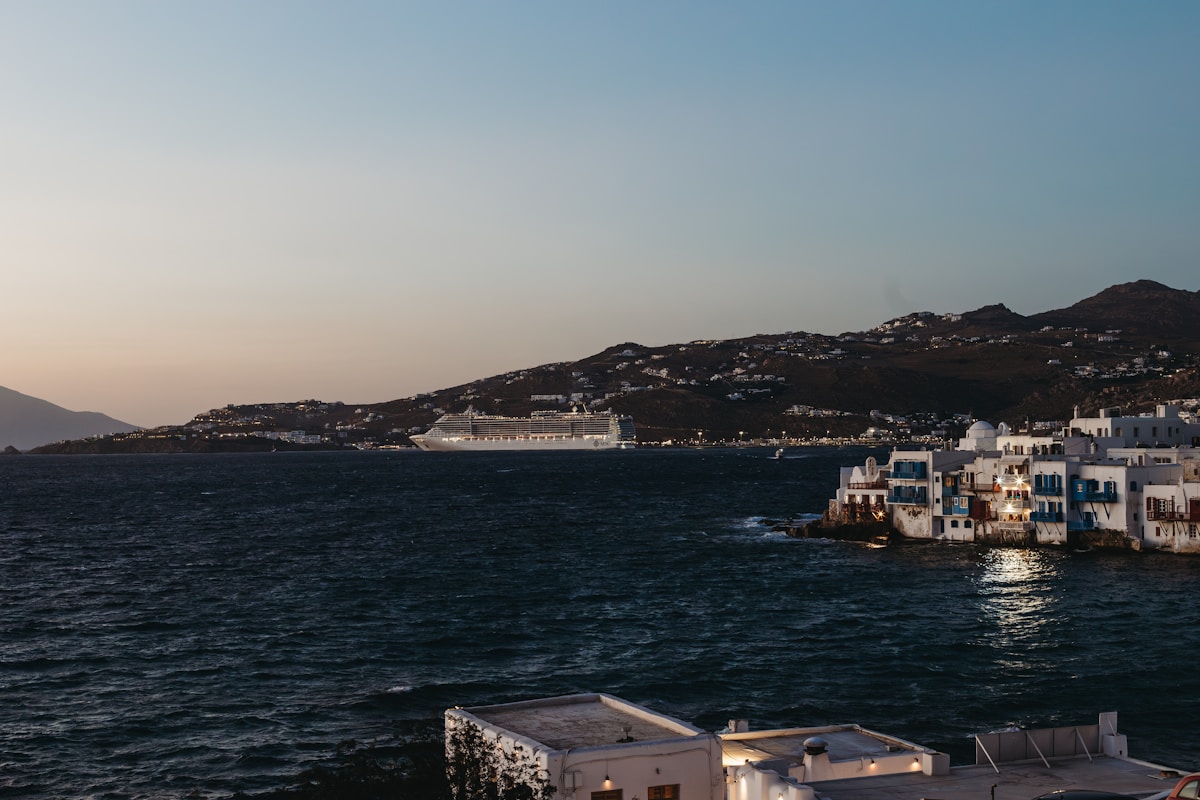
Mykonos is Greece’s most glamorous island - a centre of international beach tourism with a famously energetic social scene. It is also genuinely beautiful: whitewashed Cycladic architecture, narrow alleys in Mykonos Town (Chora), working windmills, and the Little Venice waterfront.
Getting ashore: Most cruise ships dock at the New Port (Tourlos), 2 km north of Mykonos Town. Free shuttle buses run from the pier to town; journey time 5–10 minutes. Some ships, particularly smaller vessels, tender into the Old Port at the edge of Mykonos Town.
What to prioritise with one day:
Mykonos Town (Chora) is the essential experience - the densest concentration of Cycladic architecture in Greece. Wander the alleys around the windmills (Kato Mili), Little Venice (the waterfront terrace of bars and cafes built on the sea’s edge), and the Paraportiani Church (a cluster of four chapels fused together, 15th–17th century). Entry to the town is free; getting lost is part of the experience.
Beaches: Mykonos’s most famous beaches are on the south coast, 4–10 km from town. Psarou (celebrities and beach clubs, sunbeds approximately EUR 25–40 per pair), Paradise (younger crowd, loud music, busy), Super Paradise (similar energy). For something quieter, Agios Sostis on the north coast has no facilities - bring your own food and water. Bus from town to Paradise Beach EUR 2, 20 minutes.
Delos day trip: The uninhabited island of Delos (a 30-minute boat trip from Mykonos Old Port, ferries approximately EUR 20 return as of 2026) is one of the most important archaeological sites in the ancient Greek world - birthplace of Apollo and Artemis, and the commercial hub of the Aegean in antiquity. The site covers the entire island (entry EUR 12). Time this carefully: if your ship has a short call, Delos alone takes 3–4 hours and may not be feasible.
Best shore excursion: A guided Mykonos Town walking tour (from EUR 25 per person) covers the key historical sites and explains the labyrinthine street layout - useful in a town designed to confuse invaders. Alternatively, a beach club day pass at Paradise or Super Paradise (from EUR 30–50 including sun lounger and drink) works if the goal is simply to enjoy a famous Greek beach.
Port logistics: The New Port has a small shopping area at the pier. The town is very busy in July–August - narrow alleys become crowded by 11:00am. An early start makes a significant difference.
Corfu: Old Town and Natural Landscapes
Corfu (Kerkyra) is Greece’s greenest island - 4 million olive trees cover the interior, planted under a Venetian policy from the 17th century. The island was successively Venetian, French, and British before becoming part of Greece in 1864. Corfu Town’s UNESCO-listed Old Town is the most complete Venetian-era townscape surviving in the Mediterranean.
Getting ashore: Corfu has two cruise piers - the New Port (Kerkyra), directly adjacent to the Old Town and city centre, and the Old Port (Faliraki), a 10-minute walk from the centre. Both are well-positioned.
What to prioritise with one day:
Corfu Old Town is compact (1 km diameter) and walkable. Key sites: the Old Fortress (Paleó Froúrio, EUR 6 entry) on the eastern headland - Byzantine origins rebuilt by the Venetians with panoramic views over the strait to Albania. The Liston arcade on the Spianada (modelled on Paris’ Rue de Rivoli, built under French occupation, 1807–1814). The Spianada itself - the largest public square in the Balkans, now a cricket ground (the British left both the game and a taste for ginger beer). The Campiello quarter - the oldest neighbourhood, a maze of 13th-century alleys and overhanging buildings.
Paleokastritsa: On the northwest coast, 26 km from Corfu Town, Paleokastritsa is the island’s most spectacular coastal location - six coves between dramatic limestone headlands, clear water, and a Byzantine monastery above the beach. Taxi EUR 40–50 each way, 40 minutes. A half-day with a booked shore excursion (from EUR 35 per person by coach) is the most efficient approach from the port.
Best shore excursion options:
A Corfu Old Town walking tour (from EUR 25 per person, 2 hours) provides context for the architectural layers - Venetian, French, British - that make Corfu Town unlike any other Greek city.
A north Corfu panoramic tour (from EUR 40 per person, half-day) covers Paleokastritsa, the Canal d’Amour at Sidari, and the viewpoint at Afionas - the best overview of the island’s dramatic coastal landscape.
Port logistics: Both Corfu piers are well connected and within easy walking distance of the Old Town. The Old Town is manageable without a tour, though a guide adds significant context. Corfu is less crowded than Mykonos and Santorini - this makes it one of the more relaxed cruise stops in Greece.
Planning Tips Across All Ports
Best months: May–June and September–October for all four ports. July and August see the highest cruise volumes - Santorini in particular can have 8–10 ships anchored simultaneously, which affects tender queuing times and town crowding.
Shore excursion vs independent: For Piraeus/Athens and Corfu Old Town, independent travel is straightforward and saves significant money. For Santorini (where time management and transport are trickier) and Mykonos (where knowing which beach to prioritise matters), a half-day guided tour can be efficient value. Boat trips - the catamaran in Santorini, the Paleokastritsa boat in Corfu - are rarely offered at better prices through ship operators than through local operators ashore.
Return timing: Build in a buffer. Tender queues in Santorini and delays at busy ports mean the “last tender” time requires strict observance. Missing the ship is a real possibility at Santorini in peak season - stay aware of your call-back time and err early.
Pick up a Greece eSIM before you fly - keeps you connected without roaming charges. Pre-book an airport transfer in Greece to skip taxi queues on arrival.
Related Destination Guides
- Athens Travel Guide - making the most of a full day at Piraeus
- Santorini Island Guide - caldera walk, Akrotiri, and wine tasting
- Mykonos Island Guide - beaches and Chora for cruise day visitors
- Corfu Island Guide - Old Town and Paleokastritsa by taxi or bus
- Best Tours in Athens - skip-the-line Acropolis options
Plan Your Trip
✈️ Book your flights to Greece 🛡️ Get travel insurance 📱 Stay connected with an eSIM 🚗 Rent a car