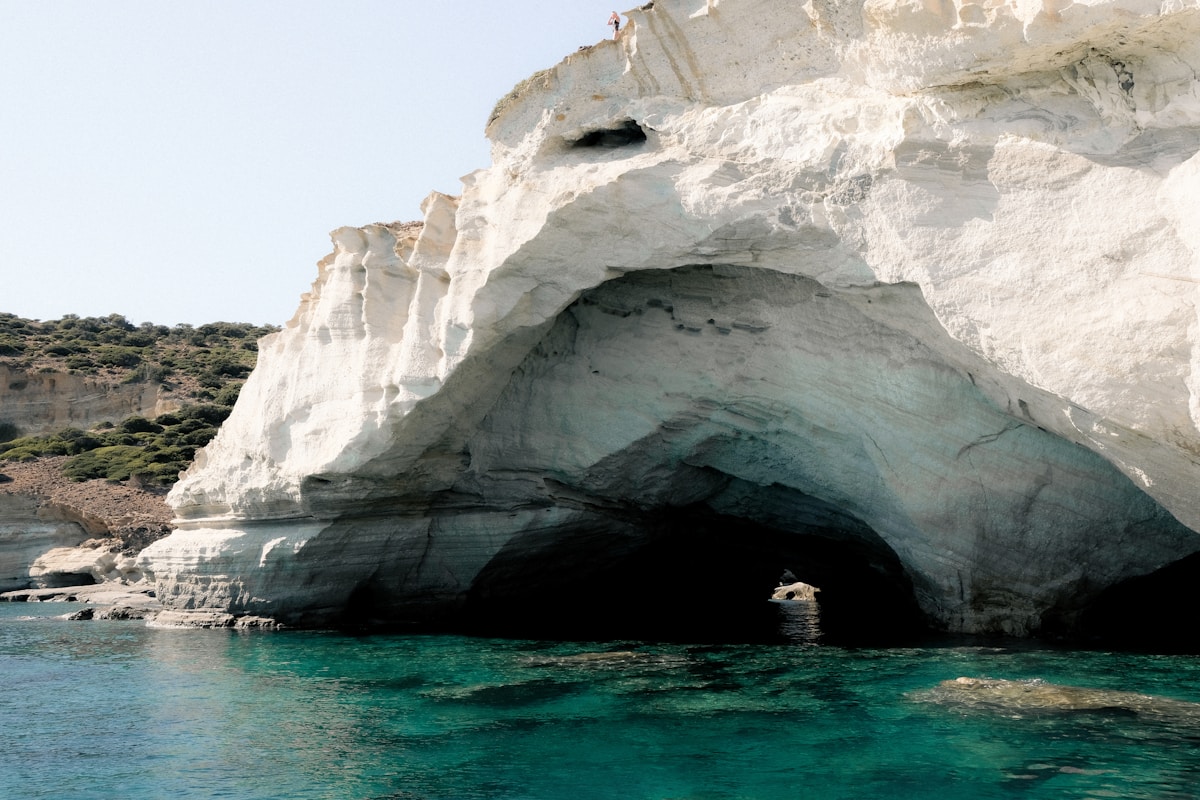
Milos is unlike any other island in Greece. Its volcanic geology has produced landscapes that look more like the moon than the Mediterranean - white ash formations, sea caves carved into cliffs, and coloured rock in shades of orange, pink, and ochre depending on the mineral content. The island has over 70 named beaches, no two of which look quite the same. A hire car is almost essential - compare car rental options for Milos and book in advance in summer when local supply is limited.
Top Tours in Milos
| Tour | Duration | Price (from) | Group Size | Highlights |
|---|---|---|---|---|
| Full-Day Catamaran — Kleftiko & Polyegos | 9 hrs | from €110/person | Up to 12 | Kleftiko sea caves, Polyegos wild beaches, BBQ lunch, snorkelling |
| Half-Day Catamaran to Kleftiko | 5 hrs | from €65/person | Up to 12 | Kleftiko arch and caves, 2 swim stops, snorkel gear provided |
| Milos Island Highlights Day Tour | 4 hrs | from €40/person | Small group | Sarakiniko, Catacombs, Plaka village, Venus de Milo replica site |
| Catacombs of Milos Guided Entry | 1.5 hrs | from €15/person | Small group | Early Christian catacombs, 2nd–5th century AD, expert guide |
| Private Luxury Speedboat — Milos Coastline | 5 hrs | from €350/boat | Private | Fully custom route, Kleftiko, sea caves, up to 8 passengers |
Browse all Milos tours → GetYourGuide
Sarakiniko Beach
The first thing anyone does on Milos is go to Sarakiniko. Nothing else in Greece looks like it. White volcanic ash, compressed and eroded over millennia, forms smooth white rock formations that plunge into transparent turquoise water. The lunar analogy is overused but it is the right one - the landscape is entirely alien.
The beach at the base of the rocks is accessible at low tide and gives a swim in extraordinary surroundings. The rocks themselves are popular for jumping - ranging from small drops to higher ledges - but assess conditions carefully; the rocks are slippery when wet and the current runs through the cove. The best photographs come from the right-hand side of the bay where the formations stack highest.
Getting there: 7km north of Adamas by road. Local bus runs from Adamas several times daily in summer. Walk or rent a scooter for flexibility.
Cost: Free. No facilities on-site beyond a basic café nearby.
When to go: Before 09:00 or after 17:00 to avoid peak crowds and harsh midday light.
Kleftiko Sea Caves (Boat Tour)
Kleftiko sits on the remote south-west coast of Milos, accessible only by boat. The area is a series of interconnected sea caves, arches, and rock stacks rising from water that changes colour from pale green to deep blue as the depth increases. The caves were historically used by pirates as shelter - the name comes from kleftis (thief) in Greek.
A full-day boat tour from Adamas visits Kleftiko as the centrepiece, typically including stops at Sykia Cave (a collapsed sea cave open to the sky), Gerakas (a beach only accessible by sea), and several swimming stops in clear water. Some tours include lunch; check what is included when booking.
Operators: Several companies run from Adamas harbour. Prices are approximately €35–€50 per person for a full-day tour as of 2026. Private boat hire is also possible at significantly higher cost (€300–€600+ per day for the boat, exclusive).
Book in advance: Popular full-day tours fill by mid-season. Book your first or second day on the island, or book online before arrival in July–August.
Plaka Village and the Kastro
Plaka is the main town of Milos - a white hilltop village built to a traditional Cycladic pattern, with the Kastro (castle) rising at the top. The views from the Kastro across the bay are excellent, particularly at sunset. The village has a good Archaeological Museum (entry approximately €3 as of 2026) displaying a copy of the famous Venus de Milo (the original is in the Louvre; a copy is exhibited here alongside genuine local finds).
Below Plaka, the neighbouring village of Trypiti overlooks the ancient theatre. The site is small but the setting - a hillside facing the bay - gives the ruins more atmosphere than their modest condition might suggest. Entry is free.
Plaka’s streets are steep and cobbled; wear shoes you can walk in. The village is quiet in the morning and busier in the evening when people come for dinner and sunset views.
The Christian Catacombs of Milos
One of the most significant early Christian sites in the Mediterranean, the Milos Catacombs contain the remains of approximately 8,000 Christians buried in underground galleries carved from soft volcanic rock between the 1st and 5th centuries AD. The site dates from a period when Christianity was still persecuted in the Roman Empire, and the Milos catacombs are among the oldest and best-preserved of their kind outside Rome.
The tour (guided, approximately 30–40 minutes) takes you through the main gallery by artificial light. The site is atmospheric and properly informative rather than a tourist spectacle. Combined with the nearby ancient theatre and the Venus de Milo find site below Trypiti, this area forms a coherent half-day of history.
Entry: Approximately €6 as of 2026. Check current prices and opening hours at odysseus.culture.gr.
Location: 2km south-east of Plaka, near Trypiti village.
Firopotamos, Mandrakia, and the Syrmata Fishing Villages
Milos’s traditional fishing villages - Firopotamos on the north coast, Mandrakia on the north-east - are rows of brightly painted boathouses (syrmata) built directly into the rock at sea level, each with its own door opening above the water. They are among the most photographed scenes on Milos after Sarakiniko, and rightfully so.
These villages are small, quiet, and best in early morning or late afternoon when the light catches the painted facades. There are no major facilities - no restaurants, no shops - just the houses, the fishing boats, and the sea.
Beaches Beyond Sarakiniko
Milos has more beach variety than almost any island in Greece:
Tsigrado: A narrow cleft in the cliff face reached by rope down a ladder, opening onto a small beach in a sheltered cove. The approach is adventurous; the result is a private swimming spot inaccessible to most. Accessible from Tsigrado village by a short walk and descent.
Firiplaka: One of the easiest large beaches to reach, south coast. Red and orange striped cliffs, clear water, taverna. Long and not too crowded by Milos standards.
Paleochori: Long south-coast beach with thermal springs visible as warm water seeping through the sand. Geologically strange and popular with return visitors. Two tavernas on the beach.
Gerakas: Remote beach on the south-east coast with a small coloured rock cliff. Accessible only by boat or a long rough track that requires a 4WD - the boat tour route is the practical option.
Agia Kyriaki: Quiet beach south of Adamas with easy road access and an excellent fish taverna nearby. Good for a low-effort afternoon.
Pollonia and the Milos Mining Museum
Pollonia on the north-east coast is the departure point for the short ferry to Kimolos (20 minutes), and has a laid-back waterfront with good tavernas and a small sandy beach. If you have a rental vehicle, the drive north from Adamas through Pollonia and along the coast towards the selenite quarries is one of the better road trips on the island.
The Mining Museum in Adamas (entry approximately €5 as of 2026) documents Milos’s extensive industrial history - the island has been mined for obsidian since the Neolithic, and later for bentonite, kaolin, perlite, and other minerals. It is a genuinely unusual museum for a Greek island and worth an hour if history interests you.
Practical Notes
Getting around: Adamas is the central port. Local buses serve Plaka, Sarakiniko, and Pollonia. A scooter or car gives access to the less-connected beaches and villages. Roads in the interior and to remote beaches can be rough.
Water: Drinkable from the tap, but some visitors prefer bottled water. Carry water on boat tours and beach days.
Shade: Sarakiniko has almost none in the middle of the day. Bring an umbrella or go early.
Accommodation base: Most visitors stay in Adamas (most services, nearest to port) or Plaka (better atmosphere, higher ground). Pollonia suits those focused on the north and east coast.
For the complete Milos island guide including where to stay and getting here, see our Milos travel guide. For beaches from Sarakiniko to Firiplaka and the boat-access coves, see best beaches in Milos. For restaurants in Plaka, Adamas, and the beach tavernas, see best restaurants in Milos. Choosing between Milos and Santorini? See our Milos vs Santorini comparison.
Search hotels in Milos, Greece on Booking.com
See Also
- Milos Travel Guide - island overview with where to stay, Plaka village, and getting there
- Milos Beaches - Sarakiniko, Tsigrado, Kleftiko, and the boat-access coves
- Restaurants in Milos - Plaka tavernas, Adamas seafood, and beach spots
- Milos vs Santorini - comparing two volcanic Cycladic islands on every measure
- Best Beaches in Greece - where Milos ranks nationally for beach quality
- Greek Island Ferry Guide - ferries from Piraeus to Milos and onward connections
- Greek Island Hopping Guide - where Milos fits in a western Cyclades circuit