Amorgos rewards people who like to move under their own steam. The headline sights, a monastery built into a cliff and a hidden-looking pebble cove, are close together, but the best of the island is on foot along old paths between villages. This guide covers what to do, how long it takes and what it costs. For the island overview and where to stay, start with our Amorgos travel guide.
Visit the Hozoviotissa Monastery
The Panagia Hozoviotissa is the island’s defining landmark: a whitewashed, multi-storey monastery squeezed into a cliff face about 300 metres above the sea. Traditionally dated to 1088, it is entered by a stairway of roughly 300 steps and welcomes visitors with loukoumi and raki. Entry is free (donations welcome), dress must be modest, and opening hours are short, usually a morning window and sometimes a late-afternoon one, so check locally. Allow about an hour including the climb. It sits on the road above Chora, reachable by bus, taxi or scooter.
Swim at Agia Anna
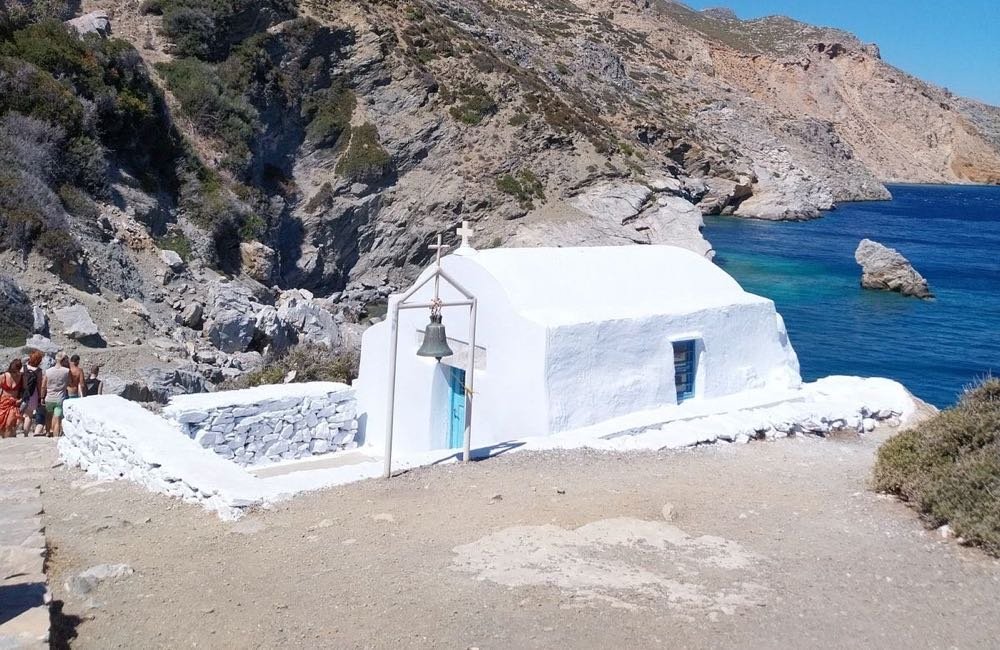
A 30-minute walk below the monastery, Agia Anna is a small pebble cove with a white chapel and dark-blue water, one of the island’s most photographed spots and associated with The Big Blue. There are no real facilities beyond a seasonal snack stand. Go before 10:00 or after 17:00 in summer and bring water and shoes for the pebbles.
Walk the Old Paths
Hiking is the best way to see Amorgos. Three routes stand out:
- Katapola to Chora: The easiest route from the main port, 1 to 1.5 hours uphill on an old stone path, finishing in the village. You can bus or taxi back.
- Chora to the monastery and Agia Anna: A longer coastal walk along the cliff road and steps. It is exposed, so go early.
- Aegiali to Tholaria and Langada: The most rewarding route, linking two hillside villages above the northern bay with terraced fields, chapels and views. Allow 3 to 4 hours for the round trip.
Take a hat, plenty of water and good shoes, and avoid midday in July and August. Guided hikes are also available; you can browse tours in Amorgos for current walking and island-tour options.
Wander Chora
Amorgos’s capital is a compact maze of white lanes, a small central square, a ruined Venetian kastro on the rocky outcrop above and a ridge line of old windmills. Spend an evening here for a taverna dinner, then catch the sunset from the kastro path. It is the island’s best place for a slow wander without a car.
Relax in Aegiali
Aegiali’s bay has the island’s longest sandy beach, shallow water and a handful of beach bars. Agios Pavlos, a short walk along the coast, has quieter water and is good for families. The surrounding villages, Langada and Tholaria, have small galleries, tavernas and views back over the bay.
Explore Katapola and Ancient Minoa
Katapola is the working port, set around a crescent bay with fishing boats and waterfront tavernas. Just outside the village, the ruins of ancient Minoa include remains of a gymnasium and a temple area, and there is a small archaeological museum in Chora. Katapola is also the best place to arrange a boat taxi or scooter.
Take a Boat Trip
Boats run from Katapola and Aegiali to the islet of Nikouria and to secluded south-coast coves such as Kalotaritissa, usually in the summer season. Full-day cruises with swimming stops and lunch run from approximately EUR 60 to 110 per person as of 2026. Winds can cancel departures, so keep a flexible day. A walk-up booking on the day is common in shoulder season.
Practical Tips
- Getting around: Buses link the main villages on a limited timetable. Taxis are scarce, so rent a car or scooter for the south coast and monastery.
- Money: Take cash; some small tavernas and beach bars do not accept cards, and ATMs are in the main villages only.
- When to go: Late April to June and September to October are best. The meltemi wind can make some beaches uncomfortable in July and August.
- Getting here: Ferries from Piraeus via Naxos take roughly 5 to 9 hours. See our Greek island ferry guide and the Naxos guide for onward connections.
Prices are approximate as of 2026. For ideas on combining Amorgos with other islands, see the Greek island hopping guide. The Greek National Tourism Organisation also lists current events and practical information.