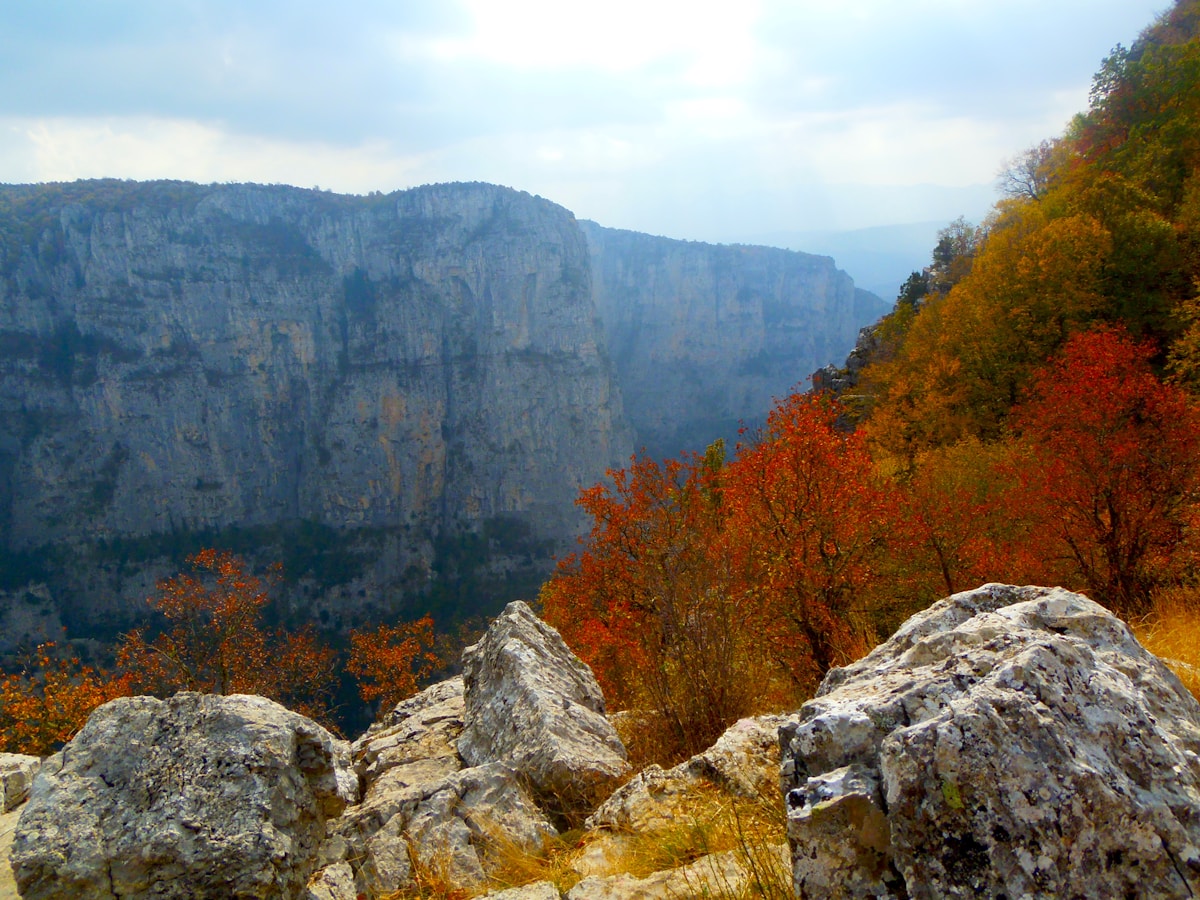
Most visitors to Greece stay on the islands. That’s understandable - the Aegean in summer is hard to argue with. But mainland Greece has a different character: rugged mountain landscapes, stone-village architecture, deep gorges, and a slower pace that the islands rarely match.
Top Tours at a Glance
| Tour | Duration | Price (from) | Group Size | Highlights |
|---|---|---|---|---|
| Zagori: Private Vikos Gorge Hike | 6–7 hrs | from €99 | Private | O3 trail traverse, Papingo, Voidomatis River |
| Ioannina: Private Zagori Sightseeing Jeep Tour | 8 hrs | from €192 | Private | Stone bridges, 46 villages, gorge viewpoints |
| Zagori: Guided Dragon Lake Hike, Mt Tymfi | 8 hrs | from €105 | Small group | Alpine lake, ridge trail, Pindus wilderness |
| Pelion: Guided Hiking and Village Tour | Half day | from €45 | Small group | Forest trails, Makrinitsa, traditional architecture |
Browse all Greece mainland tours → GetYourGuide
Two regions stand out. Zagori in the Epirus region of northwest Greece gives you the deepest accessible gorge in the world, a network of arched stone bridges, and villages that look unchanged since the Ottoman period. The Pelion peninsula in Thessaly offers something else again - forested mountains tumbling to some of the most secluded beaches on the Greek mainland, with a village architecture that blends local stone with wooden Macedonian-style overhanging houses.
Both are accessible by car. Neither requires specialist hiking ability. Both are significantly less crowded than the major islands.
Zagori: Stone Villages and Vikos Gorge
Zagori is a collection of 46 villages spread across the Pindus Mountains in the Epirus region. The villages are collectively protected as a UNESCO Heritage Site. What makes them distinctive is their construction: everything is built from the grey-brown local limestone - houses, walls, churches, bridges, fountains. The effect is of villages that grew organically from the rock itself.
The region is sparsely populated and deliberately low-key in terms of tourism infrastructure. That’s its appeal.
Getting There
The nearest city is Ioannina, which has an airport with connections to Athens (approximately 1 hour, from EUR 40–70 one-way as of 2026) and Thessaloniki. From Ioannina, Zagori is 30–50km depending on the village. A rental car is essentially required - public buses serve only a handful of villages, and the distances between attractions make a car non-negotiable.
From Athens, Ioannina is approximately 450km (5 hours by car) via the Egnatia Odos motorway.
Monodendri: Gorge Viewpoint and Hike Entry
Monodendri is a well-preserved village of about 60 permanent residents, sitting at 1,100m on the rim of Vikos Gorge. It’s one of the two main entry points for the gorge hike (the other is Papingo).
From the village, a ten-minute walk leads to the Oxia viewpoint - a limestone ledge overhanging the gorge with a vertical drop of roughly 900m. On a clear day, you can see the full length of the gorge below, the riverbed threading between cliffs that rise over 1,000m on either side. The Guinness World Records once listed this as the deepest gorge relative to its width in the world.
The Monastery of Agia Paraskevi clings to the cliff edge above the gorge entry. The monastery dates from the 15th century; the original frescoes are partially intact. No entry fee; hours are irregular.
The Vikos Gorge Hike (O3 Trail)
The classic hike runs from Monodendri to Papingo via the gorge floor. It’s approximately 12km, with a descent of around 900m to the riverbed and then a gradual climb out to the village. The total time is 5–7 hours for most walkers.
Difficulty: Moderate to challenging. The descent from Monodendri is steep and involves rocky terrain; some sections require using your hands for balance. The gorge floor is flat but uneven - large boulders, tree roots, and stream crossings. Good trail shoes or hiking boots are essential. Trainers will do, but trail shoes are more comfortable.
Water: The Voidomatis River runs through the gorge for much of the year, but the upper gorge floor can be dry in late summer (July–August). Carry at least 2 litres. There are springs marked on the E4/O3 maps, but verify conditions locally before setting out.
Waymarking: The trail is marked with red-and-white E4 blazes and occasionally O3 markers. Navigation is straightforward in good conditions; a downloaded GPX track is useful insurance.
Best season: May–June or September–October. Avoid July–August for a comfortable gorge hike - the canyon traps heat in summer. October brings spectacular autumn colours on the gorge walls.
Reverse direction: Some walkers prefer starting from Papingo (lower starting point) and climbing out to Monodendri for the views. The ascent from Papingo to the gorge rim is a sustained climb; we prefer the Monodendri start for the views on the way down.
Zagori Stone Bridges
The Zagori region has over 40 arched stone bridges (packhorse bridges), built between the 17th and 19th centuries to connect villages across the mountain streams. They’re architectural marvels that were built without mortar - each stone is cut and placed to hold the arch in tension.
The most photographed:
Kokkori Bridge (Noutsou Bridge): A triple-arched bridge over the Voidomatis River at the base of the gorge, accessible from the main Ioannina–Konitsa road. You can walk to it in five minutes from the roadside parking. The reflection in the river is the classic Zagori postcard image.
Plakida Bridge: Near the village of Kipi, part of the “Kipi Bridges” cluster - four bridges within a 2km walk through a forested valley. The walk linking them takes about 45 minutes and is easy, with no significant elevation gain.
Kalogeriko Triple Bridge: Near Kipi, this is one of the most elaborate - three arches of different sizes spanning a ravine, with the ruins of an old mill nearby.
Papingo: Best Base for the Gorge
Papingo is split into Megalo Papingo (larger, slightly more developed) and Mikro Papingo (smaller, quieter, the one in most of the photographs). They’re 3km apart on the road, 20 minutes on foot via a marked trail.
Mikro Papingo in particular looks like a film set - stone-paved lanes, overhanging plane trees, a single plateia (village square) with one kafeneio, and the limestone spires of the Astraka massif rising behind. Population: around 30 people.
Drakolimni (Dragon Lake): From Papingo, a marked trail climbs to Drakolimni at 2,050m - a glacial lake surrounded by alpine meadows and the Astraka peaks. The ascent takes approximately 3–4 hours from Papingo; total round trip 6–8 hours. The trail is well-marked; the upper sections involve scrambling on loose rock above the treeline. This is a more serious undertaking than the gorge hike - suited to confident hill walkers.
Guesthouses in Papingo:
- To Papaevangelou (Mikro Papingo): Traditional stone guesthouse, double rooms from approximately EUR 80–100/night as of 2026. Breakfast included. Often cited as the best guesthouse in the region. Book two to three months ahead for May–June and September–October.
- Saxonis Houses (Megalo Papingo): Stone-built with wooden interiors, pool, doubles from approximately EUR 90–120/night as of 2026. More facilities than Mikro Papingo options.
Other Zagori Villages Worth Visiting
Kipi: The bridge cluster walk starts here. The village itself is small and quiet, with a good kafeneio serving pites (savoury pies) - spinach and cheese, or meat.
Dilofo: One of the most photogenic villages in Zagori, with a circular tower-house and unobstructed valley views. About 20 residents.
Tsepelovo: A larger village (by Zagori standards - about 100 people) with a wider range of accommodation. The village square has a fountain and is the social hub on summer evenings.
Pelion Peninsula: Forests, Villages, and Hidden Beaches
The Pelion peninsula juts into the Aegean southeast of Volos, a thumb of forested mountains with villages perched between the tree line and steep drops to the sea. Greek mythology places the centaurs here, and the landscape has a faintly mythic quality - dense chestnut and plane forests, stone-paved paths (kalderimia), and a Mediterranean sea that appears unexpectedly at the end of a forest track.
Pelion is more accessible than Zagori (it’s connected by good roads and within reach of Volos), and sees more domestic Greek tourism in summer. The best time to visit is May–June or September–October.
Getting There
Volos is the gateway city: 325km from Athens (3.5–4 hours by car), or accessible by train from Athens (approximately 4.5 hours, from EUR 15–25 one-way as of 2026). From Volos, the Pelion villages are 30–50 minutes by car. There’s a seasonal bus network connecting Volos to the main villages, but a car gives you significantly more flexibility.
Makrinitsa: The “Balcony of Pelion”
Makrinitsa clings to the mountainside at 700m above sea level, overlooking the Pagasetic Gulf. The village is car-free above the main parking area - you walk up stone-paved paths to the central square, which has a 300-year-old plane tree, a Byzantine church (Agios Ioannis Prodromos), and views across the Gulf that on clear days reach Thessaly and the distant Sporades.
The architecture here is the distinctive Pelion style: tall mansions with projecting upper floors (sahnisia) overhanging the street, built by wealthy merchants in the 18th–19th centuries. Many have been converted to guesthouses.
Guesthouses in Makrinitsa:
- Archontiko Sakali: Traditional mansion guesthouse with period furniture and wooden ceilings, doubles from approximately EUR 90–130/night as of 2026.
- Portaria Hotel (nearby Portaria village, 3km from Makrinitsa): Larger property with pool, doubles from approximately EUR 100–150/night as of 2026.
Tsagarada: Four Squares, One Ancient Tree
Tsagarada is technically four separate neighbourhoods (Agios Stefanos, Agia Kyriaki, Agios Taxiarchis, Agia Paraskevi) spread across a forested hillside at 550m. The villages feel half-hidden in the trees; the main road between them offers sudden openings with sea views below.
The centrepiece of Agios Stefanos is a 1,000-year-old plane tree - one of the oldest in Europe, with a trunk circumference of approximately 14m. It’s in the village square and still alive.
Tsagarada is the best base for accessing the beaches on Pelion’s eastern (Aegean) coast, particularly Mylopotamos - a pebble-and-sand beach in a gorge that requires a 25-minute walk or a dirt track to reach. The water is turquoise; facilities are minimal. Also accessible from Tsagarada is Fakistra Beach, accessed by a 45-minute hiking trail from the road - small, shingle, and usually quiet even in summer.
Guesthouses in Tsagarada:
- Kanakia Suites: Restored stone house with views, doubles from approximately EUR 100–160/night as of 2026.
- Ta Tria Aderfia (The Three Brothers): Small guesthouse, known for good breakfasts, doubles from approximately EUR 70–100/night as of 2026.
Hiking in Pelion: Kalderimi Paths
Pelion has an extensive network of old stone-paved paths (kalderimia) that connected villages before roads were built. Most are now maintained as hiking trails.
Makrinitsa to Portaria: Approximately 3km, 45 minutes to 1 hour, gentle descent. Easy. Signposted from the Makrinitsa square.
Tsagarada to Mylopotamos Beach: Approximately 2km, 45–60 minutes descent. Moderate (steep stone steps; the return is the harder leg). The beach at the bottom makes it worthwhile. Return via the same path or dirt road.
Zagora to Horefto Beach (east coast): Approximately 5km, 2–3 hours. This is one of the better through-routes, descending from the agricultural village of Zagora through chestnut forest to the coastal village of Horefto. A seasonal bus or taxi back makes it practical as a one-way walk.
Makrinitsa to Tsagarada (long route): Approximately 12km, 4–5 hours. The classic Pelion traverse, following the ridge of the peninsula through multiple villages. Signposted but takes some navigation - a map or GPS track is recommended.
Pelion Beaches
The eastern (Aegean) coast of Pelion has the best beaches - many accessible only by trail or via long dirt roads, which keeps them relatively quiet.
Mylopotamos: The most famous, near Tsagarada. A pebble beach with very clear water, set in a gorge with a small waterfall. Seasonal taverna in summer. Arrives early to get space in August.
Damouchari: A tiny harbour village with good snorkelling and a small taverna. Accessible by road. Film crews have used it (scenes from Mamma Mia were filmed here). Low-key, beautiful.
Agios Ioannis: The most developed beach on the eastern coast - sun loungers, multiple tavernas, and good watersports. Crowded in August, pleasant in June and September.
Platanias: On the western (Pagasetic) side - calmer, warmer water, and easier access by road. Better for families; less dramatic than the eastern coast beaches.
Combining Zagori and Pelion
If you’re planning a mainland Greece nature trip, it’s possible - but not effortless - to combine both regions. The distance from Ioannina (Zagori) to Volos (Pelion gateway) is approximately 260km (3 hours by car). A practical itinerary:
- Days 1–3: Ioannina → Zagori (Monodendri, Vikos Gorge hike, Papingo, Kipi bridges)
- Days 4–5: Drive to Pelion via Egnatia Odos/Larissa (3.5–4 hours)
- Days 5–7: Makrinitsa, Tsagarada, eastern coast beaches
A week gives you a reasonable experience of both. Two weeks allows you to slow down, repeat the good guesthouse meals, and take the longer mountain walks.
Both regions are quieter and more affordable than the Cycladic islands in summer. A quality guesthouse in Papingo or Tsagarada costs roughly half what a comparable room on Mykonos or Santorini would in peak season. If you want to add guided hikes or nature tours, browse mainland Greece tours for guided options including Zagori gorge walks and Pelion day trips.